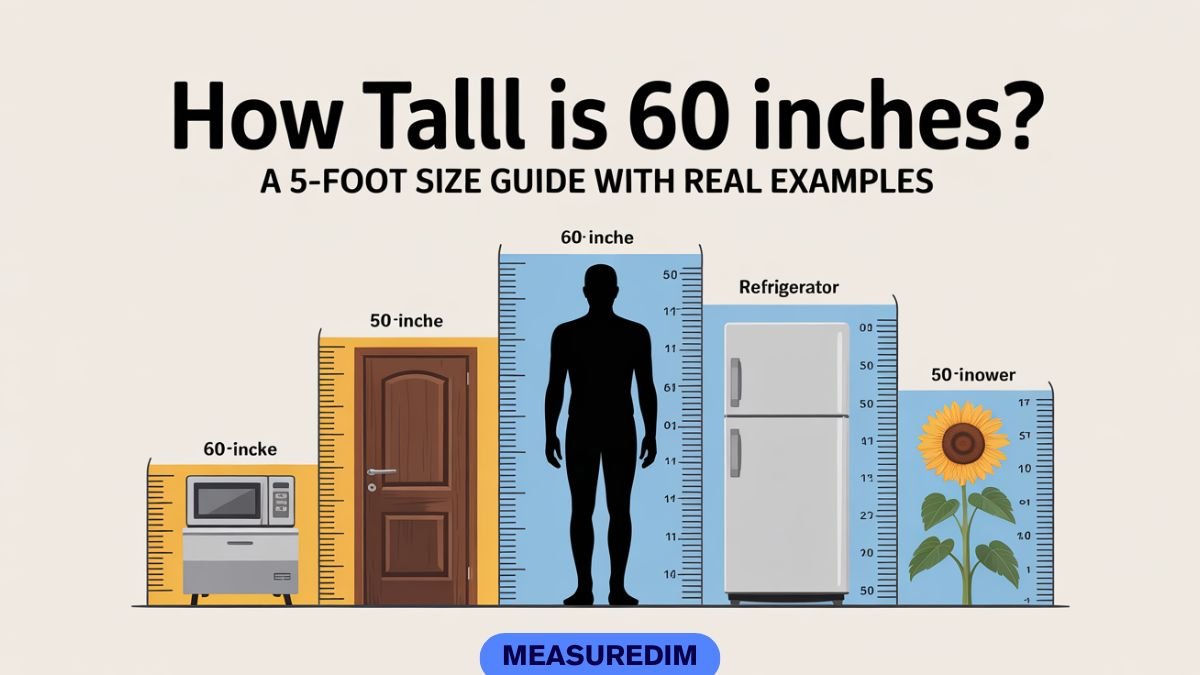
How Tall Is 60 Inches? A 5-Foot Size Guide With Real Examples
Sixty inches is a way to measure height. It is the same as 5 feet. In centimeters, that is 152.4 cm.
Have you ever tried to picture how tall 60 inches really is? It is not just a number on a screen. Once you see it, you will spot it everywhere.
Many everyday things stand about 60 inches tall. A floor lamp, a fence, or a small tree can reach this height. It is short for an adult but tall for a child.
The Short Version: 60 Inches Is Exactly 5 Feet
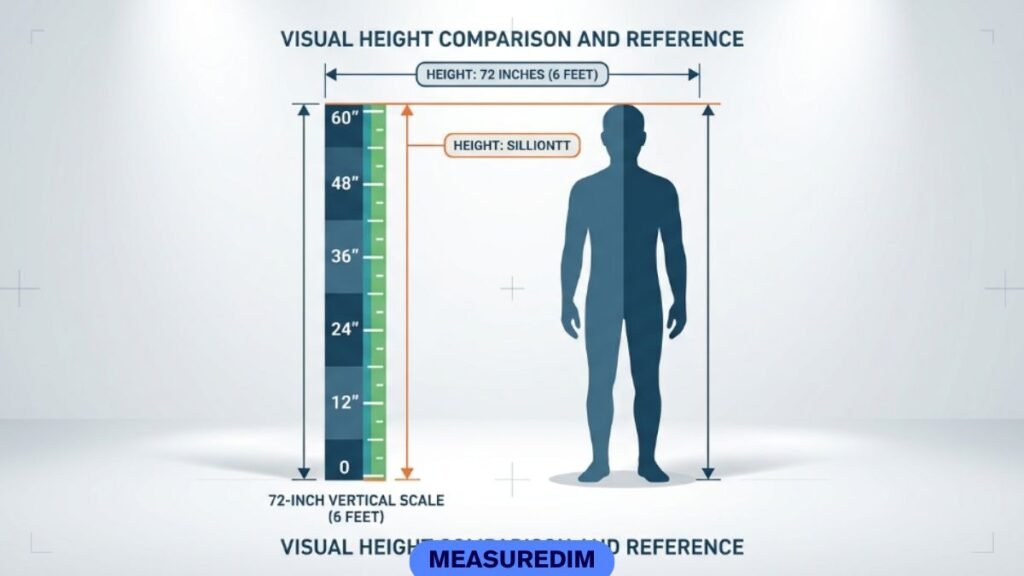
Sixty inches is 5 feet, dead on. Divide 60 by 12 and you land on a whole number with nothing left over, which is why five feet feels like such a natural milestone — it’s the point where a growing kid officially “hits five feet,” and the shorter end of adult human height.
In metric, 60 inches is 152.4 centimeters, or 1.524 meters. That’s it. Everything else on this page is about turning that flat number into something you can actually visualize.
60 Inches in Every Unit You Might Need
Whether you’re shopping in imperial or metric, here’s the full conversion set for 60 inches. I’ve kept the exact figures rather than rounding, because a stray half-centimeter matters more often than people expect.
| Unit | 60 inches equals |
| Feet | 5 ft (exactly) |
| Centimeters | 152.4 cm |
| Millimeters | 1,524 mm |
| Meters | 1.524 m |
| Yards | 1.667 yd (1 yd, 2 ft) |
| Feet + inches | 5 ft 0 in |
One conversion to burn into memory: 60 inches is 152.4 cm, not 150 cm. Rounding down to a flat 150 quietly shaves off nearly a full inch, which can be the difference between a shelf that fits under a window and one that doesn’t. [INTERNAL LINK: inches to cm conversion guide]
What Five Feet Actually Looks Like in a Room
Picture the shorter side of adult height. A person who’s exactly five feet tall stands with the top of their head roughly level with the chin or lower lip of an average-height man (around 5 feet 9). If you’re that average-height guy, hold your hand flat at your own throat — that height off the floor is close to 60 inches.
It also helps to think horizontally. Lay five one-foot rulers end to end and you’ve drawn out 60 inches on the floor. Stand that same span up on its end and you’ve got the height of a tall floor lamp or a five-foot Christmas tree. Five feet is tall enough to feel substantial in a room, but short enough that most adults can rest a hand flat on top of it without reaching.
Everyday Things That Stand About 60 Inches Tall
Below are objects that land at or very near 60 inches. I’ve flagged which ones are exact standards and which are typical-but-variable, because pretending a range is a fixed number is how bad size guides lose your trust.
A Person Who Stands Exactly Five Feet Tall
The cleanest human reference for 60 inches is simply someone who measures 5 feet 0 inches — 60 inches from heel to crown, no rounding needed. This sits below the average adult woman’s height in most Western countries (typically closer to 5 feet 4) but is a common, real, everyday stature you’ll recognize instantly once you’re looking for it.
A living person is the most portable ruler you own. When you can mentally place a five-foot friend beside a doorway, a fridge, or a fence, you’ve got an accurate sense of 60 inches without a single tool. This trick shines when you’re eyeballing whether a piece of furniture will clear a low ceiling slope or fit under a staircase.
The Length of a Standard Bathtub
Walk into most bathrooms and the tub tucked into the wall is a standard 60-inch alcove bathtub — 60 inches is the industry-standard length for these, which is why so many bathrooms are framed to that exact opening. Width usually runs 30 to 32 inches and depth around 14 to 16, but the 60-inch length is the fixed dimension manufacturers build around.
Because it’s a true standard rather than a rough average, a bathtub is one of the most reliable 60-inch references in any home. Next time you’re near one, note how it spans the full wall of a compact bathroom — that entire run is your five feet. It’s genuinely useful when you’re trying to judge whether a five-foot sofa or bookcase will fit along a wall of similar length.
Read Also: How Long Is 30 Feet? 10 Everyday Objects to Picture It
A Five-Foot Artificial Christmas Tree
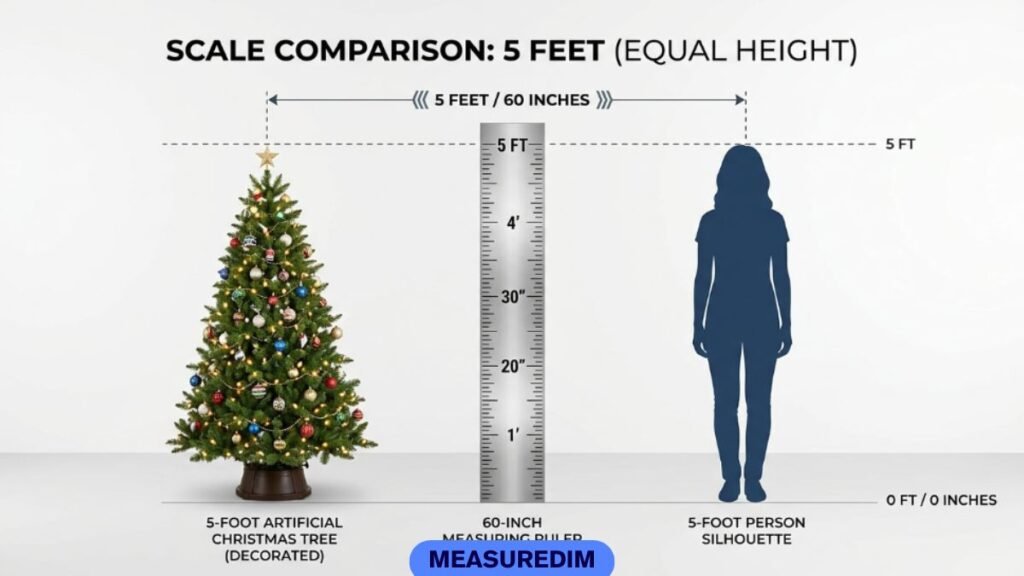
A boxed 5-foot artificial Christmas tree stands 60 inches from the base of the stand to the tip of the top branch. It’s one of the most popular tree sizes sold, sitting comfortably in a living room without crowding an eight-foot ceiling.
The reason a tree works so well as a mental yardstick is that most people have stood right next to one and felt where the top lands relative to their own height. For a lot of adults, a five-foot tree tops out around eye level — a quick, first-hand gut check for 60 inches you can recall any time of year.
A Living-Room Floor Lamp
A typical standing floor lamp measures somewhere between 58 and 64 inches, and a huge share of them land right around 60. That height is deliberate: it puts the shade at roughly the level of a seated person’s head, casting light down onto a book or across a room rather than into your eyes.
Floor lamps make a good approximate reference precisely because they’re so common — most living rooms have one within arm’s reach. Stand beside yours and you’ll feel where five feet hits you. When you’re guessing whether a lamp will overpower a low side table or suit a reading nook, that 60-inch ballpark is the number to hold in mind.
A 152 cm Ski or Snowboard
Winter gear gives you an almost-exact metric match: a 152 cm ski or snowboard is 59.8 inches long — a hair under 60. Skis and boards are sold in centimeter lengths, and 152 is a mainstream size for smaller adults and teens, so it’s easy to find one and stand it upright against yourself.
This one’s satisfying because the conversion is so tight — 152 cm rounds to 60 inches for any practical purpose. Prop a 152 cm board on its tail and it reaches roughly the shoulders of an average-height adult, which is a clean visual for just-under-five-feet. Handy when you’re picturing how a piece of sports gear will fit in a closet or car.
A Senior Ice-Hockey Stick
An uncut senior ice-hockey stick runs about 56 to 63 inches, with many landing close to 60 before they’re trimmed down to a player’s fit. Held vertical with the blade on the floor, a full-length senior stick reaches the chin or nose of a typical adult.
Sticks vary by brand and are usually cut shorter for actual play, so treat this as a “roughly 60 inches before trimming” reference rather than a fixed number. Still, if you’ve ever stood a hockey stick on end next to yourself, you’ve already felt five feet. It’s a useful anchor for anyone estimating the length of long, thin objects like poles, dowels, or curtain rods.
A Five-Foot Fence Panel
A 5-foot garden or chain-link fence measures exactly 60 inches from the ground to the top rail. It’s a standard residential fence height — tall enough for privacy and pet containment, short enough to stay under many local height limits without a permit.
Fences are one of the easiest outdoor references because that top rail sits at a very recognizable height: around the shoulders or neck of most adults standing beside it. Once you’ve leaned on a five-foot fence, you’ve calibrated your eye for 60 inches outdoors. That comes in handy when judging hedge heights, gate sizes, or how tall a raised trellis will end up.
An Apartment-Size Refrigerator
A compact, apartment-size refrigerator in the 10-to-11-cubic-foot range typically stands about 59 to 61 inches tall — right around 60. (Full-size family fridges are taller, usually 65 to 70 inches, so don’t confuse the two.) These slimmer units are built to fit smaller kitchens where a towering fridge would dominate the space.
An appliance you use daily is a strong reference because you already have a body-memory of where the top lands. If the top of your apartment fridge sits near your shoulders, you’re looking at roughly five feet. It’s a practical gauge when you’re measuring whether a new appliance or cabinet will clear an overhead shelf.
A Five-Tier Bookcase
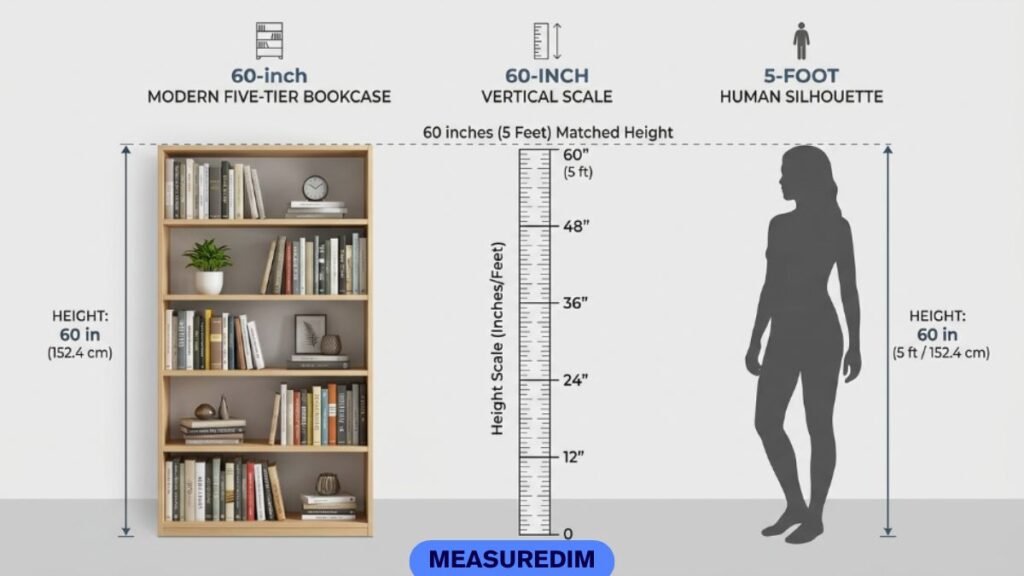
An entry-level five-shelf bookcase often stands right around 60 inches, though this category ranges widely — some five-shelf units climb to 71 or 72 inches, so check the spec rather than assuming. The 60-inch versions give you five usable shelves while staying low enough to place under a window or against a half-wall.
Because the height varies by model, treat a bookcase as an approximate reference and lean on the ones you can actually measure. That said, a 60-inch bookcase is a great real-world stand-in for five feet indoors, and picturing one helps when you’re planning whether a storage unit will block a light switch or sit neatly beneath a sloped ceiling.
The Objects at a Glance
Here’s the lineup sorted from most exact to most variable, so you can pick the reference that fits your situation.
| Object | Approx. height/length | Exact or typical? |
| Person who’s 5 ft 0 in | 60 in | Exact |
| Standard alcove bathtub | 60 in (length) | Exact standard |
| 5-foot Christmas tree | 60 in | Exact (nominal) |
| 5-foot fence panel | 60 in | Exact standard |
| 152 cm ski/snowboard | 59.8 in | Near-exact |
| Floor lamp | ~58–64 in | Typical ~60 |
| Apartment refrigerator | ~59–61 in | Typical ~60 |
| Senior hockey stick (uncut) | ~56–63 in | Variable |
| Five-tier bookcase | ~60–72 in | Variable |
No Tape Measure? Here’s How to Judge It
You can approximate 60 inches with nothing but your own body, as long as you know a couple of your personal measurements.
- Use your own height as the baseline. If you’re taller than five feet, mark where 60 inches lands on you. On an average-height man (5 ft 9), five feet reaches roughly the chin. On a 5-foot-4 woman, it’s up around the eyes and forehead. Measure yourself once and you’ll always have a walking five-foot mark.
- Arm span roughly equals height. For most people, fingertip-to-fingertip with arms outstretched is close to their standing height. A person around five feet tall therefore has an arm span near five feet — a quick horizontal check for 60 inches.
- Stack five one-foot references. Five dollar bills are about 6.14 inches each, so ten laid end to end is a touch over five feet. Five standard sheets of US Letter paper stood end to end (11 inches each) reach 55 inches — close, but remember you’re an inch short per two sheets.
- Borrow a known object. A standard bathtub’s full length is your ready-made five-foot ruler in any bathroom.
None of these is laser-accurate, so treat them as estimates. But for “will this roughly fit” decisions, they get you there without hunting for a tape measure.
Read Also: How Big Is 30cm? 11 Everyday Objects That Show the Length
60 Inches Next to 48 and 72
Sizes make more sense with neighbors on either side, so here’s how 60 slots between the nearest whole-foot marks.
- 48 inches (4 feet): A foot shorter than 60. This is a low countertop-height fence, the height of a tall child, or a stack of four one-foot rulers. Drop 12 inches off any of the objects above and you’re here.
- 66 inches (5 feet 6 inches): Right in the middle of average adult height and a common doorway-adjacent reference point.
- 72 inches (6 feet): A foot taller than 60. This is a tall adult man, a standard-depth home door minus a few inches, and the height where furniture starts to feel imposing in a normal room.
Seen side by side, 60 inches is the “shorter-adult” tier — clearly taller than a young child, clearly shorter than a six-foot man.
Where People Go Wrong With 60 Inches
A few reliable mix-ups trip people up with this exact measurement.
- Reading 60 as six feet. The number 60 and “six feet” sit close in the mind, but 60 inches is five feet. Six feet is 72 inches. This one costs people a full foot of error.
- Confusing inches with centimeters. Sixty centimeters is only about 23.6 inches — less than two feet. If a listing says 60 cm and you’re picturing five feet, you’re off by more than half.
- Assuming a door is 60 inches tall. Standard interior doors are 80 inches (6 ft 8 in), not 60. A 60-inch panel would barely clear the shoulders of a tall adult.
- Thinking a 60-inch TV is 60 inches wide or tall. Televisions are measured on the diagonal. A 60-inch TV is only about 52 inches wide and 29 inches tall in a 16:9 shape — nowhere near 60 inches in any single straight-line dimension.
Why 60 Inches Shows Up So Often
Five feet is a “designed-to” number, which is why it recurs across so many products. Bathtubs, fence panels, and nominal Christmas-tree and lamp heights all cluster here because 60 inches balances usefulness against the size of a normal room and a normal person. It’s tall enough to matter, short enough not to overwhelm, and it converts to a clean 5 feet and a tidy 152.4 cm — friendly in both measuring systems. Once you start noticing it, five-foot objects show up everywhere from the hardware aisle to the ski rack.
Quick-Fire Questions About 60 Inches
Is 60 inches 5 ft?
Yes. 60 inches is exactly 5 feet, since 60 divided by 12 equals 5.
How tall is 60 inches in human height?
It is 5 feet (152.4 cm), which sits at the shorter end for an adult but is a solid height for a child.
Is 60 in 5 ft tall?
Yes. 60 inches equals 5 feet 0 inches, with no leftover inches.
How many inches is being 5’4″?
5 feet 4 inches equals 64 inches (5 × 12 = 60, plus 4).
Is 5.4 feet a good height?
Height is not “good” or “bad.” Note that 5.4 feet (about 5 ft 5 in) differs from 5’4″; both fall within a normal, healthy adult range.
Now You’ll Read 60 Inches at a Glance
Now you know how tall is 60 inches. It is the same as 5 feet. In metric units, that means 152.4 centimeters. This height sits at the shorter end for a grown adult. For a child, it marks a proud growth moment. You can picture it with simple things around you. A tall floor lamp reaches this height. A standard bathtub measures the same length. A five-foot fence and a small tree fit here too.
These everyday objects help you learn this size fast. Line one up in your mind and you will judge 60 inches with ease. You will no longer need a tape measure for a quick guess. Remember the clean numbers, and this height will stay in your memory for good.
Related Guides:
1: How Big Is 20cm? 11 Everyday Objects That Nail the Size
2: How Big Is 14 Inches? Real Objects That Show You the Size
3: How Long Is 2 Meters? 9 Everyday Objects to Picture It
4: How Long Is 5 Meters? Feet, Cm & Real-World Examples
5: How Long Is a Foot? The Exact Length, Plus 10 Everyday Things to Compare It To