How Long Is 2 Inches? Real Objects That Show You Exactly
Two inches is a small length. It equals 5.08 centimeters, or 50.8 millimeters. It is also one-sixth of a foot, so it is short but easy to picture.
Ever wonder what 2 inches really looks like? It is not tiny, and it is not big. It sits right between a coin and your whole palm.
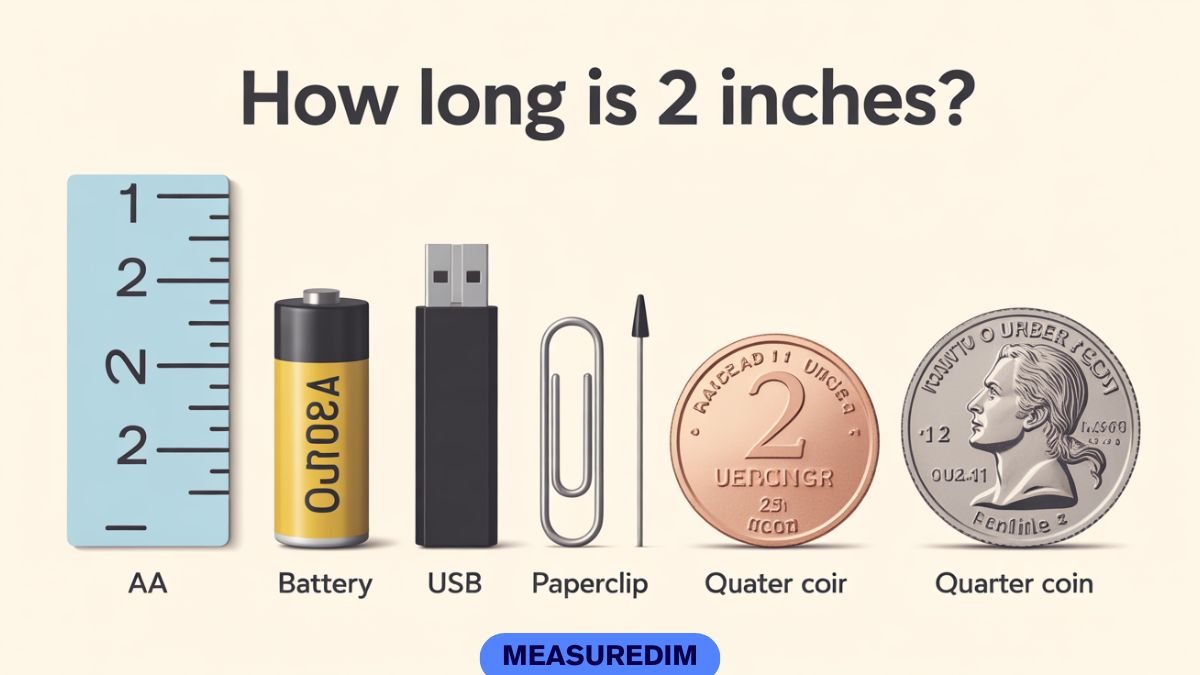
You see this size every day without noticing. An AA battery is almost exactly 2 inches long. The short edge of a business card matches it too.
The Two-Second Answer
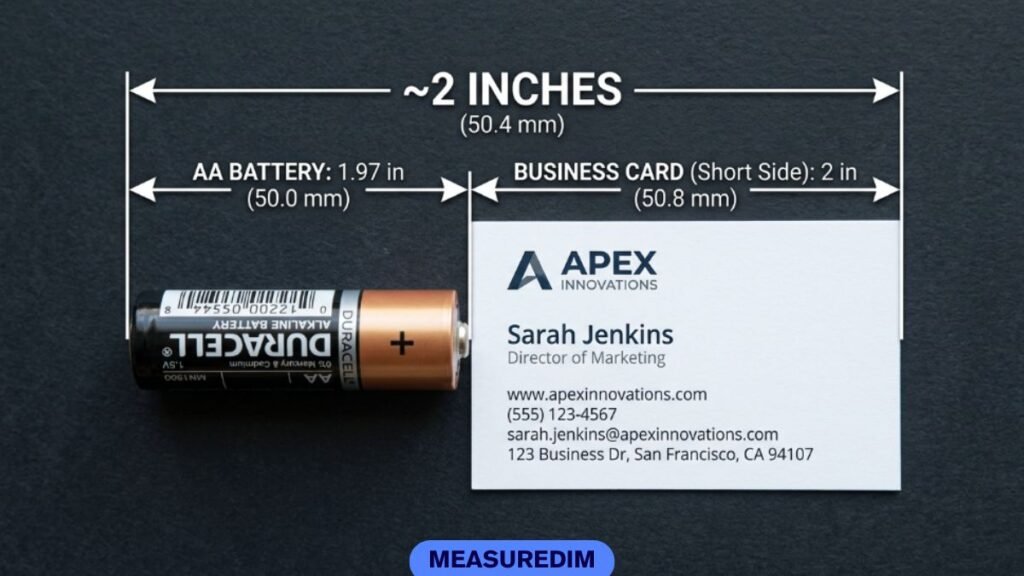
Two inches is 5.08 centimeters, 50.8 millimeters, or exactly one-sixth of a foot. For a mental image, hold up a single AA battery — at 1.99 inches, it’s practically a 2-inch ruler you already own. The short edge of a US business card is another dead-on match at exactly 2 inches.
2 Inches in Every Unit You’ll Need
Because 1 inch is defined as exactly 2.54 cm, every conversion below is precise — no rounding drift, no guesswork.
| Unit | 2 inches equals |
| Centimeters | 5.08 cm |
| Millimeters | 50.8 mm |
| Feet | 0.1667 ft (1⁄6 ft) |
| Yards | 0.0556 yd |
| Meters | 0.0508 m |
One thing worth flagging up front: 2 inches and 5 cm are not the same thing, even though they get swapped all the time. Five centimeters is 1.97 inches, while 2 inches is 5.08 cm. Close cousins, not twins — the gap is about 2 millimeters, which matters the moment you’re cutting fabric or drilling a hole.
Picture It: What Two Inches Actually Looks Like
Two inches is short but not tiny. It’s roughly the width of three fingers held together, the height of a large egg standing on end, or the distance across a golf ball plus a little extra. It’s too long to be “bite-sized” and too short to be “a handful.” Think of it as the sweet spot where an object still fits comfortably between a thumb and forefinger with room to spare.
If you stack two US quarters flat, you’re just shy of 2 inches. Line up two AA batteries end to end and you’ve doubled it to 4. That in-between scale — bigger than a coin, smaller than your palm — is the intuition to hold onto.
Everyday Objects That Land Right at Two Inches
Here are nine references you almost certainly have within arm’s reach. Each entry tells you the object’s real measurement, how closely it maps to 2 inches, and one moment where the comparison earns its keep.
The AA Battery in Your Remote
A single AA cell measures 50.5 mm from button to base — that’s 1.99 inches, close enough to 2 that you can treat them as identical for everyday purposes. Slide one out of a TV remote, a wireless mouse, or a game controller and you’re holding a factory-calibrated 2-inch stick. The tolerance is minuscule: every AA on Earth is built to the same IEC standard, so they don’t vary from brand to brand.
This is my go-to 2-inch reference, and I reach for it constantly. AAs are ubiquitous, cheap, and rigid, which makes them far more trustworthy than a floppy tape measure when you’re checking a small gap. Wondering if a shelf clearance will swallow a phone charger, or whether that “compact” gadget really is as short as the box claims? Grab a battery and lay it alongside — you’ll have your answer in a second.
The Short Edge of a Business Card
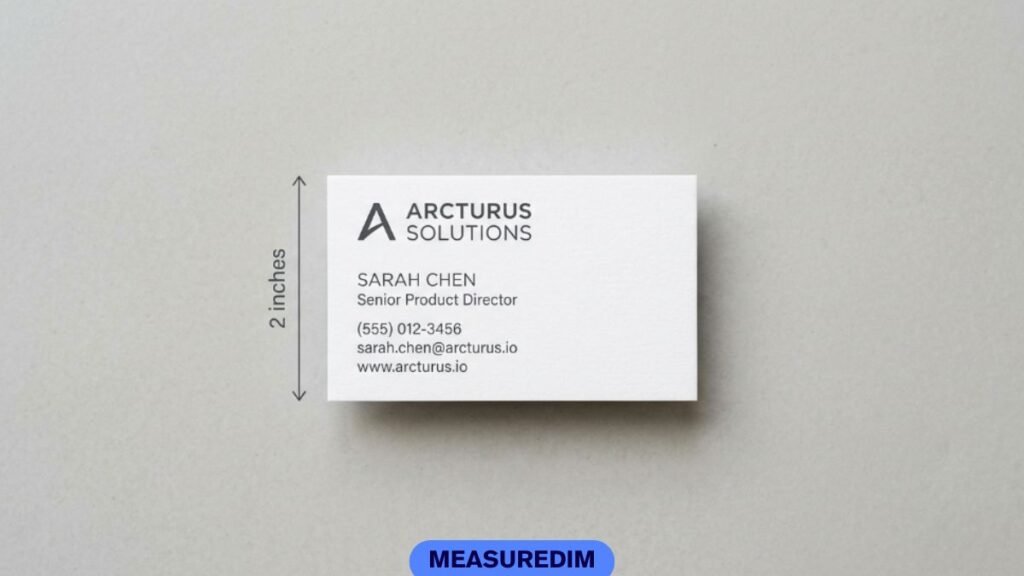
A standard US business card is 3.5 × 2 inches (88.9 × 50.8 mm), which means its short side is exactly 2 inches — not “about,” not “roughly,” but bang on. This is an exact match, because the dimension is a printing standard that shops around the country hold to tightly.
Since it doesn’t drift, a business card doubles as a pocket ruler you didn’t know you were carrying. Tuck one into your wallet and you always have a precise 2-inch (and 3.5-inch) edge on hand. I’ve used the short side to check picture-frame matting, confirm a screw was too long, and eyeball whether a parcel slot was wide enough — all without hunting for a tape measure.
Read Also: How Long Is 6 Inches? Real Objects to Picture It Fast
A Jumbo Paper Clip
The oversized clip — the big brother of the everyday No. 1 clip — stretches to about 50 mm, or 1.97 inches. That’s a shade under 2, near enough that the difference is invisible to the naked eye. (Note the standard small clip is only around 1.4 inches, so this only works with the jumbo size.)
Because these clips are flat and stiff, they’re handy for measuring across small openings. When I’m sorting beads, spacing pilot holes, or judging the gap on a curtain ring, a jumbo clip gives me a quick, honest 2-inch benchmark. Straighten one out and you also get roughly 4 inches of wire, which is a bonus for longer estimates.
A Wooden Kitchen Match
A standard wooden safety match runs about 48–50 mm, landing between 1.9 and 2.0 inches depending on the box. Treat this one as approximate: long fireplace and BBQ matches exist and can be twice this length, so I’m talking about the ordinary kitchen match here.
The appeal is that a match is thin and light, so it’s easy to hold flush against a curved or awkward surface where a rigid ruler won’t sit. If you’re checking the depth of a candle wick, the reach of a small hinge, or the thickness of a stack of coasters, a plain wooden match is a surprisingly practical 2-inch yardstick — just don’t strike it while you measure.
A Standard Domino Tile
A tournament-grade double-six domino measures 2 × 1 × ⅜ inches, giving you an exact 2-inch length along its long side. Everyday travel sets sometimes run a touch smaller, so reach for a full-size set if you want the precise figure.
Dominoes are rigid, rectangular, and have crisp square ends, which makes them excellent for setting consistent gaps. I’ve lined a few up edge to edge to mark out even spacing when hanging a row of hooks, and a single tile is a tidy 2-inch reference for checking that a shelf bracket sits far enough from the wall’s corner.
Two Quarters, Side by Side
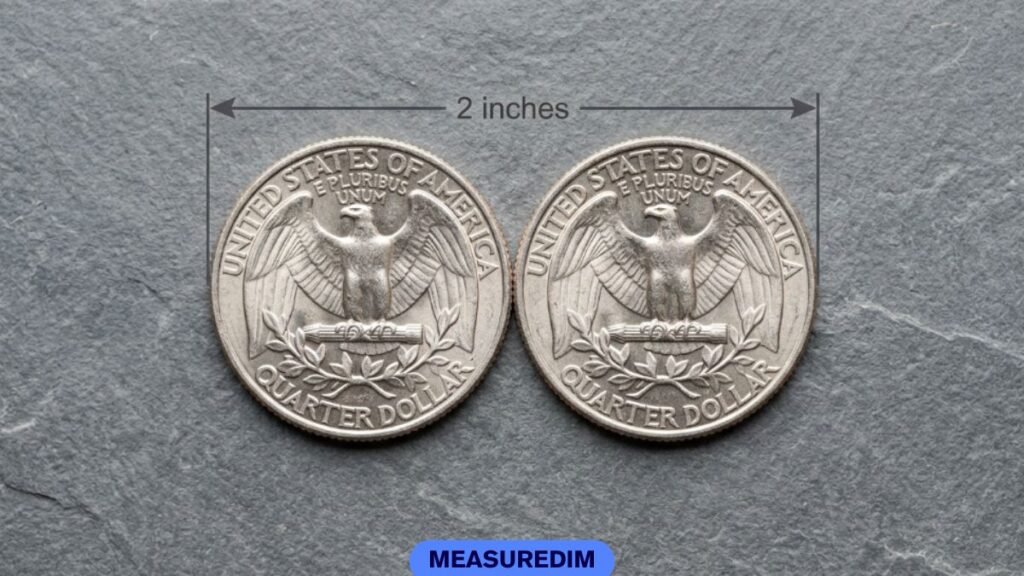
A US quarter is 0.955 inches (24.26 mm) across. Butt two of them together and you span roughly 1.91 inches — slightly under 2, but a fair approximation when coins are all you’ve got. This one is deliberately an estimate; you’re about a tenth of an inch short.
The beauty of pocket change is that it’s always available and always the same size, since coin diameters are federally fixed. Sitting at a café and want to know if a napkin ring is about 2 inches wide, or whether a keychain will fit a slot? Two quarters give you a rough read on the spot. For a tighter match, remember that three quarters in a row land near 2.9 inches.
A Classic Golf Tee
The traditional short golf tee stands 2⅛ inches, or about 54 mm — just barely over the 2-inch mark. This is approximate on the high side; longer driver tees reach 2¾ inches or more, so use the standard short tee for this comparison.
A tee is pointed and slim, which makes it useful for poking into soil or checking narrow depths. Gardeners will find it handy: press one into a seed tray and it marks a planting depth right around 2 inches. It’s also a neat visual for anyone eyeballing a small vertical clearance, like the lip on a phone stand or the height of a bottle cap plus its neck.
Your House Key
A typical residential house key — think a common Kwikset or Schlage blank — runs about 2 to 2.25 inches from the tip of the blade to the top of the bow. Call this a rough reference; key patterns vary by brand and lock, so treat 2 inches as the ballpark rather than a guarantee.
The advantage is obvious: your keys are almost always on you. When you need a quick gut-check on whether something is “about 2 inches,” pulling out a house key beats guessing. I’ve used mine to confirm a cable gland size and to judge whether a drawer gap would trap a small remote — good enough for the decision, even if it’s not lab-precise.
The Long Axis of a Large Egg
A USDA large chicken egg stands about 2.2 inches (56 mm) along its long axis, so it’s a touch over 2 inches — an approximate reference on the generous side. Egg size grades run from medium to jumbo, so a large egg is the one to picture for this comparison.
Eggs are a great kitchen-scale gauge because everyone has a sense of their size. When a recipe calls for a 2-inch chunk of dough, a 2-inch ball of ground meat, or a knob of butter around that size, imagining “a hair smaller than a large egg’s height” gets you remarkably close without dirtying a ruler.
All the References at a Glance
| Object | Actual length | How it compares to 2 in | Precision |
| AA battery | 50.5 mm / 1.99 in | Dead-on | Near-exact |
| Business card (short side) | 50.8 mm / 2.00 in | Identical | Exact |
| Domino tile (tournament) | 50.8 mm / 2.00 in | Identical | Exact |
| Jumbo paper clip | ~50 mm / 1.97 in | A hair under | Approximate |
| Wooden kitchen match | 48–50 mm / ~1.9–2.0 in | Just under to spot-on | Approximate |
| Two quarters, edge to edge | 48.5 mm / 1.91 in | Slightly under | Approximate |
| Classic golf tee | 54 mm / 2.13 in | Slightly over | Approximate |
| House key (overall) | ~51–57 mm / 2.0–2.25 in | About right | Rough |
| Large egg (long axis) | 56 mm / 2.2 in | A bit over | Approximate |
No Tape Measure? Use Your Hands and Pocket Change
Your body is a decent backup ruler once you know your own dimensions. Two inches is close to the width of three adult fingers held together at the middle knuckle — measure yours once against a real ruler and memorize whether you run a little over or under.
The tip of your thumb to its first knuckle is famously about 1 inch, which is where the unit’s old definition comes from. That makes 2 inches roughly the length of your thumb from the tip down to the base joint for many adults — check yours to calibrate. And if hands feel too variable, fall back on the coins: two quarters side by side land within a tenth of an inch of the target, and they never change size.
For anything where being off by a few millimeters matters — sewing, carpentry, drilling — use one of the exact references instead. A business card’s short edge or an AA battery will always beat a body-based guess.
Read Also: How Big Is 4 Inches? A Complete Size Guide With Real Objects
Where People Get Two Inches Wrong
The most common slip is treating 2 inches and 2 centimeters as interchangeable. They’re wildly different: 2 cm is only 0.79 inches, less than half of 2 inches. Skim a spec sheet too fast and that mix-up can wreck an online order.
A second trap is assuming round objects hit 2 inches when they don’t. A golf ball is only 1.68 inches across, and a ping-pong ball just 1.57 inches — both noticeably under 2, despite feeling “about that big.” If you need a true 2-inch sphere reference, there isn’t a common one, which is exactly why the flat objects above are more reliable.
People also misread screen and phone sizes. A “2-inch” display is measured on the diagonal, not the width or height, so a 2-inch screen is actually narrower than 2 inches across its short side. Diagonal-versus-edge confusion trips up plenty of shoppers.
Two Inches vs. Its Neighbors
Sizing something correctly often means knowing what sits just above and just below.
One inch (2.54 cm) is half of 2 inches — the length of the top segment of your thumb, the width of a US quarter plus a sliver, or the height of a standard bottle cap. If 2 inches feels a bit long for what you’re picturing, an inch is the next natural step down.
Three inches (7.62 cm) is the step up — roughly the length of a standard golf pencil, the width of a business card’s long side minus half an inch, or the diameter of a hockey puck. Going from 2 to 3 inches is a jump you can genuinely feel in your hand, which is why the 2-inch band is so useful: it’s the compact size that still holds real presence.
For a finer split, 1.5 inches is about the width of two stacked quarters plus one on its edge, and 2.5 inches is close to the height of a golf ball resting on a tee. Anchoring 2 inches between these gives you a quick ladder of sizes to reason with.
Real Places Two Inches Shows Up
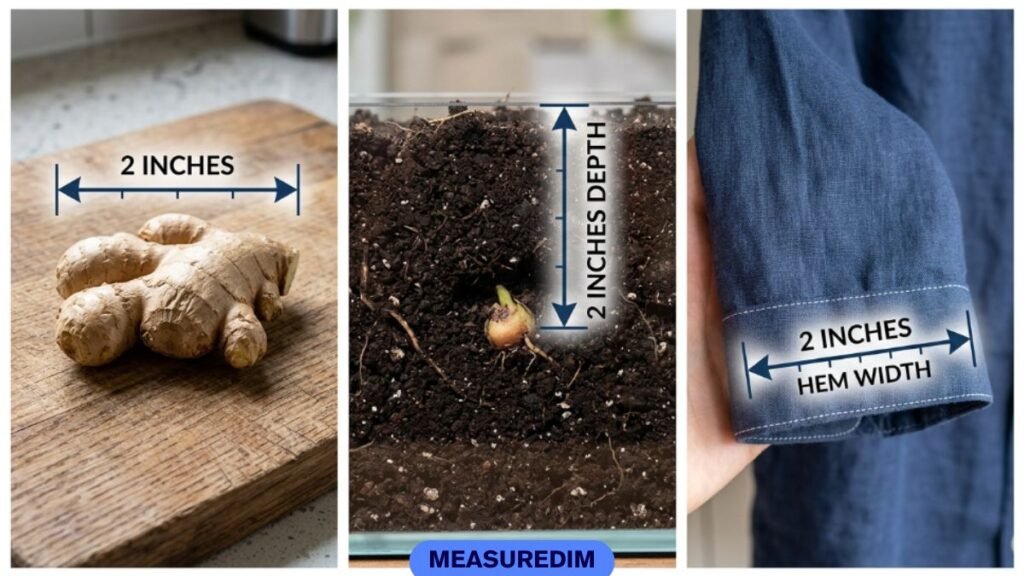
This measurement isn’t academic — it’s a recurring size in daily life. In the kitchen, recipes lean on it constantly: a 2-inch piece of ginger, a steak cut 2 inches thick for a good sear, meatballs rolled to about that width.
In the garden and home, 2 inches is a standard sowing depth for many bulbs and larger seeds, a common mulch layer, and the nominal size of a 2-inch drain or waste pipe in plumbing. Sewers know it as a typical hem allowance, and picture-framers use it as a generous matting border.
It also crowds the world of small products and hardware: pocket knives, luggage padlocks, hinges, casters, and countless “mini” gadgets get described in 2-inch terms. Even weather reports use it — 2 inches of rain is a soaking, and 2 inches of snow is enough to coat the ground and slow the commute. Knowing the length on sight helps you read all of these faster.
Quick-Fire Questions
What does 2 inches look like?
It looks like an AA battery or the short edge of a business card — small, but bigger than a coin.
How many fingers is 2 inches?
About three adult fingers held together at the middle knuckle measure close to 2 inches.
What does 2 inches long look like?
Picture a large egg standing on its end, or a golf tee — both sit right around 2 inches long.
How to measure 2 inches with a finger?
Your thumb tip to its first knuckle is about 1 inch, so two of those lengths make 2 inches.
How can I measure 2 inches without a ruler?
Use an AA battery, a business card’s short edge, or two US quarters set side by side.
Locking Two Inches Into Your Mind’s Eye
Now you know how long is 2 inches. It is 5.08 centimeters, or 50.8 millimeters. It is one-sixth of a foot. You can picture it fast. An AA battery is nearly 2 inches long. The short edge of a business card is exactly 2 inches. Two quarters side by side come very close too. Keep one of these pictures in your mind. You will spot 2 inches at a glance.
This size helps you every day. You will measure things in the kitchen, in the garden, and at your desk. You can check a length without a ruler. Just grab a battery or a card. Remember that 2 inches and 2 centimeters are different sizes. Now you can measure with real confidence.
Written by a measurement-and-dimensions editor who has spent more time than is reasonable holding batteries up against things to check their size.
Related Guides:
1: How Long Is 8 Inches? Everyday Objects to Picture It
2: How Big Is 7 Inches? 10 Everyday Objects to Picture It