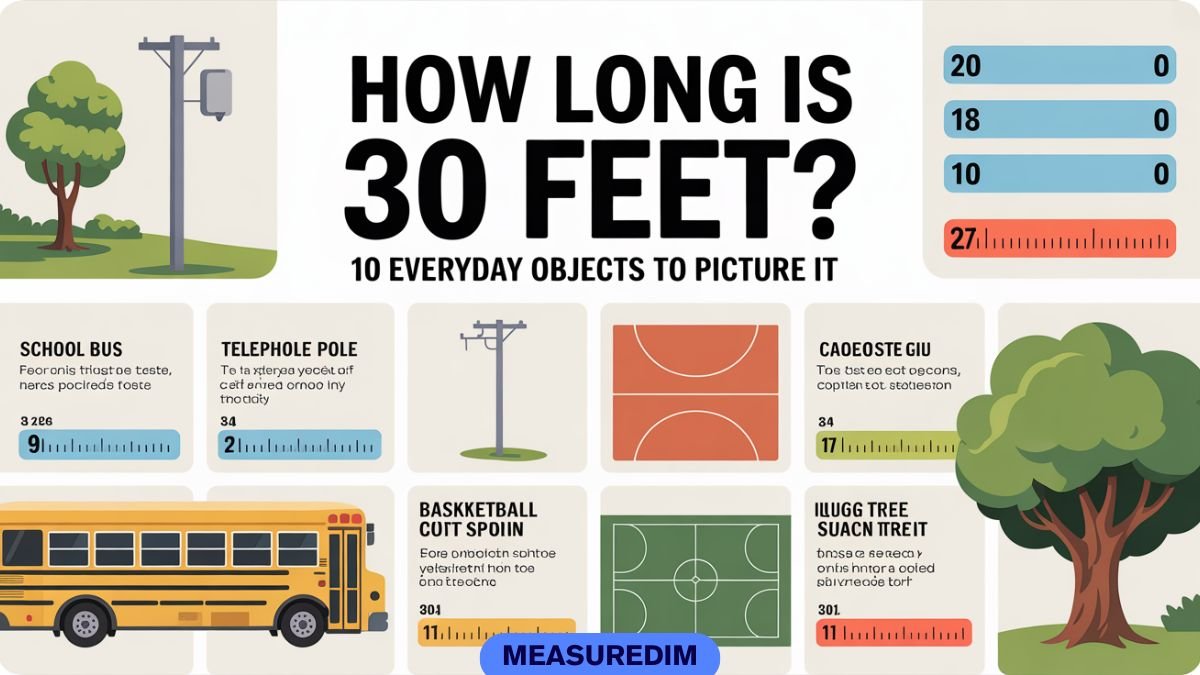
How Long Is 30 Feet? 10 Everyday Objects to Picture It
Thirty feet is a length. It equals 360 inches or 9.14 meters. It is also exactly 10 yards, or three floor levels stacked up.
Say “30 feet” out loud and most people freeze. The number sounds simple. But picturing it is the hard part, and that blank is normal.
You meet 30 feet often. It fits two cars parked end to end. It matches half a bowling lane. Knowing it by sight helps you shop, park, and pack faster.
The Short Answer: 30 Feet at a Glance
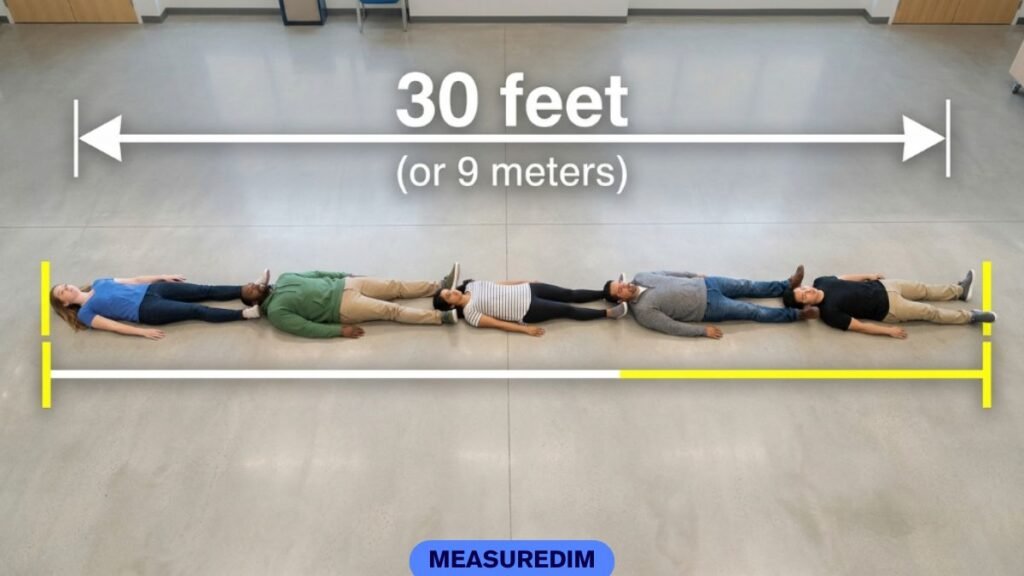
Thirty feet is 360 inches, 9.14 meters, or exactly 10 yards — roughly the length of two parked cars nose to tail, or half a bowling lane from the foul line to the head pin.
If you want one image to hold onto: stand five six-foot adults head to toe and you’ve drawn a line almost exactly 30 feet long.
30 Feet Converted: Inches, Centimeters, Meters and More
Here’s every unit you’re likely to need, from imperial to metric, with no rounding sleight-of-hand — the figures below all describe the same single length.
| Unit | 30 feet equals |
| Inches | 360 in |
| Feet | 30 ft |
| Yards | 10 yd |
| Millimeters | 9,144 mm |
| Centimeters | 914.4 cm |
| Meters | 9.144 m |
A quick note on the conversion math, in case you need to redo it for a different length: one foot is exactly 0.3048 meters and 12 inches, so multiplying 30 by those gives you 9.144 m and 360 in. Divide the feet by three and you get yards — which is why 30 feet is a clean 10 yards, a handy shortcut worth remembering.
Picture It: What 30 Feet Actually Looks Like
Nine meters is longer than most rooms in a house and shorter than the average backyard. It’s about the distance you’d cover in ten to twelve relaxed walking steps. Indoors, it’s roughly the span of a large open-plan living-and-kitchen area wall to wall.
Vertically, 30 feet is close to the roofline of a three-story home — high enough that you’d never want to climb it without a proper ladder. Whether you’re gauging a length across the ground or a height up a wall, the number stays the same; only the direction changes. Keep both the horizontal and the vertical version in mind, because 30 feet shows up as both.
Ten Everyday Things That Measure Close to 30 Feet
Each reference below is either spot-on or a close approximation — I’ve flagged which is which so you’re never guessing.
Two Mid-Size Cars, Bumper to Bumper
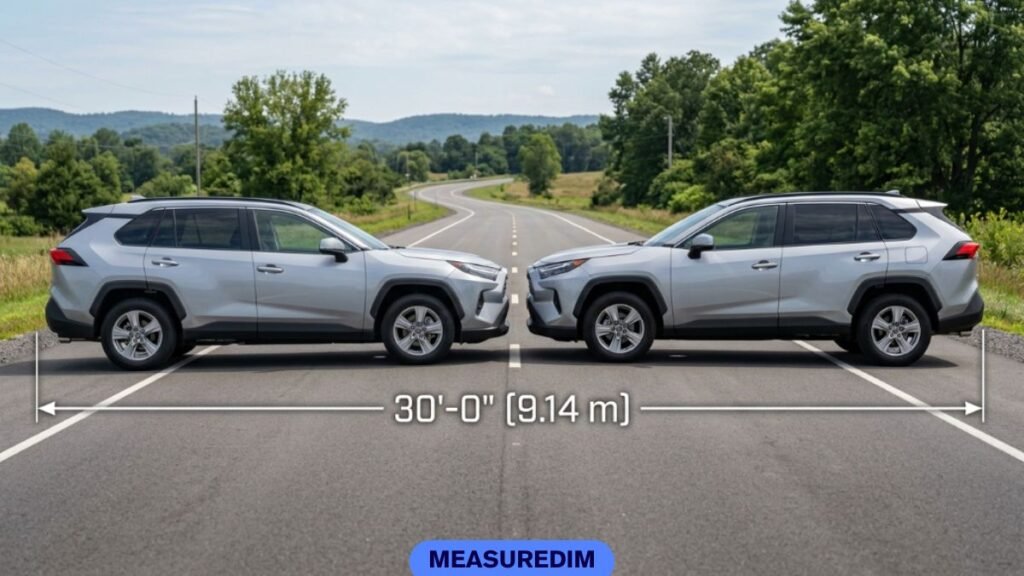
A compact-to-mid-size sedan runs about 15 to 16 feet long — a Honda Civic sits near 15.3 feet, a Camry closer to 16. Park two of them tight, nose to tail, and the pair spans roughly 30 to 32 feet. Treat this as an approximate match that lands right at 30 with the shorter sedans and a hair over with the longer ones.
Cars are everywhere, which makes this the reference most people can conjure instantly. Next time you’re in a lot, glance down a row: two cars end to end is your 30-foot yardstick, no tape measure required. It’s the fastest way to eyeball whether a boat, a trailer, or a driveway will fit.
Half a Bowling Lane
From the foul line to the center of the head pin, a regulation bowling lane measures 60 feet. Cut that in half and you’re standing exactly 30 feet from the pins — a genuinely precise reference if you’ve ever bowled. The approach where you take your steps adds another 15 feet in front of the foul line, so don’t count that part.
I like this one because the distance feels deceptively long in person. Watching a ball travel 60 feet gives you a gut sense that 30 feet — the halfway mark — is farther than it sounds on paper. That instinct is useful whenever a listing says “30 feet” and your first guess feels too small.
Read Also: How Big Is 30cm? 11 Everyday Objects That Show the Length
A 30-Foot Travel Trailer
Plenty of RVs and travel trailers are built and sold at almost exactly this length; a “30-foot” Class C motorhome or bumper-pull trailer is one of the most common sizes on the road. This is an exact reference by design — the marketed length is the thing itself.
If you’ve ever stood beside one at a dealership or campground, you already own a reliable mental image of 30 feet. It’s why RV owners obsess over it: campsite length limits, garage depth, and towing rules all hinge on that number.
The Width of a Three-Car Garage
A three-car garage is typically 30 to 32 feet wide — three vehicle bays of roughly 10 to 11 feet each, plus the wall framing. Call it an approximate 30-foot span measured side to side across the doors.
Most people have walked past one, so the width is easy to recall. It’s a solid stand-in when you’re judging a wide, flat distance rather than a long, narrow one — say, how much fence, countertop, or shelving a 30-foot run would cover.
A 26-Foot Box Truck, Cab Included
The largest common rental moving truck has a 26-foot cargo box, but add the cab up front and the whole vehicle stretches to about 30 feet bumper to bumper. That makes the total length a close approximate match, even though the box alone is shorter.
Anyone who’s driven or parked one of these knows they feel enormous — and that feeling is accurate. It’s a great reference for maneuvering questions: whether a 30-foot vehicle clears a gate, fits a loading bay, or turns down a tight street.
Ten Yardsticks in a Row
Lay ten standard yardsticks end to end and you’ve built exactly 30 feet, since each stick is precisely three feet. This is the cleanest exact reference there is — no tolerance, no estimating.
It’s also the easiest to reproduce at home or in a classroom. Teaching a kid what 30 feet means? Ten yardsticks (or ten floor tiles of the 36-inch kind) turns an abstract number into something they can physically walk beside. [IMAGE: ten yardsticks laid end to end spanning 30 feet]
A Utility Pole Standing Above Ground
A standard 35-foot wooden utility pole is buried about five to six feet deep, which leaves roughly 29 to 30 feet rising above ground. Read that as a close approximation — the exact exposed height depends on burial depth and terrain.
Poles are a rare vertical reference you can spot from anywhere, which makes them handy for gauging height rather than length. When you need to picture how high 30 feet reaches — a tree, a roof, a crane arm — the visible part of a nearby pole is your ruler.
One Side of a Volleyball Court
A regulation volleyball court is 18 meters long, split by the net into two equal halves. Each side — net to end line — measures 9 meters, or about 29.5 feet, landing just under 30. Approximate, but close enough that a single team’s playing area is a fair 30-foot stand-in.
If you’ve played, you’ve felt this distance while chasing a deep ball. That embodied memory beats any number on a page. It works well for indoor spaces, since a court half is a rectangle you can actually walk.
A Three-Story House at the Roofline
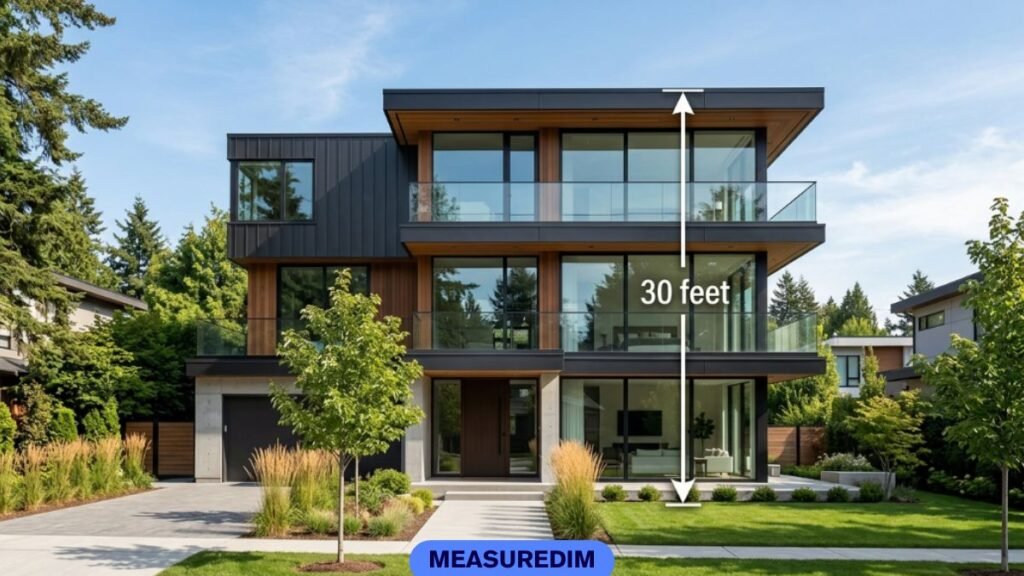
Residential floors run about 10 feet from one level to the next, so three stacked stories reach roughly 30 feet at the eaves before the roof peak adds more. Treat this as an approximate height, since ceiling heights and floor thickness vary by build.
It’s the reference I reach for when someone needs the height version of 30 feet. Standing at street level looking up at a three-story facade gives you an honest, slightly intimidating sense of the distance — exactly the reality check ladder and roofing decisions call for.
Five Adults Lying Head to Toe
Line up five adults head to toe and the chain runs close to 30 feet. With average heights near 5 feet 9 inches it lands a touch under — about 28.75 feet — while five genuine six-footers hit 30 feet on the nose. Approximate, and honestly dependent on who’s lying down.
The value here is that your own body is always with you. Know your height, and you can mentally stack copies of yourself to rough out 30 feet anywhere, with nothing but the number in your head.
All Ten References Side by Side
| Object | Approx. length / height | Match |
| Two mid-size cars, end to end | 30–32 ft | Approximate |
| Half a bowling lane (foul line to head pin) | 30 ft | Exact |
| 30-foot travel trailer | ~30 ft | Exact (by design) |
| Three-car garage width | 30–32 ft | Approximate |
| 26-foot box truck, total length | ~30 ft | Approximate |
| Ten yardsticks in a row | 30 ft | Exact |
| Utility pole above ground (35-ft pole) | 29–30 ft | Approximate |
| One side of a volleyball court | ~29.5 ft | Approximate |
| Three-story house at the roofline | ~30 ft | Approximate |
| Five six-foot adults head to toe | 30 ft | Approximate |
No Tape Measure? Pace It Out Instead
You don’t need a tool to estimate 30 feet — you need a body part you’ve already measured once. Here are three field methods, roughly in order of reliability.
Walk it. A relaxed adult step covers about 2.5 to 3 feet. Ten to twelve normal steps lands you near 30 feet. Count “one full pace” as two steps (about 5 feet), and six paces gets you there — a cleaner tally to keep in your head.
Span it with your arms. Most people’s arm span roughly matches their height, so a 6-foot person spans about 6 feet fingertip to fingertip. Five of those spans, marked along a wall or floor, approximate 30 feet.
Count the floor. Indoors, standard tiles are 12 inches square — thirty of them in a line is 30 feet exactly. No tiles? A sheet of printer paper is 11 inches long, so about 33 sheets nose to tail gets you close in a pinch.
None of these are lab-precise, but for “will this fit” and “how far is that” questions, they’re more than good enough.
Read Also: How Big Is 20cm? 11 Everyday Objects That Nail the Size
Where People Get 30 Feet Wrong
A few honest traps catch people again and again:
Mixing up feet and yards. Thirty feet is 10 yards. Thirty yards, by contrast, is 90 feet — three times as long. Read the unit before you picture anything.
Assuming a school bus is 30 feet. It usually isn’t. A conventional full-size school bus runs about 35 to 40 feet; only the small Type A “short bus” dips toward 20 to 25 feet. Thirty feet falls in the gap between them.
Dropping a factor on the metric side. Thirty feet is about 9 meters, not 3. The person who guesses 3 meters has quietly converted feet as if they were yards. Nine meters is the number to trust.
Confusing linear feet with square feet. Thirty feet is a straight-line distance. Thirty square feet is an area — a patch roughly 5.5 feet on each side. They’re not interchangeable, and listings sometimes blur the two.
When 30 Feet Actually Matters
This length turns up more often than you’d think once you start noticing it.
For RVs, boats, and trailers, 30 feet is a threshold that decides whether you clear a campsite limit, a boat slip, or your own garage. Towing rules and parking spots frequently draw the line right here.
Around the home and yard, 30-foot runs are common for string lights, garden hoses, extension cords, and rope — often sold in 25- and 50-foot lengths, with 30 feet a frequent custom cut. Property setbacks and driveway lengths cluster in this range too.
In tech and construction, cable runs (Ethernet, HDMI) and ladder reach both butt up against 30 feet as practical limits, where signal loss or safety starts to matter. Knowing the distance by sight helps you buy the right length the first time.
20, 25, 40: How 30 Feet Compares to Its Neighbors
Sizing 30 feet against what sits just below and just above it makes it stick.
Just below (20–25 feet): A 20-foot shipping container and a compact “short” bus both live here. Drop from 30 to 20 feet and you’ve lost a full third of the length — the difference between two cars and about one-and-a-third.
Just above (35–40 feet): A full-size school bus and a 40-foot shipping container occupy this band. A 40-foot container is a third longer than 30 feet, which is exactly why the two container sizes look so different side by side on a truck.
Slotting 30 feet between these anchors gives you a scale, not just a single dot — and scale is what makes a number intuitive.
Questions People Actually Ask About 30 Feet
How big is 30 feet compared to a human?
It equals about five 6-foot adults lying head to toe, or five tall people stacked up.
What does 30 feet look like?
It looks like two cars parked end to end, or half a bowling lane from the foul line to the pins.
How many cars is 30 feet?
About two mid-size cars bumper to bumper, since each car runs roughly 15 to 16 feet long.
How long is a 30 ft example?
A 30-foot travel trailer is a spot-on example, and ten yardsticks in a row match it exactly.
How long is 30ft visually?
Picture 9.14 meters — two cars end to end, or the eaves of a three-story house going up.
Fixing 30 Feet in Your Mind
So, how long is 30 feet? It is 360 inches, 9.14 meters, or a clean 10 yards. You now hold ten clear pictures for it. Two cars end to end make 30 feet. Half a bowling lane matches it too. Five tall adults on the ground reach the same line. Ten yardsticks in a row give you the exact length. Pick the picture closest to your day and keep it.
From now on, you will read “30 feet” and see it at once. You can pace it in ten to twelve steps. You can check if a trailer, hose, or driveway fits. This one number will help you shop, park, and plan with real confidence. Keep the simple images in mind, and 30 feet stays easy forever.
Related Guides:
1: How Big Is 14 Inches? Real Objects That Show You the Size
2: How Long Is 2 Meters? 9 Everyday Objects to Picture It
3: How Long Is 5 Meters? Feet, Cm & Real-World Examples
4: How Long Is a Foot? The Exact Length, Plus 10 Everyday Things to Compare It To
5: How Long Is 13 Inches? 7 Everyday Objects to Picture It