
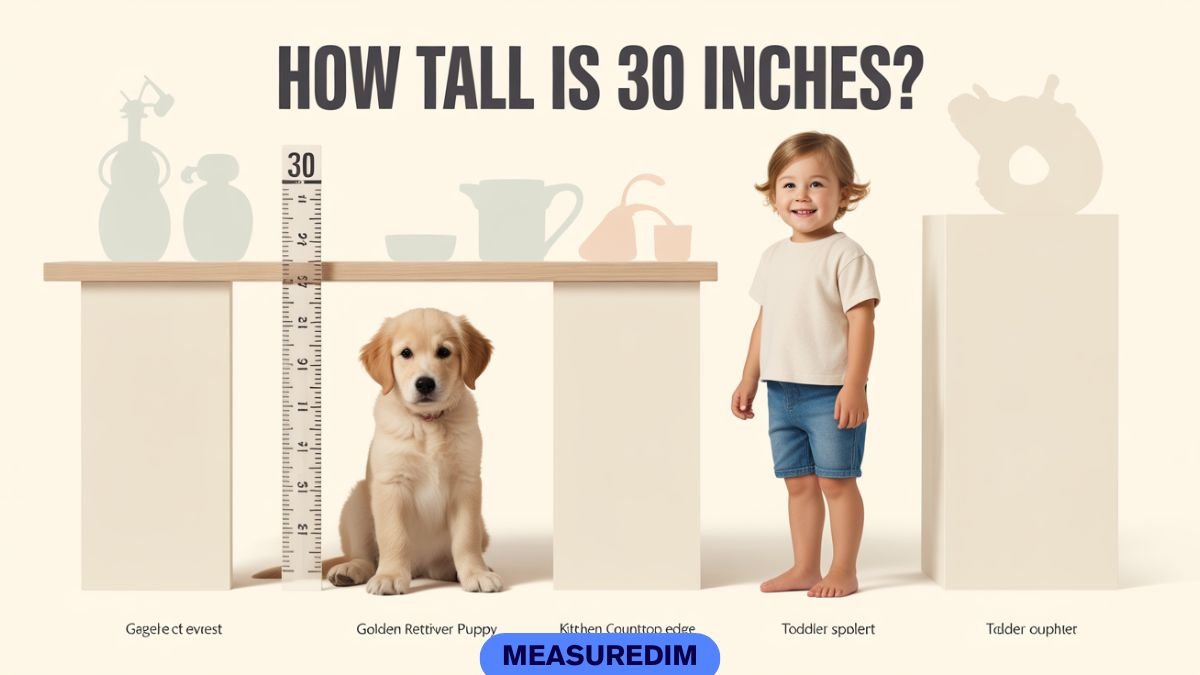
How Tall Is 30 Inches? Real Objects That Show You
Thirty inches is a length that equals 2.5 feet. In the metric system, it is 76.2 centimeters. It is also 762 millimeters, or a little over three-quarters of a meter.
Ever tried to picture 30 inches in your head? It sounds tricky, but it hides in plain sight all around you. Your dining table, a big suitcase, and a toddler are all close to this size.
Thirty inches is the height of most dining tables and desks. It matches a common youth baseball bat and a large checked suitcase. Line up two and a half rulers, and you hit 30 inches exactly.
30 Inches, Answered Fast
Thirty inches equals 2.5 feet, or 76.2 centimeters. It’s the standard height of a dining table, the length of a common youth baseball bat, and roughly how tall the average one-year-old stands. If you can picture a table edge hitting you around mid-thigh, you’re already picturing 30 inches.
That’s the snapshot. Below, it gets concrete.
30 Inches in Every Unit You’d Need
Converting between the imperial and metric systems trips people up constantly, so here’s the full breakdown in one place. Every figure below describes the same length — no rounding tricks, no contradictions.
| Unit | Value |
| Inches | 30 in |
| Feet | 2.5 ft |
| Yards | 0.833 yd (5/6 of a yard) |
| Centimeters | 76.2 cm |
| Millimeters | 762 mm |
| Meters | 0.762 m |
To do the math yourself: multiply inches by 2.54 to get centimeters, or divide by 12 to get feet. So 30 × 2.54 = 76.2 cm, and 30 ÷ 12 = 2.5 ft. Keep those two conversions in your head and you can translate almost any inch measurement on the fly.
Picturing Two and a Half Feet
Numbers are slippery; body-scale references stick. Thirty inches lands right around the height of most people’s fingertips when they let their arm hang straight down — measure from the floor to where your longest finger dangles, and for an average adult that’s close to 30 inches. Stand at a standard table and the top edge meets you at about mid-thigh.
Another way in: two and a half school rulers stacked end to end. A yard is 36 inches, so 30 inches is a yard minus a hand-span. It’s shorter than a golf club and taller than most nightstands. Hold that mental picture — “a hair under waist height on a shorter adult” — and you’ll rarely be far off.
Ten Everyday Things That Stand About 30 Inches Tall
Each object below is a real reference with a real dimension. I’ve flagged which ones are exact and which are close approximations, because honest labeling beats fake precision every time.
Standard Dining and Desk Height
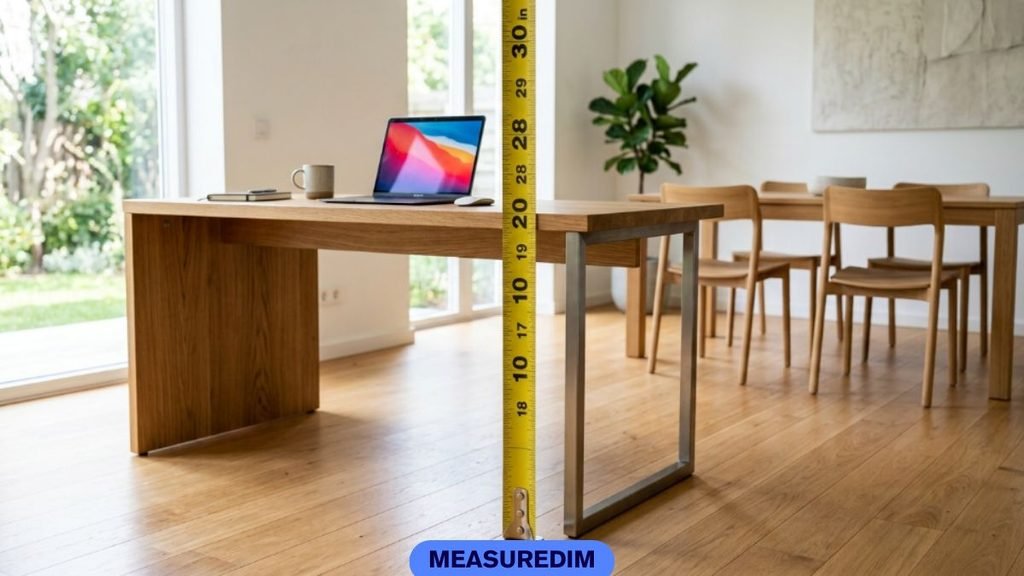
Pull up to almost any dining table or writing desk and the surface sits 28 to 30 inches off the floor, most commonly right at 30 inches. This is the furniture industry’s default “table height,” distinct from taller counter and bar surfaces. When a listing just says “table,” this is the height you’re getting.
I trust this one because it’s everywhere and it’s standardized — designers build to it so a normal chair (seat around 18 inches) tucks underneath comfortably. Next time you’re seated at dinner, glance at where the tabletop meets your leg: that gap from floor to surface is your living, in-home 30-inch ruler. It’s the fastest gut-check I know for this size.
The Average One-Year-Old
A child at their first birthday measures roughly 29 to 30 inches tall on average, with boys landing a touch higher than girls. It’s an approximate reference — kids vary a lot — but the average is remarkably close to the target.
This one is useful precisely because it’s relatable. Parents carry an intuitive sense of how tall a one-year-old is, and mapping that onto 30 inches makes the number click instantly. If you’re explaining the size to someone and there’s a toddler in the room, you’ve got a walking, wobbling demonstration.
Read Also: How Long Is 17 Inches? Objects, Conversions & Examples
A Youth Baseball Bat
Bat length is measured in inches, and 30 inches is one of the most common sizes for players roughly nine to twelve years old. This is an exact match, not an estimate — a 30-inch bat is literally labeled “30 inches.”
Sports gear makes a great reference because the number is printed right on the product. If you’ve ever shopped for a Little League bat, you’ve handled 30 inches directly. Stand one on its end beside a table and you’ll see the two land at nearly the same height, which reinforces both references at once.
Two and a Half School Rulers
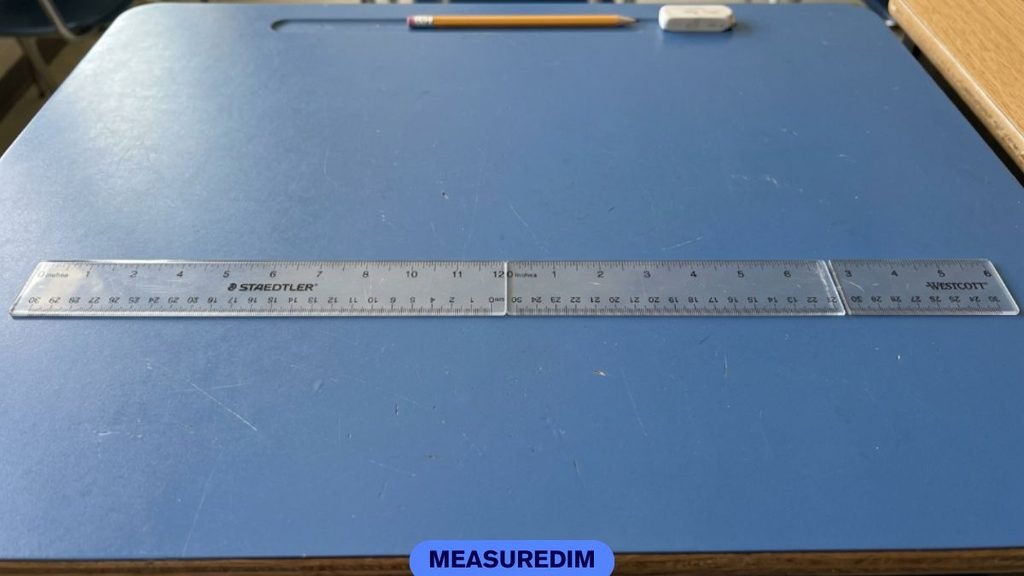
A standard ruler is 12 inches. Line up two of them and add half of a third, and you hit 30 inches exactly. There’s no approximation here — it’s simple arithmetic you can reproduce on a desk in ten seconds.
This is my favorite teaching trick because everyone has rulers and everyone trusts them. It’s the cleanest way to show a kid what 30 inches means without any special tools. Lay them head to tail on the floor and the total spans exactly the height we’re talking about.
A 30-Inch Interior Door
Interior doors come in set widths — 24, 28, 30, 32, and 36 inches — and a 30-inch door is a common choice for bedrooms and bathrooms. The width is exact by design, since doors are cut to standard framing.
Here the reference is a fixed architectural standard, which makes it dependable. Measure the width of a typical bedroom door and there’s a strong chance it reads 30 inches across. It’s a handy benchmark when you’re sizing furniture to fit through a doorway — if a piece is wider than 30 inches, a standard door may become a squeeze.
A Bar-Height Stool Seat
Seat heights on stools cluster into tiers: counter stools sit around 24 to 26 inches, while bar-height stools put the seat at roughly 28 to 30 inches off the floor. The taller end of that range is essentially our target, so I’ll call it a close approximation.
Stools are a good reference because you sit on the number rather than beside it, giving you a felt sense of the height. If you’ve perched on a bar stool with your feet dangling toward the footrest, that seat-to-floor drop is about 30 inches. It’s the go-to comparison when someone’s picturing a raised surface.
A Complete Skateboard
Most standard skateboards run about 28 to 32 inches in length, with 31 inches being the everyday average — close enough to 30 that a skateboard deck is a solid stand-in. I’ll flag it as approximate since deck length shifts with style.
Skateboards work well because they’re a familiar object with a graspable footprint. Stand a deck vertically against a wall and the top rides just above 30 inches. If you’re trying to describe the size to a teenager, this is often the reference that lands fastest.
A Large “30-Inch” Checked Suitcase
Luggage is sold by height, and a 30-inch checked suitcase is a large-format bag built for long trips. The label refers to the case’s height, so this is an exact, named size rather than a guess.
Travelers know this size viscerally — a 30-inch bag is the one that’s borderline too big for the overhead and definitely getting checked. Set it upright next to your leg and the top reaches past your knee toward your lower thigh. It’s a great reference for anyone who’s wrestled a big suitcase down an airport concourse.
A Stock SUV or Light-Truck Tire
The overall diameter of many SUV and light-truck tires falls right around 29 to 30 inches, and a “30-inch tire” is a well-known spec among off-road drivers. Passenger-car tires run smaller (often 25 to 27 inches), so this is a light-truck reference and an approximate one.
Tires make a vivid comparison because they’re a big, round, waist-high object you can walk up to. Roll one upright and its top edge lands close to 30 inches. Mechanics and drivers who talk in tire sizes carry this reference automatically, which makes it useful shorthand in a garage.
A Two-Drawer Filing Cabinet
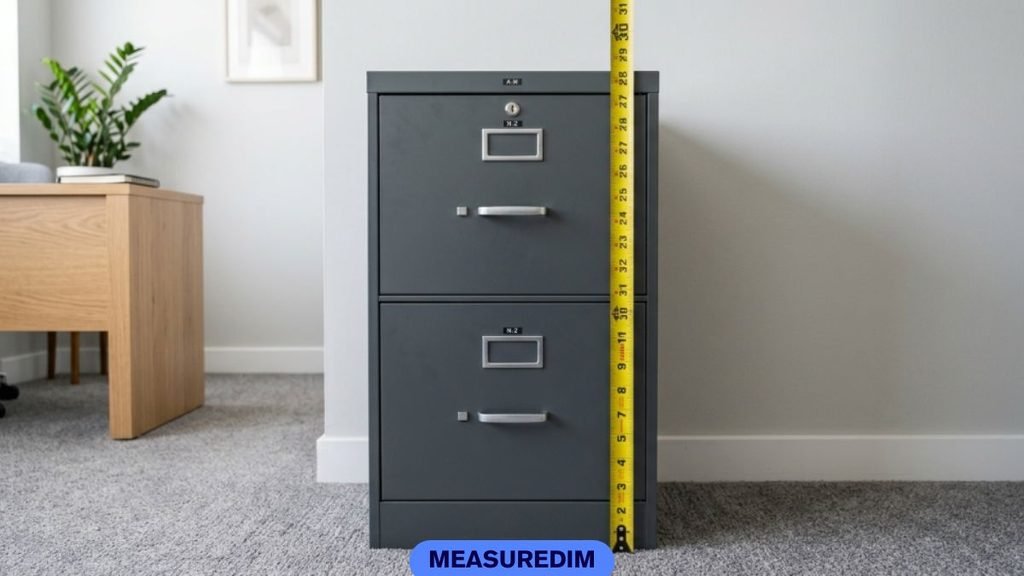
A standard vertical two-drawer file cabinet stands about 28 to 30 inches tall — engineered, not coincidental, so it slides neatly beside or under a 30-inch desk. Call it a close-to-exact match at the top of its range.
Office furniture is reliable because it’s built to consistent specs. If you’ve got a two-drawer cabinet nearby, its top surface probably sits within an inch or two of your desktop — both hovering around 30 inches. It’s the reference to reach for when you’re describing the size in a workspace.
The 30-Inch Lineup, Side by Side
Here’s every object above at a glance, with its real measurement and how tightly it matches. Scan this when you just need a quick anchor.
| Object | Real measurement | Match to 30 in |
| Dining / desk height | 28–30 in (typ. 30) | Very close |
| Average one-year-old | 29–30 in | Close (approx.) |
| Youth baseball bat | 30 in | Exact |
| 2.5 school rulers | 30 in | Exact |
| 30-inch interior door (width) | 30 in | Exact |
| Bar-height stool seat | 28–30 in | Close (approx.) |
| Complete skateboard | ~31 in | Close (approx.) |
| Large checked suitcase | 30 in | Exact (named size) |
| SUV / light-truck tire | 29–30 in | Close (approx.) |
| Two-drawer file cabinet | 28–30 in | Close |
No Tape Measure? Gauge It With Your Body
You carry several 30-inch estimators on you at all times. Here’s how to use them.
The arm drop is the quickest: stand up straight, let one arm hang loose, and note where your fingertips end. For a large share of adults, floor-to-fingertip is close to 30 inches. It’s not laboratory-grade, but it’s a reliable ballpark.
Step length helps too. An average adult walking stride covers roughly 28 to 31 inches heel to heel, so one comfortable step forward traces out about 30 inches on the ground. Pace it off when you need a rough horizontal read.
Finally, thigh height on a standing adult — floor to mid-thigh — hovers near 30 inches for many people. Combine any two of these and cross-check them, and you’ll gauge this length surprisingly well without ever opening a drawer to hunt for a ruler.
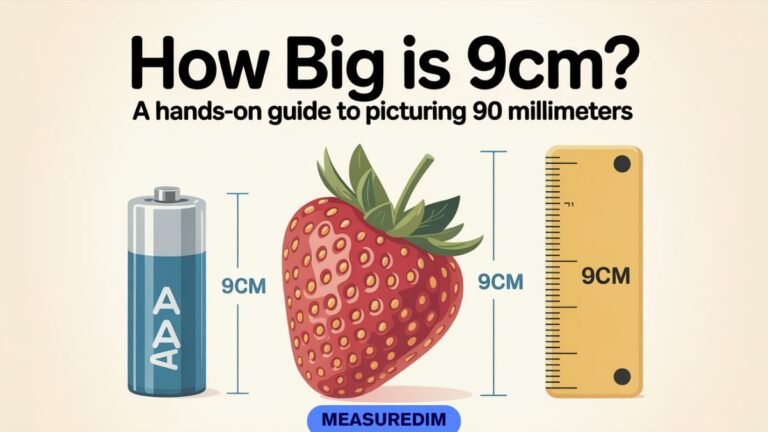
Read Also: How Big Is 9cm? A Hands-On Guide to Picturing 90 Millimeters
Where People Get 30 Inches Wrong
A few consistent mix-ups cost people accuracy — and sometimes money on returns.
The biggest is confusing table height with counter height. A 30-inch surface is dining-table height; kitchen counters stand a full 36 inches. Order 30-inch counter stools and they’ll leave you sitting six inches too low.
Another is treating a “30-inch TV” as if the screen were 30 inches tall. TV sizes describe the diagonal, not the height — and 30 isn’t even a standard panel size (32 inches is). A 32-inch TV’s screen is only about 16 inches tall, not 30.
People also blur inches and centimeters. Thirty centimeters is just under 12 inches — barely a third of 30 inches. Mixing the two badly warps your mental picture, so always confirm which unit a spec is using.
Why 30 Inches Shows Up Everywhere
This isn’t a random number; it’s a design sweet spot. Thirty inches is the height where a seated adult can rest their forearms comfortably, which is why desks and dining tables converge on it. Pair that surface with an 18-inch chair seat and the ergonomics just work.
It also governs clearances and fit. Furniture that’s 30 inches wide clears a standard 30-inch door. Filing cabinets, side tables, and appliances get built around this figure so they tuck under or beside work surfaces. In shipping and storage, 30 inches is a common box and case dimension because it stacks and travels well. Once you start noticing it, the number turns up in kitchens, offices, garages, and airports alike.
How 30 Inches Stacks Against 24 and 36
Seeing the neighbors sharpens your sense of the target.
24 inches is two feet flat — think a standard base cabinet’s depth, or the width of a slim bookshelf. It reads noticeably shorter than 30 inches, about the height of a low nightstand.
36 inches is three feet, a full yard, and the height of a kitchen counter. Step up from 30 to 36 and you’ve added half a foot — the exact jump that separates a dining table from a counter, or a countertop from a bar. Holding all three in mind (2 feet, 2.5 feet, 3 feet) gives you a clean mental ladder for estimating almost anything in this range.
Questions People Actually Ask
What is 30 inches in feet?
Thirty inches equals 2.5 feet. You get this by dividing 30 by 12, since one foot holds 12 inches.
How can I visualize 30 inches?
Picture a standard dining table, which stands about 30 inches tall. You can also line up two and a half 12-inch rulers.
How tall is 30 inches in human height?
Thirty inches reaches about mid-thigh on an average adult. It also matches the full standing height of a typical one-year-old child.
Is 30 inches 5 feet?
No, 30 inches is only 2.5 feet. Five feet equals 60 inches, which is double the length of 30 inches.
How tall is a 5-6 person?
A person who is 5 feet 6 inches stands 66 inches tall. That equals 167.6 centimeters, or about 1.68 meters.
Locking 30 Inches Into Memory
So now you know exactly how tall is 30 inches. It is 2.5 feet, or 76.2 centimeters. You can picture it with things you see every day. A dining table stands this tall. A big suitcase reaches this height too. A youth baseball bat measures the same. Even the average one-year-old child stands close to 30 inches. These simple objects turn a plain number into a clear picture in your mind.
Pick one object and remember it well. Most people choose their kitchen table. That single image locks the size into memory for good. After that, you will spot 30 inches everywhere you look. You will judge this length fast, even without a ruler or tape measure. Now this handy size belongs to you.
Related Guides:
1: How Big Is 4 cm? Nine Everyday Objects That Nail This Size
2: How Long Is 2 cm? Real-Life Size Comparisons + Chart
3: How Big Is 8 cm? A Clear Look With Everyday Objects
4: How Big Is 3 Inches? Real Objects, Sizes & Conversions
5: How Long Is 18 Inches? 10 Objects to Picture It Fast

2 Comments