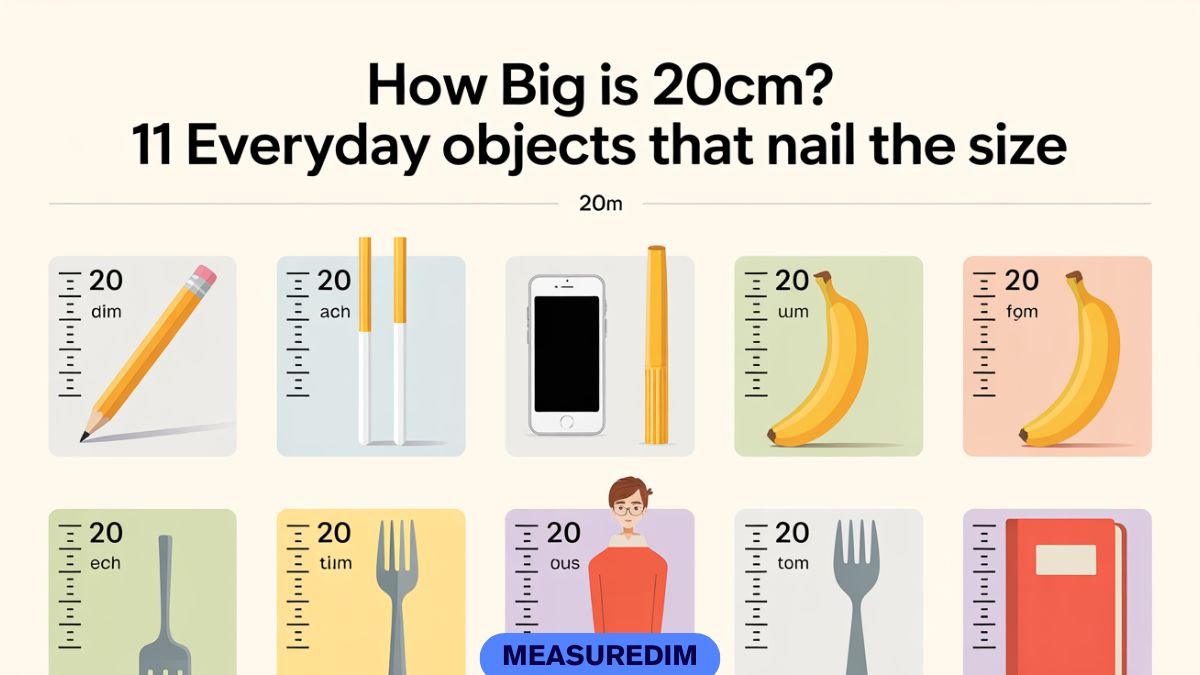
How Big Is 20cm? 11 Everyday Objects That Nail the Size
Twenty centimetres is a small unit of length. It equals 7.87 inches, or 200 millimetres. In simple terms, 20cm is just under 8 inches long.
Ever tried to picture a size without a ruler? It sounds hard, but it is not. A few common objects make 20cm easy to see.
A large banana is close to 20cm. So is the blade of a chef’s knife. Spread your hand wide, and that span is close too.
20cm at a Glance
20cm is 7.87 inches — a shade under 8 inches — or 200mm. In everyday terms, it’s about the length of a large banana, the blade of a standard chef’s knife, or an adult man’s hand from wrist to fingertip. If you remember one thing: it’s roughly two-thirds of a 30cm school ruler.
20cm in Every Unit You’ll Need
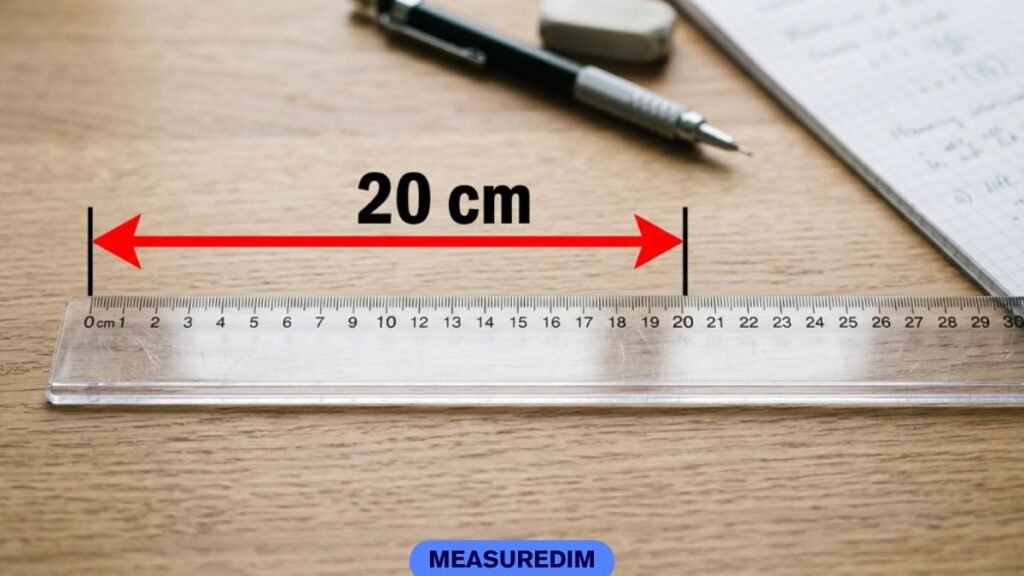
Here are the conversions you’re most likely to reach for, rounded sensibly rather than to fake decimal places.
| Unit | Value |
| Centimetres | 20 cm |
| Millimetres | 200 mm |
| Inches | 7.87 in (≈ 7⅞ in) |
| Feet | 0.66 ft |
| Yards | 0.22 yd |
| Metres | 0.2 m |
The one worth memorising: 20cm = 7.87 inches. People often round it to “8 inches,” but a true 8 inches is 20.32cm, so 20cm falls about 3mm short. Fine for casual talk, not for a precise cut.
[IMAGE: a 20cm segment marked on a ruler with a labelled dimension arrow spanning 0 to 20]
What 20 Centimetres Actually Feels Like
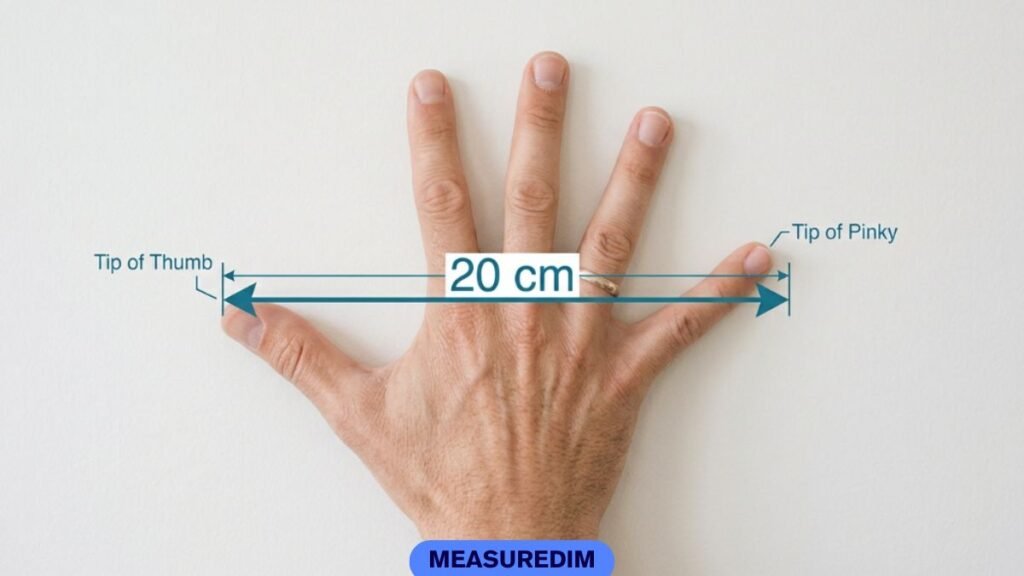
Length is easier to trust when you attach it to your own body. Spread your hand wide and the span from thumb tip to pinky tip is, for many adults, around 20 to 22cm — so a slightly relaxed full stretch is roughly 20cm. Measure from your wrist crease to the tip of your middle finger and most adult hands land near 19cm, a hair under.
Away from the body, think of a paperback novel stood upright, or the width of a sheet of A4 paper with a sliver trimmed off. None of these is exact, but together they build a gut feel: 20cm is comfortably longer than a smartphone and clearly shorter than a standard 30cm ruler. It’s the “large everyday object” zone — big enough to hold with intent, small enough to slip into a bag.
11 Everyday Things That Land Right Around 20cm
Each object below is a real, common item with a believable measurement. I’ve flagged which ones are near-exact and which are honest approximations, because a comparison you can’t trust is worse than none at all.
The Blade of an 8-Inch Chef’s Knife
The blade on a standard 8-inch chef’s knife measures about 20.3cm — the tightest everyday match you’ll find to a clean 20cm. That “8 inches” refers to the cutting edge only, not the handle, so the steel runs from just past the bolster to the tip at almost exactly our target. Since 8 inches converts to 20.32cm, the blade sits a whisker over 20cm rather than under it.
This is my first-choice mental ruler because the 8-inch chef’s knife is the default all-rounder in kitchens worldwide — pull one from any block and you’re holding a reliable 20cm reference. When you’re shopping for cookware online and a listing quotes blade length, picturing that familiar knife tells you instantly whether a 20cm santoku or bread knife will feel right in the hand.
A Brand-New Wooden Pencil
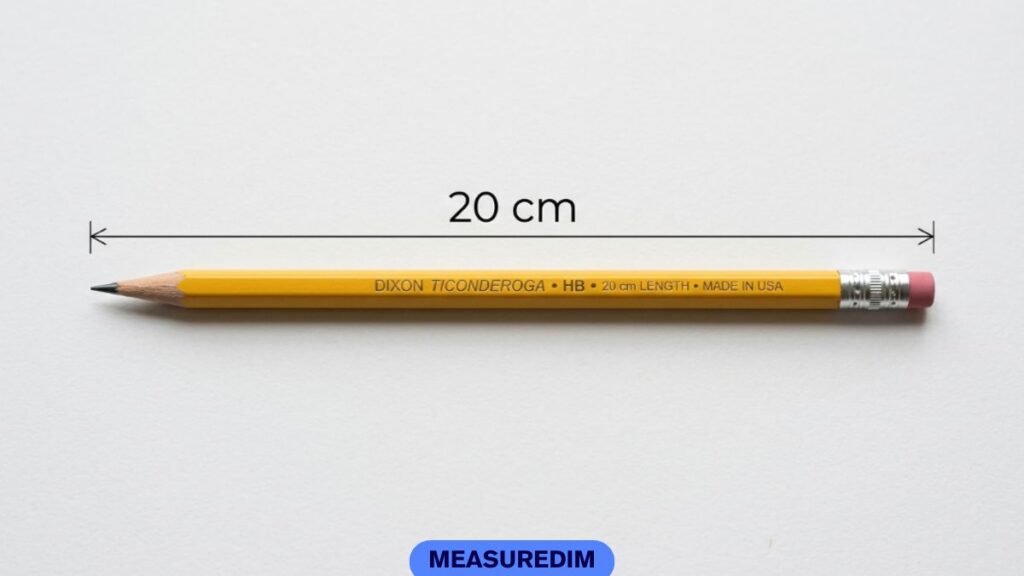
An unsharpened #2 pencil leaves the factory at 7.5 inches, or about 19cm — roughly a centimetre shy of 20cm. Sharpen it a few times and it shrinks fast, so only a fresh, untouched pencil holds this figure.
Because pencils turn up on every desk and in every child’s pencil case, they make an easy pocket reference. Lay one flat, imagine adding a fingertip’s width past the eraser, and you’ve mapped out 20cm. It’s a genuinely useful trick when you’re sketching out shelf spacing and don’t feel like hunting for a tape measure.
Read Also: How Big Is 14 Inches? Real Objects That Show You the Size
The Long Edge of an A5 Sheet
A single sheet of A5 paper — the size of a small notebook page — measures 148 × 210mm. Its longer edge is 21cm, sitting just 1cm over 20cm, while the short edge at 14.8cm falls well under. So it’s the long side you want here.
Anyone in a metric country has A5 within arm’s reach, which makes it dependable. Shave a fingernail’s width off the top and the remaining length is essentially 20cm. I reach for this one when judging whether a photo print or a folded document will slide into a slot or sleeve.
A Full-Size Dinner Fork
Pull a dinner fork from a cutlery drawer and you’re usually holding something between 18 and 20cm, most commonly right around 19–20cm. Continental forks tend to run to the longer end of that range; US table forks sit slightly shorter.
Cutlery is one of the few 20cm-ish objects you can find in nearly any home or restaurant, which is exactly what makes it handy. Set a fork beside a parcel or a book spine and you’ve got an instant gut-check for whether something clears the 20cm mark.
The Diameter of a Salad Plate
A salad or side plate typically spans 19–21cm across, so a mid-range one measures close to 20cm edge to edge. It’s the smaller sibling of the dinner plate, which jumps up to 25–28cm.
Plates give you a two-dimensional feel — not a line but a circle roughly 20cm wide. When I’m picturing how much counter or desk a 20cm gadget will swallow, imagining a salad plate’s footprint does the job far better than a straight measurement.
An iPad Mini Stood on Its End
Apple’s iPad mini measures 195.4mm tall — call it 19.5cm — landing about half a centimetre under 20cm along its long edge. Its width, near 13.5cm, is a different story, so it’s the height that counts here.
If you own one, it’s a precise, repeatable yardstick that already lives in your bag. Stand it upright against anything, and you’re comparing to a known 19.5cm; nudge your estimate up a touch for 20cm. Useful when you’re eyeing a shelf, a drawer, or a bag pocket for fit.
The Height of a DVD Case
A standard DVD keep case stands 190mm, or 19cm, tall — about a centimetre below 20cm. That spec has barely shifted in decades, so almost any case on a shelf holds true.
Because the dimension is so consistent, a DVD case is a quietly reliable reference for anyone with a media shelf. Stand one up, picture a little breathing room on top, and you’ve framed 20cm without touching a ruler.
A Large Banana
A big banana, measured along its outer curve, runs about 18–20cm, with the largest supermarket ones reaching the top of that range. Straighten that curve in your mind and you lose a little, so treat this as a rough match rather than an exact one.
Fruit is no precision tool, but everyone knows a banana’s rough size, which makes it a friendly first estimate. It’s the kind of comparison that helps a child grasp “20cm” far faster than “0.2 metres” ever could.
A Medium Ear of Corn
Shuck a medium ear of corn and the cob usually measures around 20cm, with the full range spanning roughly 18–23cm depending on variety and growing conditions. A typical dinner-table ear sits right about our number.
Like the banana, corn is an approximate, food-based reference — good for intuition, not blueprints. Still, when you’re describing a length to someone across a kitchen, “about as long as an ear of corn” lands immediately.
An Adult Man’s Hand
Measured from the wrist crease to the tip of the middle finger, an adult man’s hand is often 18–19cm, with larger hands reaching 20cm. Women’s hands typically run a shade shorter, so this is a person-to-person figure worth checking on yourself.
The beauty of the hand as a ruler is that it’s always with you. Once you know your own hand length, every wall, box, and gap becomes measurable at a glance. Mine sits near 19cm, so I mentally add a fingertip to hit 20cm.
A House Brick, End to End
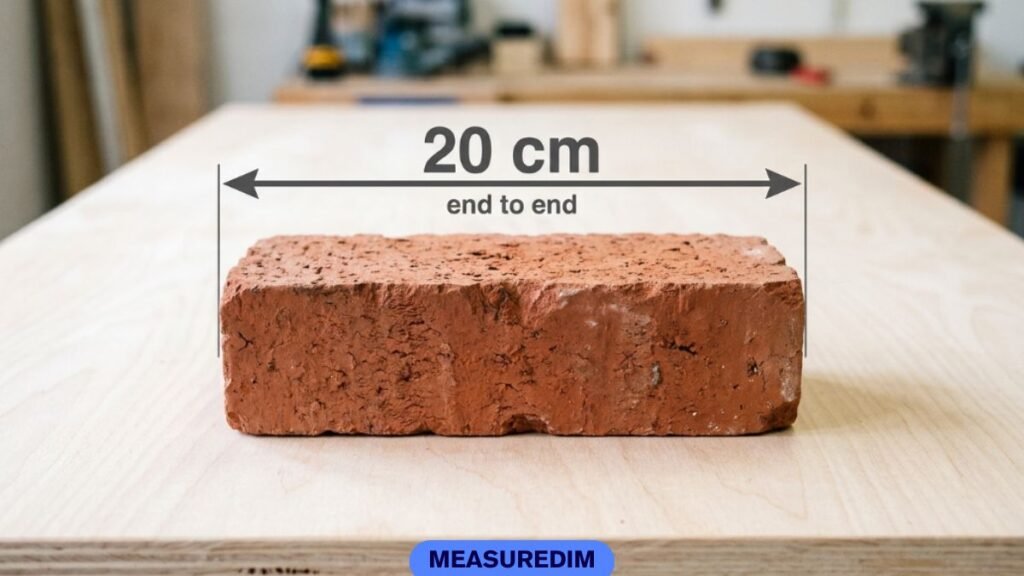
Brick length depends heavily on where you are. A US modular brick runs about 19.4cm long; a UK standard brick stretches to 21.5cm. Split the difference and you’re hovering right around 20cm — a tidy example of how region redefines the word “standard.”
Bricks make a solid outdoor reference for anyone doing garden or building work. Laid in a row, each one marks off roughly 20cm of ground, which turns pacing out a path or a flower bed into quick mental arithmetic.
The Whole List, Side by Side
Here’s every object above at a glance, with how it stacks up against a clean 20cm.
| Object | Real length | Compared to 20cm |
| 8-inch chef’s knife (blade) | 20.3 cm | Near-exact (a touch over) |
| Salad plate (diameter) | ~20 cm | Spot on |
| Medium ear of corn | ~20 cm | Spot on |
| Dinner fork | 19–20 cm | Spot on |
| iPad mini (long edge) | 19.5 cm | ~5mm under |
| DVD case (height) | 19 cm | ~1cm under |
| Unsharpened pencil | 19 cm | ~1cm under |
| Adult man’s hand (length) | 18–20 cm | Close |
| Large banana | 18–20 cm | Close (approx.) |
| A5 paper (long edge) | 21 cm | ~1cm over |
| House brick (length) | 19.4–21.5 cm | Region-dependent |
Guessing 20cm With No Ruler in Sight
When there’s no measuring tool nearby, your body and a few common objects will get you within a centimetre or two.
Your stretched hand span. Spread your fingers wide and measure from thumb tip to pinky tip. For a lot of adults that span is 20–22cm, so a slightly eased stretch is very close to 20cm. Calibrate it once against a ruler and you’ll carry a portable reference for life.
Two-thirds of a school ruler. A 30cm ruler shows 20cm exactly at its two-thirds point — the 20cm mark, obviously, but the proportion is the useful bit when you’re picturing it without the ruler present. Half of that ruler is only 15cm, a common slip-up.
Trim a sheet of paper. The short edge of A4 is 21cm (Letter paper is 21.6cm). Picture that width with a fingernail’s slice taken off and you’re at 20cm.
Stack what you know. Two credit cards laid long-edge to long-edge come to about 17cm — a little short — so add a thumb’s width to reach 20cm. Small anchors like this beat guessing from nothing.
Read Also: How Long Is 2 Meters? 9 Everyday Objects to Picture It
Where 20cm Quietly Shows Up in Real Life
This length isn’t random — it’s baked into a surprising number of products and standards.
In the kitchen, 20cm (8 inches) is the benchmark blade for a do-everything chef’s knife, which is why so many “starter” knives arrive at that size. In photography and framing, an 8×10-inch print is close to 20×25cm, and 20×20cm square frames are a metric-region staple. For houseplants, a 20cm (8-inch) pot is a go-to size, holding roughly 4–5 litres of soil for a medium plant.
The size also matters when you ship things: many carriers price or sort parcels by their longest dimension, and keeping a package under about 20cm often keeps it in the “small” bracket. And on the screen front, a 20cm diagonal works out to a roughly 7.9-inch display — precisely the small-tablet class the iPad mini occupies.
20cm vs Its Neighbours: 15cm and 25cm
Sizes are easiest to lock in when you see what sits either side of them.
Just below — 15cm (5.9 in): think a standard ballpoint pen, or half of a 30cm ruler. Set next to 20cm, that 5cm gap is clearly visible — 15cm looks noticeably stubbier.
Just above — 25cm (9.84 in): roughly a dinner plate’s diameter, or the reach of a large kitchen spoon. That’s about 10 inches, a full 5cm longer than our target and enough that you’d never confuse the two side by side.
For a wider frame of reference, 30cm is a single ruler and close to one foot — a full 50% longer than 20cm. Slotting 20cm between the pen at 15cm and the plate at 25cm gives your eye a scale it can trust.
The Mix-Ups People Make With 20 Centimetres
A few errors show up again and again with this measurement — here’s how to sidestep them.
Treating 20cm as exactly 8 inches. It’s 7.87 inches. A true 8 inches is 20.32cm, so the two differ by about 3mm. That’s harmless when you’re eyeballing a shelf and a real problem when you’re cutting timber.
Assuming a phone is 20cm. Most smartphones stand 14–17cm tall. A genuine 20cm device is small-tablet territory, not a phone — a fact worth checking before you use “phone-length” as a shorthand for 20cm.
Halving a 30cm ruler. Half of 30cm is 15cm, not 20cm. Twenty centimetres is the two-thirds mark. This one trips people up constantly.
Confusing length with area. 20cm is a straight line. It is not the same as 20 square centimetres, which describes a flat area — a distinction that matters the moment you move from measuring a length to covering a surface.
Quick Answers to Common 20cm Questions
How big is a 20 cm example?
A large banana or the blade of an 8-inch chef’s knife is about 20cm. So is a brand-new pencil.
How big is 20cm visually?
Picture a small notebook (A5) page or an iPad mini stood upright. Both sit right around 20cm.
What does 20 cm look like?
It looks like a salad plate’s width, or an ear of corn. It is just under 8 inches long.
What size is 20 cm in inches?
20cm equals 7.87 inches, or about 7⅞ inches. That is just under a full 8 inches.
How big is 20 cm compared to a human?
It matches an adult man’s hand, from wrist to fingertip. That is roughly 18–20cm long.
One Line to Remember 20cm By
By now you know how big is 20cm. It is 7.87 inches, or 200 millimetres. That is just under 8 inches. You can picture it in many easy ways. Think of a large banana. Think of the blade of a chef’s knife. Spread your hand wide, and that span comes close too. These simple objects turn a plain number into a real size you can see.
Now you can measure 20cm without a ruler. You can guess it at home, at school, or in a shop. Remember the chef’s knife and the banana as your guides. Keep the number 7.87 inches in your mind. With a little practice, you will spot 20cm fast. This small skill will help you every day.
Related Guides:
1: How Long Is 5 Meters? Feet, Cm & Real-World Examples
2: How Long Is a Foot? The Exact Length, Plus 10 Everyday Things to Compare It To
3: How Long Is 13 Inches? 7 Everyday Objects to Picture It
4: How Big Is 6mm? Size Examples You Can Actually Picture
5: How Big Is 9 Inches? Everyday Objects That Show You Instantly