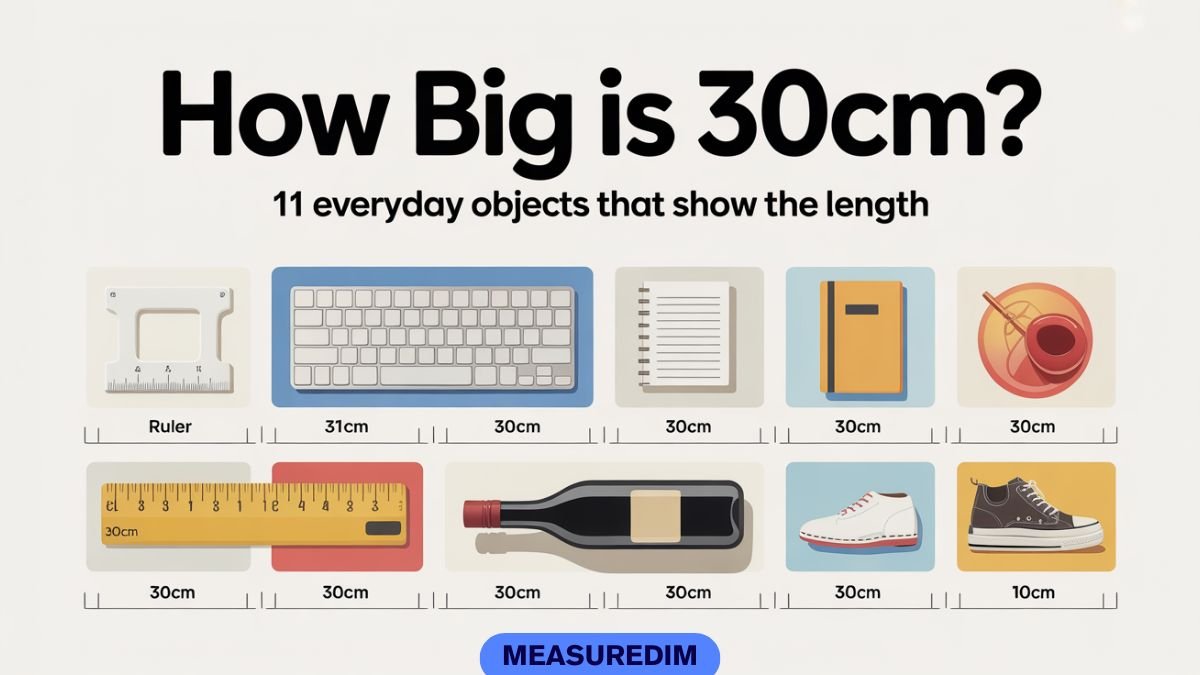
How Big Is 30cm? 11 Everyday Objects That Show the Length
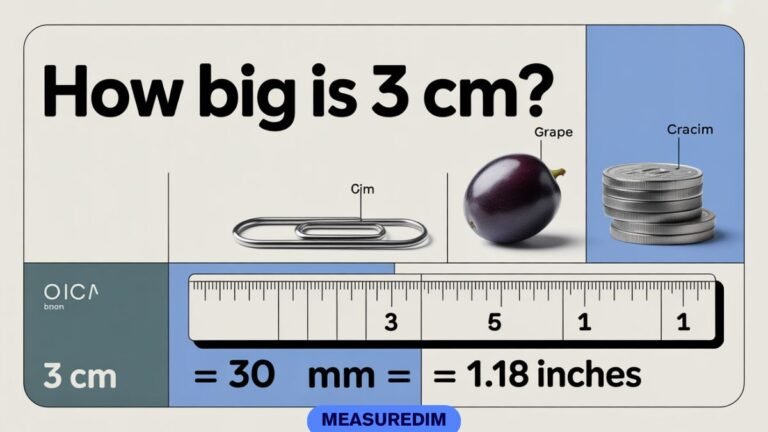
Thirty centimetres is a length just under one foot. It equals 11.81 inches, or 300 millimetres. Picture a standard school ruler, and you have it exactly.
Is it a foot? A hand? A dinner plate? Most people guess and get it wrong. The truth sits closer to home than you think.
You see 30cm every day without noticing. A vinyl record, a laptop’s width, and a wine bottle’s height all land near it. Learn one, and you can judge the rest by eye.
30cm, Summed Up in One Sentence
30cm is just under a foot — precisely 11.81 inches, or 300mm. The cleanest way to picture it: a standard school ruler, the width of a 13-inch laptop, or a wine bottle standing on the table.
That “just under a foot” bit matters, and most articles gloss over it. A true foot is 30.48cm, so 30cm falls about half a centimetre short. Close enough for eyeballing, worth remembering for anything precise.
Converting 30cm Into Every Unit You’ll Need
Here’s 30cm expressed across the metric and imperial systems, so whichever unit your project speaks, you’re covered.
| Unit | 30cm equals |
| Millimetres | 300 mm |
| Centimetres | 30 cm |
| Inches | 11.81 in |
| Feet | 0.98 ft |
| Yards | 0.33 yd |
| Metres | 0.30 m |
Keep the inch figure — 11.81 — in your back pocket. It’s the conversion people fumble most, usually by rounding straight to 12 and quietly losing 5mm.
What 30cm Actually Feels Like in the Hand
Spread your fingers wide and one adult hand span covers roughly 20cm. Now add another half a span and you’ve arrived at 30cm — a length that reads as substantial but still handheld. It’s bigger than a phone, longer than a dinner fork, and about the reach from your wrist to your elbow with a little to spare.
Think of it as the “about a foot” zone. Objects at this size feel like things you carry with one hand but couldn’t quite pocket. That intuition alone gets you within a couple of centimetres of correct, which is often all you need.
11 Everyday Things That Land Right at 30cm
Below are the most dependable real-world references for this length, from dead-exact to close-enough. Each entry notes whether it’s a precise match or an estimate — because honesty about tolerance is what separates a useful comparison from a misleading one.
The Classic 30cm Ruler
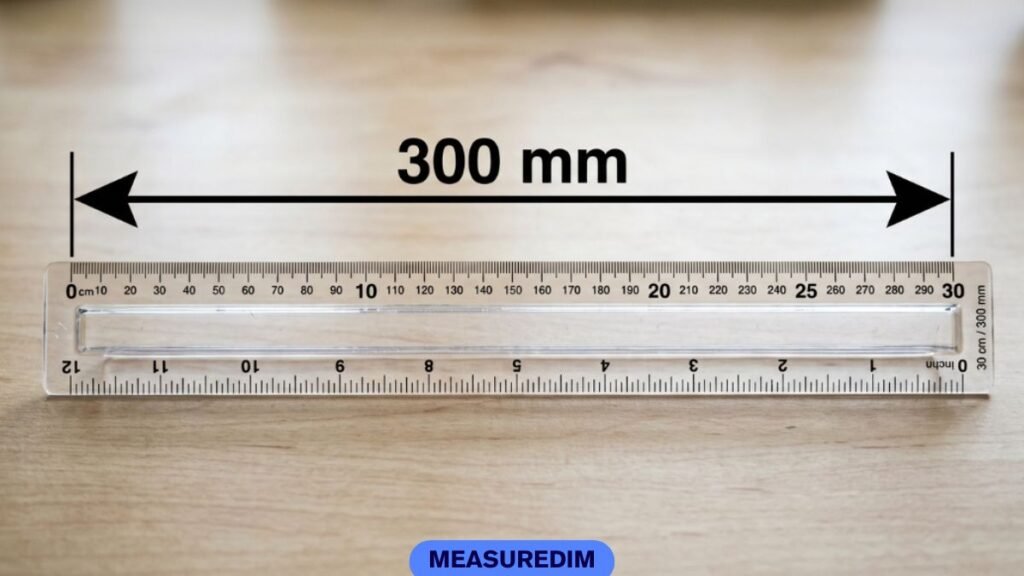
The humble school ruler is the one object engineered to be exactly this length. A standard 30cm ruler measures 300mm end to end — that’s its entire reason for existing. You’ll often see “12 inches” printed on the reverse, but twelve true inches is 30.48cm, so the stick is really a hair under a foot. Among everything on this list, it’s the single most exact 30cm reference you’re likely to own.
Because it’s purpose-made, it beats every other comparison for precision: no manufacturing drift, no “roughly.” Lay it flat and you’re staring at the literal definition of the length. When you need to check whether a parcel clears a 30cm shipping slot or a book fits a shelf gap, this is the object that settles the question in one glance.
A 12-Inch Vinyl Record
A full-size LP record is pressed to a nominal 12 inches, which works out to a manufactured diameter of about 302mm — call it 30.2cm across. Hold one by the edges and you’re gripping almost exactly the target length, rim to rim through the centre hole.
Records are rigid, flat, and scattered through second-hand shops and living rooms, which makes them an easy mental yardstick. Picture an album and you’ve pictured 30cm — though note the sleeve runs a touch larger at roughly 31.4cm square. This one’s genuinely handy when you’re judging whether a square picture frame or a floor tile shares that footprint.
Read Also: How Big Is 20cm? 11 Everyday Objects That Nail the Size
The Long Edge of an A4 Sheet
A sheet of A4 paper measures 210 × 297mm, so its long side is 29.7cm — a mere 3mm shy of the mark. It’s the closest everyday object to 30cm that also happens to sit on desks worldwide.
Nearly everyone has printer paper within arm’s reach, which is exactly what makes it such a practical stand-in. Stand a sheet on its short edge and the height it reaches is, for all intents, 30cm. I reach for this constantly to gut-check a box or drawer depth without hunting down a tape. One caveat: US Letter paper is shorter at 27.9cm, so this trick only works with A4.
A Standard Wine Bottle
A 750ml wine bottle in the classic Bordeaux shape stands roughly 30cm tall, with the real range landing somewhere between 29 and 32cm depending on the producer and the glass mould. The figure most people carry in their head is right around 30cm from base to the top of the cork.
Bottles work well precisely because they’re a familiar vertical object — you already know their weight and height by feel. Set one upright and you’ve got a living 30cm marker. This is my reference of choice for judging a shelf’s clearance or the height of a mid-size plant pot.
A 12-Inch Skillet
A frying pan sold as “12-inch” measures about 30.5cm across the top rim, though its flat cooking base is smaller — closer to 24–25cm. It’s the rim-to-rim span that lands near 30cm, so read the wider measurement, not the base.
Cast-iron and nonstick pans this size hang in most kitchens, making them an easy grab-and-compare. And because the figure is a diameter, it’s my go-to for picturing round things — a lampshade, a cake, a wall clock. Useful whenever you’re checking if a pan or serving dish will fit a drawer or a dishwasher rack.
A Subway Footlong
The footlong sandwich takes its name from a nominal 12-inch length, aiming it squarely at 30.5cm. In practice the baked bread often finishes a little shorter — sometimes nearer 29cm — because dough shrinks and portions wander. So treat it as “about 30cm,” not a calibrated instrument.
Food comparisons lodge in memory better than abstract numbers, which is the whole appeal. Next time one’s in front of you, note that end to end it’s essentially the 30cm mark, give or take. It’s a light-hearted but genuinely useful anchor for anything in the “roughly a foot” range.
The Width of a 13-Inch Laptop
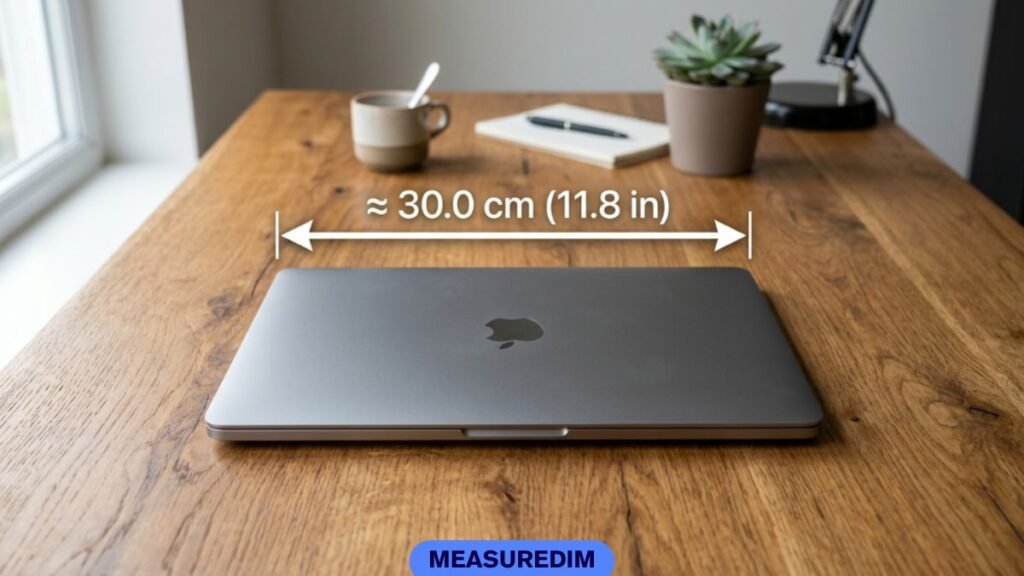
A 13-inch laptop measures roughly 30cm along its wide edge — a 13″ MacBook Air, for instance, spans 30.41cm. Remember the screen size is a diagonal; it’s the chassis width that happens to sit near 30cm.
Laptops are something you handle daily, so their width is easy to summon from memory. Close the lid, eyeball the long side, and that’s your 30cm. I lean on this when sizing up whether a laptop sleeve, a shelf, or a bag compartment will swallow a package of similar length.
A Standard 12×12 Tile
The common square floor or wall tile sold as 12×12 inches measures about 30.5cm on each side. Metric-cut tiles are frequently trimmed to an even 30cm, so either way a single edge is essentially the target length.
Tiles are dead flat and gridded, which makes them one of the most reliable references for both length and area. Picture a single kitchen or bathroom tile and you’ve fixed 30cm in your mind. This one earns its keep during DIY, where spacing, layout, and coverage all key off that per-tile dimension.
An English Cucumber
The long, thin-skinned English (telegraph) cucumber typically grows to 30–35cm, and plenty land right at 30cm. This is the wrapped, seedless variety in the produce aisle — not the stubby field cucumber, which is considerably shorter.
Produce makes for surprisingly good rulers because you can hold it and feel the length in your hand. Lay one on the counter and it spans about a foot. It’s the reference I reach for when explaining 30cm to a child — tangible, familiar, and roughly right without any measuring at all.
A Large Dinner Plate
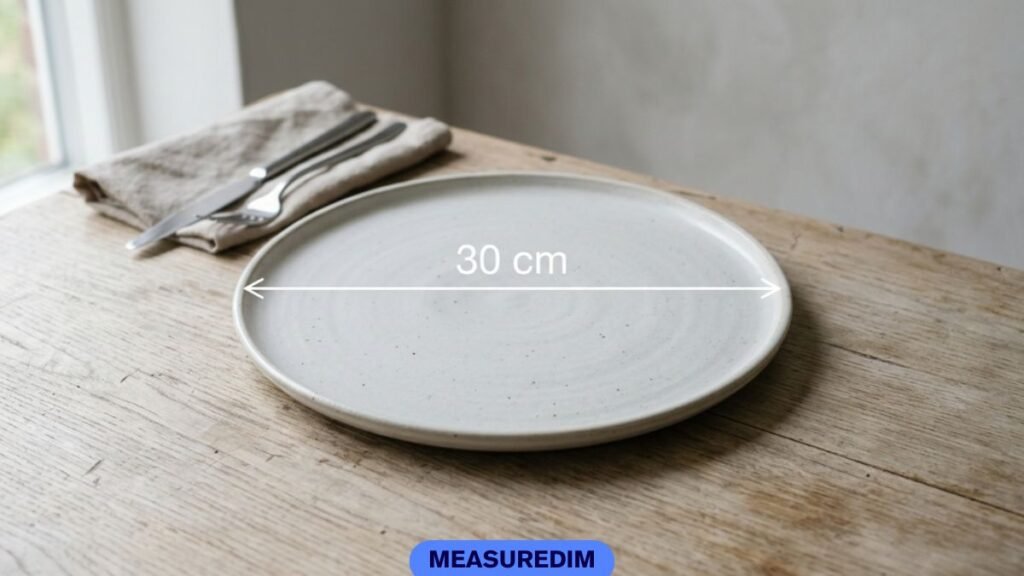
A generous dinner plate runs about 28–30cm across, and a full charger (service) plate pushes further to 30–33cm. The upper end of the dinner-plate range sits right at 30cm in diameter.
Plates give you an instant sense of a 30cm circle rather than a straight line — exactly what you want for round objects. Everyone can call a dinner plate to mind on demand. I use it to gauge things like the spread of a small pendant light or whether a round tray will slide into a cabinet.
A Tall Adult’s Foot
The foot of a tall adult — around a men’s US size 13 — measures close to 30cm heel to toe. The shoe itself runs longer, usually 31–32cm, because there’s breathing room built in past the toes, so measure the bare foot, not the sneaker.
Your own body is the one reference you can never leave at home, so knowing where your foot lands against 30cm is quietly useful. Measure yours once and you’ll always have a rough ruler underfoot. It’s my trick for pacing out a length on the floor when nothing else is within reach.
The 30cm Object Cheat Sheet
A scannable roundup of everything above, with each object’s real dimension and how tight the match is.
| Object | Measurement | Match |
| 30cm ruler | 30.0 cm | Exact |
| 12-inch vinyl LP | 30.2 cm (diameter) | Very close |
| A4 sheet, long edge | 29.7 cm | Very close |
| Wine bottle (750ml) | ~30 cm (29–32) | Approximate |
| 12-inch skillet | 30.5 cm (rim) | Close |
| Subway footlong | ~30 cm (nominal 30.5) | Approximate |
| 13-inch laptop width | ~30.4 cm | Close |
| 12×12 tile | 30.5 cm | Close |
| English cucumber | 30–35 cm | Approximate |
| Large dinner plate | 28–30 cm (diameter) | Approximate |
| Tall adult foot | ~30 cm | Approximate |
No Ruler Handy? Measure It With Your Body
When there’s no tape in the drawer, a few built-in references get you very close to 30cm:
- A sheet of A4 paper. Its long edge is 29.7cm — the most accurate no-tool method most people have on hand. Lay two side by side for a quick 60cm.
- One and a half hand spans. A spread adult hand covers roughly 20cm thumb-tip to little-finger-tip. A span and a half lands you at about 30cm.
- Two banknotes end to end. A US bill is 15.6cm long, so two laid nose to tail reach about 31cm — a whisker over 30cm, so mentally trim a hair.
- Three and a half credit cards. A card’s long side is 8.56cm; line up three and a half and you’re at 30cm almost exactly.
- Your forearm, roughly. Wrist crease to elbow is about 25–27cm on most adults — a little short of 30cm, but a decent ballpark in a pinch.
Calibrate one of these against a real ruler once, and you’ll carry a surprisingly accurate 30cm gauge with you everywhere.
Read Also: How Big Is 14 Inches? Real Objects That Show You the Size
Why 30cm Isn’t Quite a Foot
This is the trap that catches people out. A foot is 30.48cm (12 inches); 30cm is 11.81 inches, or 0.98 of a foot. The gap is small — about 4.8mm, roughly 3/16 of an inch — but it’s real.
For eyeballing a shelf or a sandwich, treating them as equal is fine. The problem shows up when you repeat the measurement. Stack ten “30cm” units and you’ve got 300cm; ten actual feet is 304.8cm. That’s nearly 5cm of drift over a short run — enough to misalign shelving, flooring, or a row of framed prints. Whenever accuracy compounds, respect the difference.
How 30cm Compares to the Sizes Just Below and Above
Slotting a length between its neighbours makes it easier to judge on sight.
- 25cm (9.84 in) — think the long edge of a 10-inch tablet, or a medium side plate. Noticeably more compact than 30cm; it reads as “a hand and a bit.”
- 30cm (11.81 in) — our subject: about a foot, a laptop’s width, a wine bottle’s height.
- 40cm (15.75 in) — picture a 16-inch pizza’s diameter, or the width of a chunky 17-inch laptop. Clearly larger, edging into “two-handed carry” territory.
Anchoring 30cm between a tablet and a large pizza gives your eye a range to interpolate against, which is exactly how quick estimation works.
Where the 30cm Mark Shows Up in Real Life
This length isn’t arbitrary — it’s a threshold that recurs across everyday design and logistics:
- Shipping and storage. Many small-parcel size tiers and cube-storage compartments are built around a 30cm dimension, so a box side at this length is a common packing constraint. [INTERNAL LINK: standard shipping box sizes]
- Shelving and furniture. A large slice of bookshelf and cabinet depths cluster right around 30cm, comfortably fitting books, plates, and most small appliances.
- Screens and tech. Mid-size laptops and larger tablets live near this width, which is why 30cm sleeves and stands are so common.
- Kitchen kit. Pans, plates, and platters routinely hit 30cm, standardising drawers, racks, and cabinets around it.
- Gardening and DIY. Row spacing, pot heights, and tile grids frequently use 30cm as a convenient round unit.
Slip-Ups People Make Judging 30cm
A handful of predictable errors throw estimates off. Sidestep these and you’ll be right far more often.
- Calling it a clean foot. As covered, 30cm is ~5mm short of 12 inches. Fine for a guess, costly when repeated.
- Trusting every “12-inch” label. Some 12-inch products are a true 30.48cm, some are cut to exactly 30cm, and a few (that footlong) quietly run under. The name is a starting point, not a guarantee.
- Mixing up diameter and length. A plate or pan’s 30cm is measured across, not around the edge. Use round references for spans, not perimeters.
- Grabbing the wrong paper. A4 works (29.7cm); US Letter doesn’t (27.9cm). Check which one you’re holding before you trust the trick.
- Reading the inch face of a ruler. Flip to the centimetre side, and confirm the “30” you’re eyeing isn’t 30 inches on a longer rule.
Questions People Actually Ask
How much does 30 cm look like?
It looks like a school ruler, a 13-inch laptop’s width, or a wine bottle standing upright — just under one foot long.
What size is 30cm in inches?
30cm equals 11.81 inches, which is a little less than a full 12-inch foot.
Is 30 cm big?
It is a medium, everyday length — bigger than a phone, about the size of a large dinner plate, but far smaller than a person.
Is 30cm exactly 12 inches?
No. 12 inches is 30.48cm, so 30cm falls about 5 millimetres short of a full foot.
How long is 12 inches visually?
It looks like a standard 12-inch ruler or a footlong sandwich — roughly the length from your wrist to your fingertips.
Locking 30cm Into Memory
So now you know how big is 30cm. It is a little less than one foot. It measures 11.81 inches, or 300 millimetres. A school ruler shows this length exactly. A vinyl record, a laptop’s width, and a wine bottle all sit close to it too. Keep just one of these objects in your mind. That way, you can guess this length any time, even without a ruler.
Remember one small point about how big is 30cm. It is not a full foot. A foot measures 30.48 centimetres, so 30cm falls about 5 millimetres short. This tiny gap grows larger when you repeat it many times. For quick guesses, you may treat them as the same. For careful work, respect the difference. Now you can picture this length with ease and confidence.
Related Guides:
1: How Long Is 2 Meters? 9 Everyday Objects to Picture It
2: How Long Is 5 Meters? Feet, Cm & Real-World Examples
3: How Long Is a Foot? The Exact Length, Plus 10 Everyday Things to Compare It To
4: How Long Is 13 Inches? 7 Everyday Objects to Picture It
5: How Big Is 6mm? Size Examples You Can Actually Picture