How Big Is 6mm? Size Examples You Can Actually Picture
6mm is a small length equal to six millimetres. It is just under a quarter of an inch. In centimetres, that comes to 0.6 cm.
Ever tried to picture 6mm and drawn a blank? You are not alone here. It sounds tiny, yet it shows up more than you think.
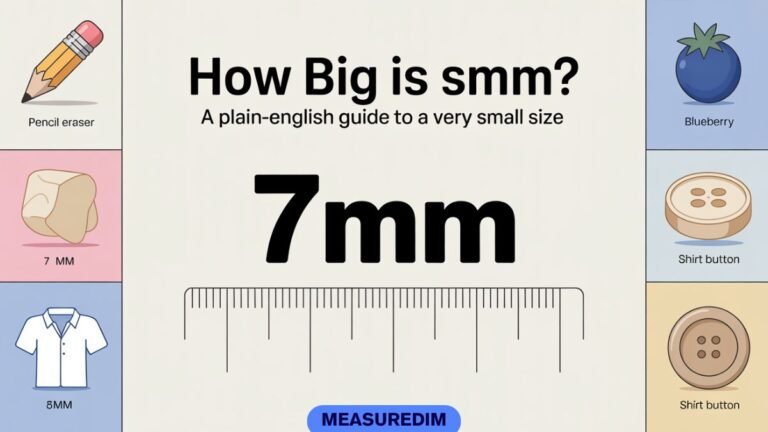
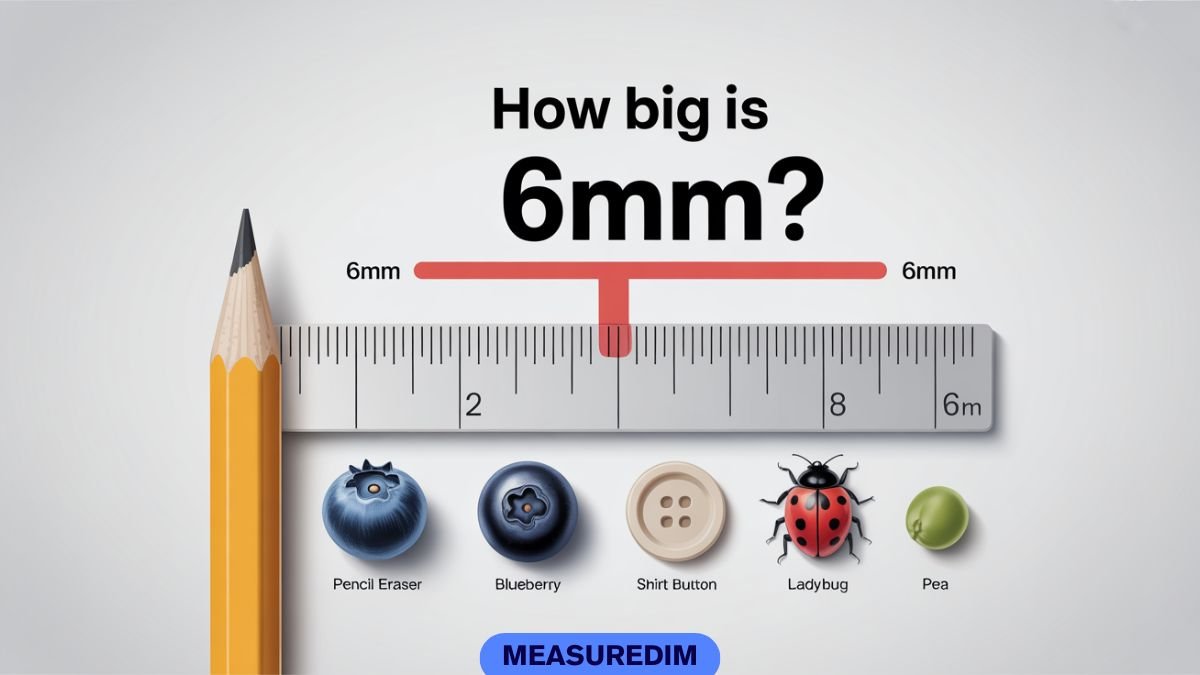
You can see 6mm as one airsoft BB or a pencil eraser. It also matches four pennies stacked together. Beads, bolts, and bands often use this size too.
The Short Answer
6mm is just under a quarter of an inch — 0.24 in, to be precise, or 0.6 cm. Hold up a standard pencil-top eraser, a single airsoft BB, or a stack of four pennies, and you’re looking at roughly 6mm. It’s small enough to sit comfortably on your fingertip, but big enough that you’d notice it as a bead, a bolt, or a band.
If you remember one anchor, make it this: 6mm ≈ a hair less than ¼ inch. A true quarter inch is 6.35mm, so 6mm falls a whisker short of it.
6mm in Every Unit You Might Need
Here’s the full conversion set so you never have to reach for a calculator mid-project.
| Unit | 6mm equals |
| Centimetres | 0.6 cm |
| Metres | 0.006 m |
| Inches (decimal) | ≈ 0.236 in |
| Inches (fraction) | ≈ 15/64 in (just shy of ¼ in) |
| Feet | ≈ 0.0197 ft |
| Yards | ≈ 0.00656 yd |
A quick sanity check on the imperial side: since 1 inch = 25.4mm, dividing 6 by 25.4 gives 0.236 in. Multiply that by 64 and you land at almost exactly 15/64 — which is why hardware charts often list 6mm and 15/64″ side by side.
What 6mm Actually Feels Like
Picture the thickness of a stack of about eight credit cards, or the width of the eraser plug on the end of a wooden pencil. That’s the scale. It’s a measurement you can pinch between thumb and forefinger and still feel a definite gap — not a paper-thin sliver like 1mm, but nowhere near the chunk of a 1cm marble.
The reason 6mm trips people up is context. As rainfall it’s a wet-but-ordinary afternoon. As a wedding-band width it reads as bold and masculine. As a kidney stone or a nodule on a scan it can feel alarmingly large. Same number, wildly different emotional weight — which is exactly why a physical reference helps more than the digits do.
Everyday Things That Measure Right Around 6mm
These are the references I reach for when I need to explain 6mm to someone without a ruler in the room. Each one is either a dead-on match or close enough to bracket the size honestly.
A Single Airsoft BB
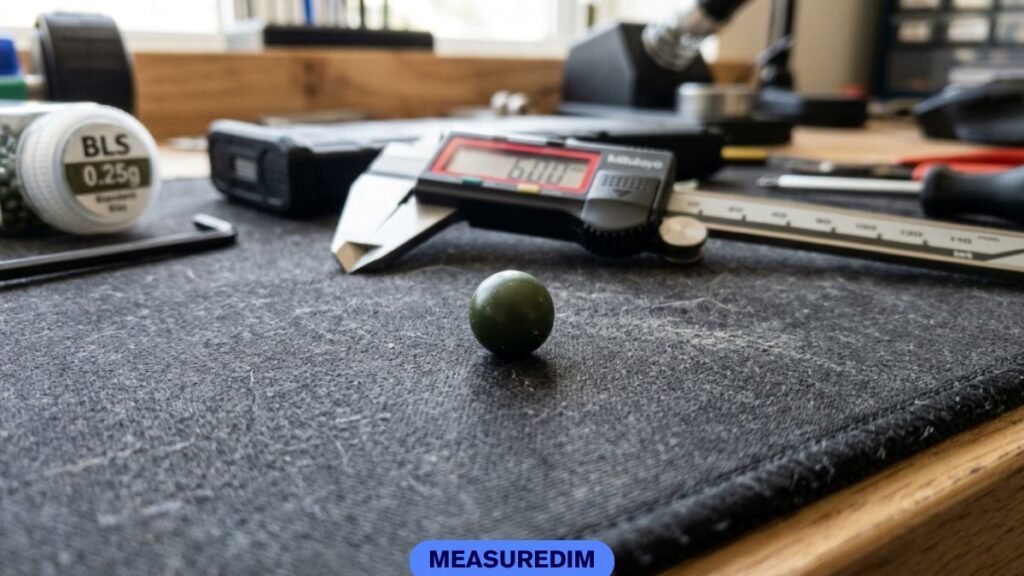
Standard airsoft BBs are manufactured to a 6mm diameter — it’s the industry baseline, moulded to tight tolerances so the pellets feed cleanly through the barrel. This isn’t an approximation; 6mm is the spec printed on the bag. One BB balanced on your fingertip is the cleanest live demo of the size you’ll find.
What makes this reference so useful is its consistency. Rice grains vary, peas vary, but a 6mm BB is a 6mm BB in every brand and every colour. If you’ve ever handled one, you already have a permanent mental yardstick for six millimetres — pull it out any time a spec sheet or a bead listing quotes 6mm and you’ll know instantly whether it’s bigger or smaller than you pictured.
The Leg of a Standard Office Staple
Open a box of the most common staples — the ones labelled 26/6 or 24/6 — and that second number is the giveaway: the legs are 6mm long before they bend. It’s a genuine engineering dimension, not a rough guess, which makes a loose staple a surprisingly precise pocket ruler.
I like this one because staples are everywhere and the measurement is baked into the product name. Straighten a leg out and lay it flat, and you’ve got a certified 6mm segment to compare against a bead, a screw, or a hole in a bracket. It’s the reference I use most often at a desk.
Read Also: How Big Is 9 Inches? Everyday Objects That Show You Instantly
Four Pennies Stacked (or Three Nickels)
A US penny is 1.52mm thick, so four of them stacked reach about 6.1mm — a fraction over our target. Prefer nickels? Each is 1.95mm, and three stacked come to roughly 5.9mm, a fraction under. Between those two little towers, 6mm sits almost perfectly in the middle.
This is my favourite “prove it to yourself” trick because nearly everyone has loose change. Build the stack, pinch it, and you’ve physically bracketed 6mm from both sides — just over with pennies, just under with nickels. It’s especially handy when you’re eyeing something like a 6mm gemstone or gauge and want a tangible feel for the height. [IMAGE: four pennies stacked next to a ruler showing ~6mm]
A Pencil-Top Eraser
The little pink plug eraser on the end of a wooden pencil usually measures 6 to 7mm across — so its diameter lands right at, or a touch over, 6mm. Manufacturing varies slightly between brands, which is why I give it as a narrow range rather than a single figure.
Because a pencil is the single most universal object in any classroom, office, or junk drawer, this is the reference I hand to kids and to anyone learning the metric system. “About as wide as the eraser on your pencil” turns an abstract number into something they can literally hold. Just remember it’s the eraser — the graphite lead inside is only 2mm, a common mix-up worth flagging.
The Hole a Single-Hole Punch Makes
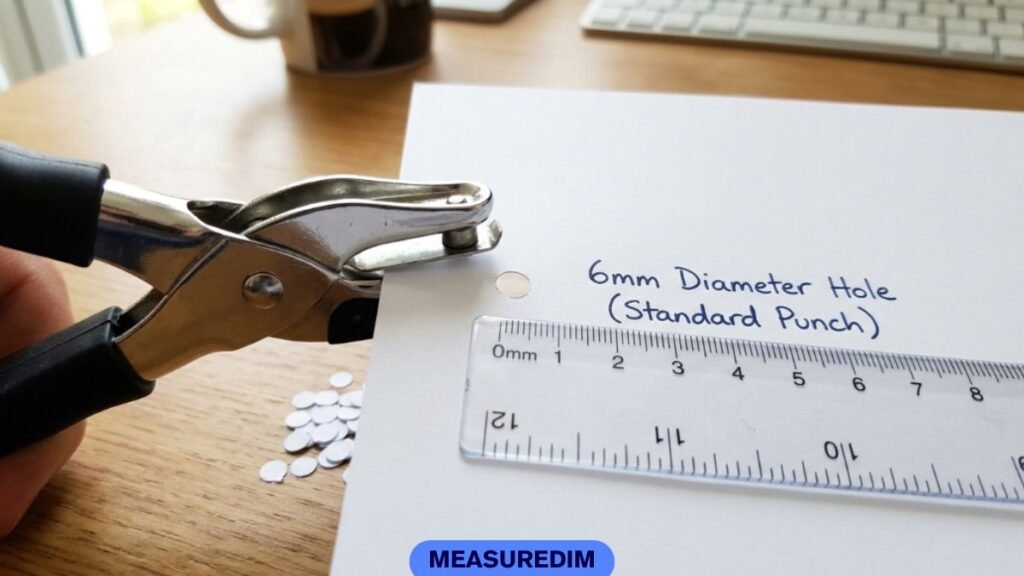
Reach for a standard office hole punch and the round it stamps out is close to 6mm in diameter on metric-spec models. (Some US-market punches cut a quarter inch, which is 6.35mm — near enough for eyeballing but not identical, so I’d call this one approximate.)
The reason it earns a spot: the punched holes and the little paper dots that pile up are both handy, repeatable stand-ins. Save one dot and you’ve got a flat 6mm circle to hold against anything you’re sizing. It’s a great cue when you’re picturing a 6mm grommet, eyelet, or drilled pilot hole.
An M6 Bolt or Screw
In metric hardware, the “M6” designation means a nominal 6mm major thread diameter — the outer width across the threads. Measure across an M6 fastener and you’ll read right around 6mm (the shank sits just under, the thread crests just over, which is normal for how threads are cut).
If you do any flat-pack furniture, bike maintenance, or general DIY, an M6 bolt and its matching 6mm hex key are probably already in your toolbox. That makes them a reliable, always-on-hand reference — and a reminder that 6mm is a workhorse size in the hardware world, not some obscure fraction.
A Grain of Long-Grain Rice
A single uncooked grain of long-grain white rice runs about 6 to 8mm end to end, so its length hovers right at the top of our 6mm zone — call it approximate, leaning slightly long. Its width, by contrast, is only around 2mm, so orientation matters when you use it.
Rice works as a reference precisely because it’s small and familiar: line a grain up against a bead or a stone and you get an instant read on whether you’re above or below 6mm. Just treat it as a soft guide rather than a precise one, since grain length genuinely varies by variety and even within the same bag.
A Regular Drinking Straw (Across)
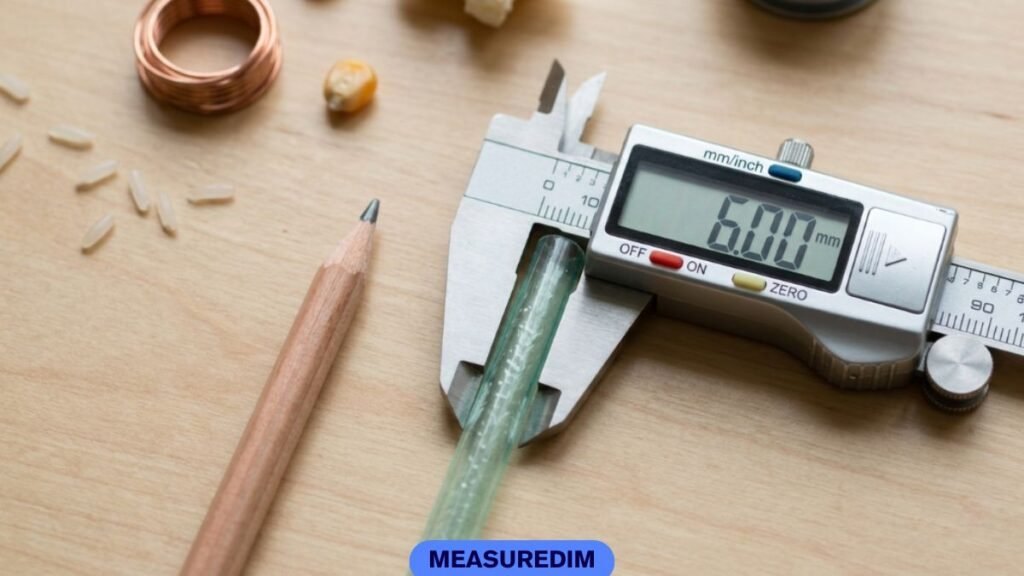
The everyday plastic or paper straw — not the fat smoothie kind — has an outer diameter of roughly 6mm. Slide one between your fingers and that circular cross-section is a decent live model of the size. (Thin juice-box straws run smaller, around 4–5mm; jumbo straws jump to 8mm or more, so specify the regular kind.)
I mention straws because the cylindrical shape adds something the flat references can’t: it shows you 6mm as a round dimension, which is how the size most often shows up in real life — bolts, beads, tubing, cords. Picture a straw’s bore and you’ve got a feel for 6mm as a diameter, not just a gap.
Side-by-Side: The 6mm Reference Table
| Object | Real measurement | How it maps to 6mm |
| Airsoft BB (diameter) | 6.0 mm | Exact match |
| Standard staple leg (26/6) | 6.0 mm | Exact match |
| M6 bolt thread | ~6 mm nominal | Nominal match |
| Four pennies stacked | ~6.1 mm | Just over |
| Three nickels stacked | ~5.9 mm | Just under |
| Hole-punch hole | ~6 mm | Approximate |
| Pencil-top eraser (diameter) | 6–7 mm | At to slightly over |
| Regular drinking straw (outer) | ~6 mm | Approximate |
| Long-grain rice (length) | 6–8 mm | Slightly over |
| Garden pea (diameter) | 7–9 mm | Noticeably over |
Gauging 6mm When There’s No Ruler Around
You rarely have a scale handy at the exact moment you need one, so here’s how to fake it convincingly:
- Use a pencil. The eraser plug is ~6–7mm across, and the whole hexagonal barrel is about 7mm — so 6mm is a hair under the pencil’s thickness.
- Pinch a change stack. Four pennies (just over) or three nickels (just under) bracket 6mm neatly. Build whichever you have.
- Grab a staple. Straighten one leg from a 26/6 box and you’re holding a certified 6mm rod.
- Eyeball a straw. A regular straw’s diameter is your round-shape reference for beads, cords, and tubing.
None of these needs a tool, and each one is repeatable. The change-stack method is the one I trust most because it brackets the target from both directions — over and under — instead of relying on a single squishy estimate.
Read Also: How Long Is 3 Meters? A Visual Guide With Real Objects
Where 6mm Actually Turns Up
This is a size that punches above its weight in the real world:
- Jewellery and beads. 6mm is a standard bead size and a popular men’s wedding-band width — substantial without being chunky.
- Hardware. M6 bolts, 6mm hex (Allen) keys, and 6mm drill bits are everyday shop staples.
- Sheet materials. 6mm plywood, MDF, and acrylic are common stock thicknesses, roughly the metric stand-in for quarter-inch board.
- Airsoft. The 6mm BB is the sport’s default ammunition.
- Body jewellery. A 6mm plug sits around the “2 gauge” mark on stretched-ear charts.
- On a scan. If a doctor has described a stone, cyst, or nodule as 6mm, the references above are purely to help you visualise the size — think a pencil eraser, not a diagnosis.
6mm Versus the Sizes Just Below and Above
Numbers make more sense with neighbours to compare against.
Step down to 5mm and you’re at a peppercorn, a standard 5mm LED, or a slightly smaller bead — a full millimetre shorter, which is genuinely noticeable at this scale. Nudge up to 6.35mm and you hit an exact quarter inch, the imperial size 6mm is so often confused with. Reach 8mm and objects grow clearly plumper — a garden pea, a jumbo straw, a stack of four nickels. Framed this way, 6mm reads as the “just under a quarter inch, comfortably bead-sized” sweet spot.
Mix-Ups Worth Avoiding
A few honest traps catch people out with this measurement:
- 6mm is not 6cm. They’re a factor of ten apart — 6cm is 60mm, roughly the width of a golf ball. Sliding the decimal by mistake is the single most common 6mm error.
- 6mm is not exactly a quarter inch. A true ¼ inch is 6.35mm. Close for eyeballing, wrong for precision drilling or machining.
- Don’t confuse the pencil with its lead. The eraser and barrel are ~6–7mm; the graphite core inside is only 2mm. Pick the right part when you use a pencil as a ruler.
- Rice and peas aren’t precision tools. They vary by type and season — great for a ballpark, unreliable for anything exact.
Quick-Fire Q&A
What does 6 mm look like in size?
It looks like a small dot just under a quarter inch, about as wide as a pencil-top eraser.
What does a 6mm look like?
Picture one airsoft BB or four pennies stacked together — that round, fingertip-sized shape is 6mm.
What is 6 mm comparable to?
It matches an airsoft BB, a 26/6 staple leg, or a regular drinking straw’s width.
Is 6mm big or small?
It is small overall, roughly a fingertip’s thickness, though it feels bigger as a bead or band.
Is 6mm very big?
No, 6mm is not very big — it sits just under a quarter inch, a modest everyday size.
Lock It In With One Image
So now you know how big is 6mm. It is a small size, just under a quarter of an inch. That equals 0.6 cm. You can picture it as one airsoft BB or the eraser on a pencil. You can also stack four pennies to reach the same height. These easy tricks help you see the size in your mind. You do not need a ruler to gauge it.
Keep one simple object in your memory as your guide. A pencil eraser works well for most people. Next time a bead, bolt, or band shows 6mm, you will know its size at once. You will also spot the small gap between 6mm and a true quarter inch. This small skill makes shopping and DIY tasks much easier.
Written by a measurements editor who checks every conversion against real object dimensions before it goes live.
Related Guides:
1: How Big Is 8 mm? A Clear, Real-World Size Guide
2: How Big Is 5 mm? Everyday Objects That Show the Size
3: How Big Is 3 mm? Real-World Objects and Quick Conversions
4: How Big Is 2mm? A Down-to-Earth Guide to Picturing Two Millimeters
5: How Long Is 20 Inches? 10 Everyday Objects to Picture It