How Big Is 8 mm? A Clear, Real-World Size Guide
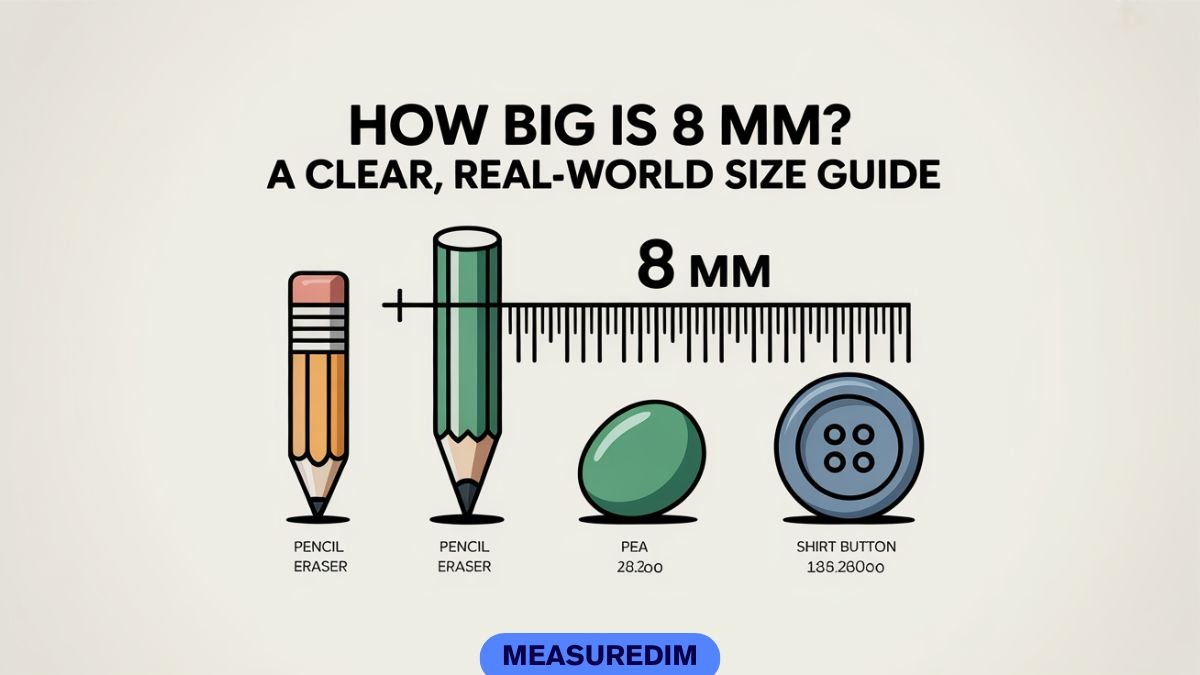
Eight millimeters is a small length. It equals 0.8 centimeters, or just over 5/16 of an inch. Think of a single pea, a pencil’s width, or a small pearl.
Ever read “8 mm” on a bead, a bolt, or a scan and felt lost? The number means nothing until you match it to something real. Once you do, you’ll spot this size in a heartbeat.
You meet 8 mm more often than you think. It shows up in pearls, beads, M8 bolts, and old film. This short size is easy to picture once you have the right everyday objects in mind.
The Short Answer: 8 mm at a Glance
Eight millimeters is 0.8 centimeters, or just over 5/16 of an inch (0.315 in to be precise). Picture the width of a standard wooden pencil, a single garden pea, or a classic 8 mm pearl — all of them hover right around this size. It’s small enough to sit comfortably on a fingertip, but big enough to pick up without tweezers.
That’s the whole answer. The rest of this page shows you why those comparisons hold up and how to eyeball 8 mm when you don’t have a ruler nearby.
8 mm Converted Into Every Unit You Need
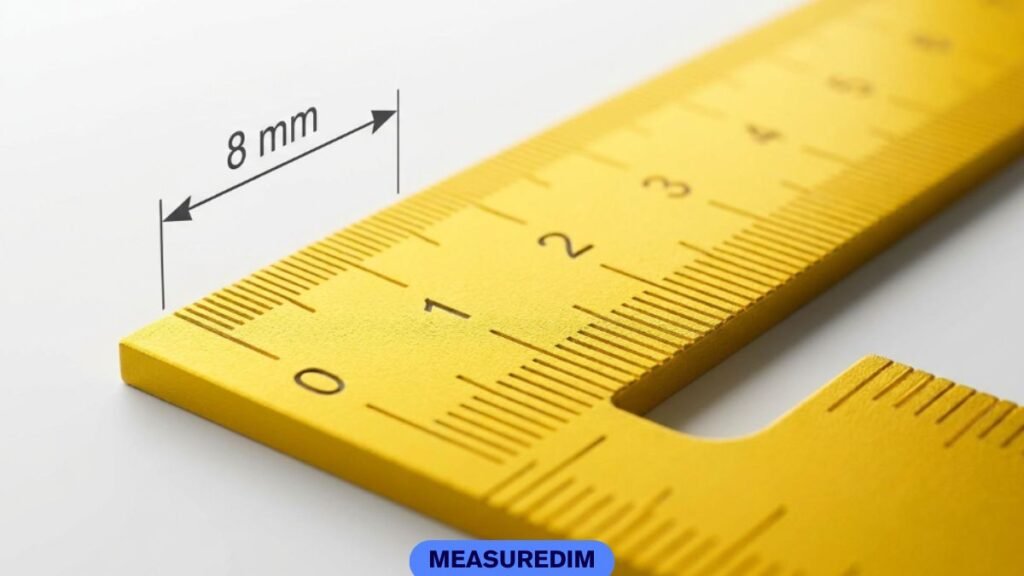
Millimeters live in the metric system, so the clean conversions are the metric ones. The imperial values are where people slip up, so I’ve kept them exact.
| Unit | 8 mm equals |
| Millimeters | 8 mm |
| Centimeters | 0.8 cm |
| Meters | 0.008 m |
| Inches | 0.315 in (≈ 5/16 in) |
| Feet | 0.026 ft |
| Yards | 0.0087 yd |
One number to memorize: 8 mm = 0.8 cm, not 8 cm and nowhere near 1 cm. And in imperial terms, it’s a hair wider than 5/16 inch — since 5/16 in works out to 7.94 mm, an 8 mm object is fractionally bigger. Close enough that a 5/16 socket and an 8 mm socket are famously easy to mix up, but not identical.
What 8 Millimeters Actually Feels Like
Hold your hand up and look at the width of your little fingernail — for most adults that’s roughly 8 to 10 mm. That’s the scale we’re working with: something you can pinch between thumb and forefinger and still see clearly.
Eight millimeters is the sweet spot between “grain of sand” small and “coin” big. It reads as a small bead, a chunky seed, a bolt you’d tighten by hand. Nothing at this size disappears on you, but nothing at this size feels substantial either. Once you’ve matched it to a couple of objects below, you’ll spot 8 mm instantly.
Everyday Things That Are Right Around 8 mm
Each item below sits within a millimeter or so of the target. I’ve flagged which ones are exact (sold or specced at 8 mm) and which are close approximations.
A Standard Wooden Pencil
Measure a regular hexagonal pencil across its widest points — corner to corner — and you’ll land at about 8 mm (roughly 7 mm across the flat faces). That’s the barrel of the pencil itself, not the graphite core inside, which is far thinner. Grab any yellow #2 pencil off a desk and you’re holding a live 8 mm ruler.
This is my favorite reference because pencils are everywhere and their dimensions barely vary between brands. Rest the pencil flat and eyeball the width; whatever spans that gap is your 8 mm. It’s genuinely useful when you’re shopping online for beads or hardware and need to sanity-check a listed size against something in the room.
Read Also: How Big Is 5 mm? Everyday Objects That Show the Size
A Classic 8 mm Pearl
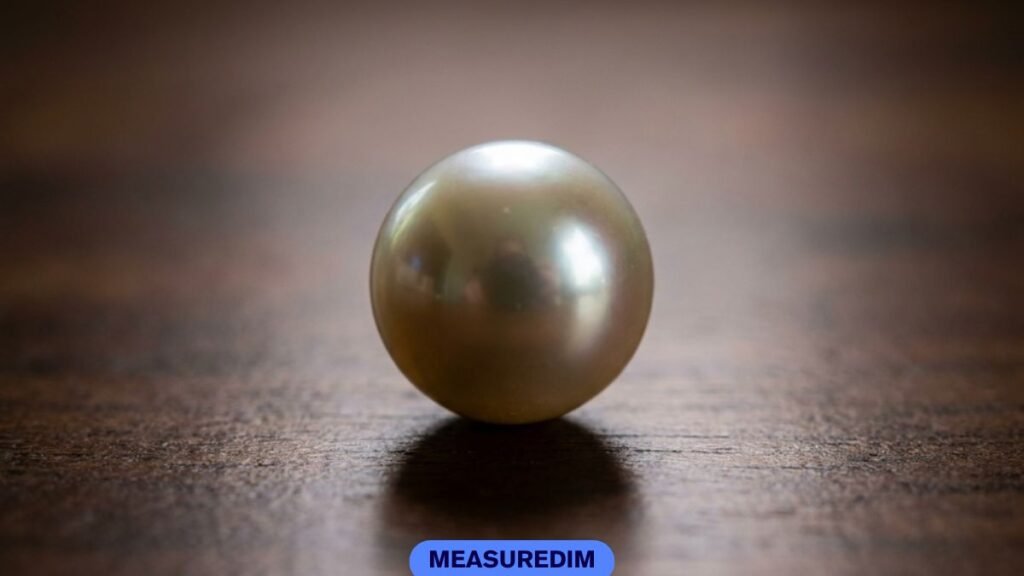
Pearls are graded and sold by diameter in millimeters, and 8 mm is one of the most popular sizes for a strand necklace or a pair of studs. Because the number is the measurement, this is an exact match rather than an estimate. An 8 mm pearl looks generous on the ear without tipping into costume-jewelry territory.
If you’ve ever handled pearl jewelry, this gives you a stored mental image you can recall on demand. Jewelers rely on it constantly — a customer asking to “size up” from 7 mm to 8 mm is asking for a difference you can barely feel but can definitely see.
A Fresh Garden Pea
A fresh green pea straight from the pod usually measures 7.5 to 9 mm across, most commonly right around 8 mm. It’s an approximate reference — peas aren’t machined to spec — but it’s a reliable one because the range is so tight. Frozen peas run a touch smaller; garden-fresh ones sit dead center.
Everyone has held a pea, which is what makes it stick. Next time you’re portioning something small in the kitchen, glance at a single pea and you’ve got 8 mm in your hand. It’s the comparison I reach for when explaining bead sizes to someone who’s never bought jewelry.
A Single Chocolate Chip
A standard baking chocolate chip is about 8 to 9 mm wide at its base and roughly 8 mm tall. Call it a close approximation — chips vary by brand and melt out of shape — but a typical morsel is a solid stand-in. Turn one point-up and the base spans almost exactly our target.
I like this one because it’s so concrete: pour a handful out and you’re looking at a pile of 8 mm blobs. It’s handy when you want a quick gut-check for something like an 8 mm gemstone or cabochon and there’s a bag of chips in the cupboard.
A Dried Corn or Popcorn Kernel
An un-popped popcorn kernel measures close to 8 mm along its longest axis. This is a near-exact everyday match and a fun one, because the same kernel that looks so small in the bag is right at our reference size. Field-corn kernels land in the same ballpark.
Kernels are worth remembering precisely because they seem smaller than 8 mm at a glance — which corrects the instinct to underestimate this measurement. Line a few up and you’ll trust the number more. Useful anytime your eye tells you “that can’t be 8 mm” and you need proof it can.
The Shaft of an M8 Bolt
In metric hardware, an M8 bolt has a nominal thread diameter of exactly 8 mm — the “8” in the name is the outer size of the threads. This is as exact as references get. An M8 is a common mid-size bolt for furniture, bike parts, and machinery.
If you’ve got a toolbox, this is your calibration standard. The matching 8 mm and 6 mm nuts, drill bits, and hex keys give you a whole graduated set to compare against. Anyone assembling flat-pack furniture has probably held 8 mm without realizing it.
A Wide Men’s Wedding Band
Ring bands are measured by their width, and 8 mm is a common choice for a bold men’s wedding band — noticeably wider than the slim 2–4 mm bands, without looking oversized. Since it’s a spec you order to, treat it as exact. Slide one on and the metal covers a broad strip of the finger.
Ring width is one of those numbers people obsess over online without a way to picture it, so this comparison earns its place. If a band feels “chunky” in a photo, 8 mm is often why.
A Grain of Basmati Rice (Lengthwise)
A single grain of long, slender basmati rice runs about 7 mm end to end, occasionally nudging 8 mm — so this is a slight underestimate of our target rather than a bullseye. Shorter rice varieties are stubbier and won’t work; it’s the long-grain types that get close.
It’s a good tie-breaker reference for the very small end of things, and it usefully shows that 8 mm is longer than a rice grain — a helpful anchor when a listed size feels ambiguous. Reach for it when a pea or pearl feels too round to compare against a long, thin object.
A Seven-Spot Ladybird
A common seven-spot ladybird (ladybug) measures roughly 6 to 8 mm in body length, with the bigger individuals right at our mark. It’s an approximate, living reference — nature doesn’t hold tolerances — but the upper end of the range fits nicely. Smaller ladybird species won’t work, so picture a plump one.
This one’s memorable precisely because it’s a creature rather than an object, which makes the scale click for kids and visual learners. It’s the comparison I’d use teaching a child what a millimeter means without reaching for a ruler.
A Frame of 8 mm Cine Film
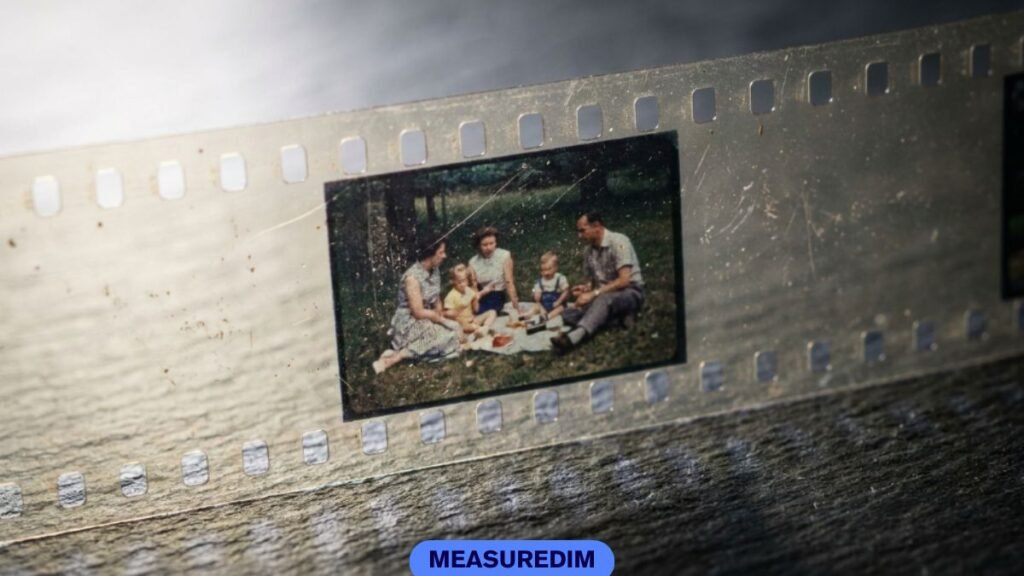
Here’s the reference hiding in a name: 8 mm film, the home-movie format from the mid-20th century, is called that because the film strip is literally 8 mm wide. Exact by definition. Its successor, Super 8, uses the same 8 mm width with smaller sprocket holes to fit a bigger image.
Even if you’ve never threaded a projector, the format’s name is a permanent size label — the width of that nostalgic strip is your 8 mm, banked for good. It’s a neat piece of trivia that doubles as a mnemonic.
The 8 mm Reference List at a Glance
| Object | Typical measurement | How it maps to 8 mm |
| Wooden pencil (corner to corner) | ~8 mm | Spot on |
| 8 mm pearl | 8 mm | Exact |
| Garden pea | 7.5–9 mm | Very close |
| Chocolate chip | 8–9 mm | Very close |
| Popcorn kernel | ~8 mm | Spot on |
| M8 bolt shaft | 8 mm nominal | Exact by spec |
| Men’s wedding band (wide) | 8 mm | Exact (sold as 8 mm) |
| Basmati rice grain (length) | ~7 mm | Slightly under |
| Seven-spot ladybird | 6–8 mm | Slightly under to spot on |
| 8 mm film width | 8 mm | Exact |
No Ruler Handy? Gauge 8 mm Like This
When there’s no measuring tool in reach, your own body and pocket change get you surprisingly close.
Stack four US nickels and you’ve got about 7.8 mm — a whisker under 8 mm and the cleanest coin trick going, since each nickel is 1.95 mm thick. Prefer pennies? A stack of five pennies lands near 7.6 mm. Six dimes get you to roughly 8.1 mm. Any of these puts you within a fraction of a millimeter.
For a body-based estimate, the width of an adult little fingernail is often around 8 mm, and the width of a standard pencil (already in most bags and drawers) is a ready-made gauge. When precision matters — hardware, jewelry — trust the pencil or the coin stack over the fingernail, since fingernails vary from person to person.
Read Also: How Big Is 3 mm? Real-World Objects and Quick Conversions
8 mm Versus the Sizes Just Above and Below
Context sharpens the picture, so here’s how 8 mm sits between its neighbors.
Drop 2 mm to land at 6 mm and you’re at the width of a typical drinking straw or a 6 mm bead — visibly slimmer, the kind of step-down you’d feel picking two beads out of a tray. Go the other way to 10 mm, which is a full 1 centimeter, and you reach the size of a standard shirt button or an aspirin tablet. That 2 mm jump from 8 to 10 doesn’t sound like much, but side by side the 10 mm object looks clearly chunkier. This is exactly why bead and bolt sizes step in small increments — each millimeter is a noticeable change at this scale.
Where 8 mm Shows Up in Real Life
You bump into this measurement more often than you’d think.
In jewelry, 8 mm is a headline number: pearl and gemstone diameters, bead sizes, and ring-band widths are all quoted in millimeters, and 8 mm is a go-to. In hardware and DIY, M8 bolts, 8 mm sockets, hex keys, and drill bits are workshop staples. Body jewelry uses it too — a 0-gauge piercing sits at about 8 mm. In photography history, the 8 mm and Super 8 film formats carry the size in their names, and slim wristwatches often quote case thicknesses in the 7–8 mm range. You may also see 8 mm quoted clinically — for instance, the diameter of a kidney stone on a scan — which is one reason people search for a size they can actually picture.
The Mistakes People Make With 8 mm
A few errors come up again and again, and every one of them is avoidable.
The big one is confusing millimeters with centimeters. Eight millimeters is 0.8 cm — smaller than a centimeter, not eight of them. Reading it as 8 cm inflates the real size tenfold. Just as costly is treating 8 mm as equal to 5/16 inch; they’re close but not identical, since 5/16 in is 7.94 mm and 8 mm is a touch bigger — enough to matter with a tight-fitting socket or bolt. Finally, people underestimate 8 mm on screens, because an object photographed against a plain background loses its scale. That’s the whole reason for keeping a physical reference — a pencil, a pea, a stacked coin — on hand instead of trusting a picture.
Questions People Actually Ask About 8 mm
What does 8 mm size look like?
It looks like a small dot you can pinch between two fingers — about the width of a wooden pencil or a single pea.
Is 8 mm the size of a pea?
Yes, near enough. A fresh garden pea measures about 7.5–9 mm, most often right around 8 mm.
What can I compare 8 mm to?
Compare it to a pencil’s width, an 8 mm pearl, a popcorn kernel, or a stack of four US nickels.
How big is 8 mm visually?
It sits just over 5/16 of an inch, or 0.8 cm — small enough to rest on a fingertip but easy to see.
What object is the size of 8 mm?
A standard pencil’s width, an M8 bolt’s thread, and an 8 mm film strip all match this size exactly.
Locking 8 mm Into Your Mind’s Eye
Now you know how big is 8 mm. It is a small size, just 0.8 centimeters or a little over 5/16 of an inch. You can picture it as a garden pea, the width of a wooden pencil, or a small pearl. These everyday objects turn a plain number into a clear picture in your mind. A stack of four nickels also comes very close, so you can check the size with coins from your pocket. Keep one of these anchors ready, and you will judge 8 mm with ease.
This size appears in many places around you. Jewelers use it for pearls and beads, and builders use it for M8 bolts and tools. Even old home-movie film measures 8 mm across. Remember one simple object, and you will spot this measurement anywhere with confidence.
Written by a measurement writer who has spent more time than is reasonable holding coins, beads, and bolts up to a caliper.
Related Guides:
1: How Big Is 2mm? A Down-to-Earth Guide to Picturing Two Millimeters
2: How Long Is 20 Inches? 10 Everyday Objects to Picture It
3: How Big Is an Inch? A Length You Can Picture Without a Ruler
4: How Much Is 10 Inches? A Real-World Size Guide
5: How Big Is 5 Inches? 9 Everyday Objects to Picture It