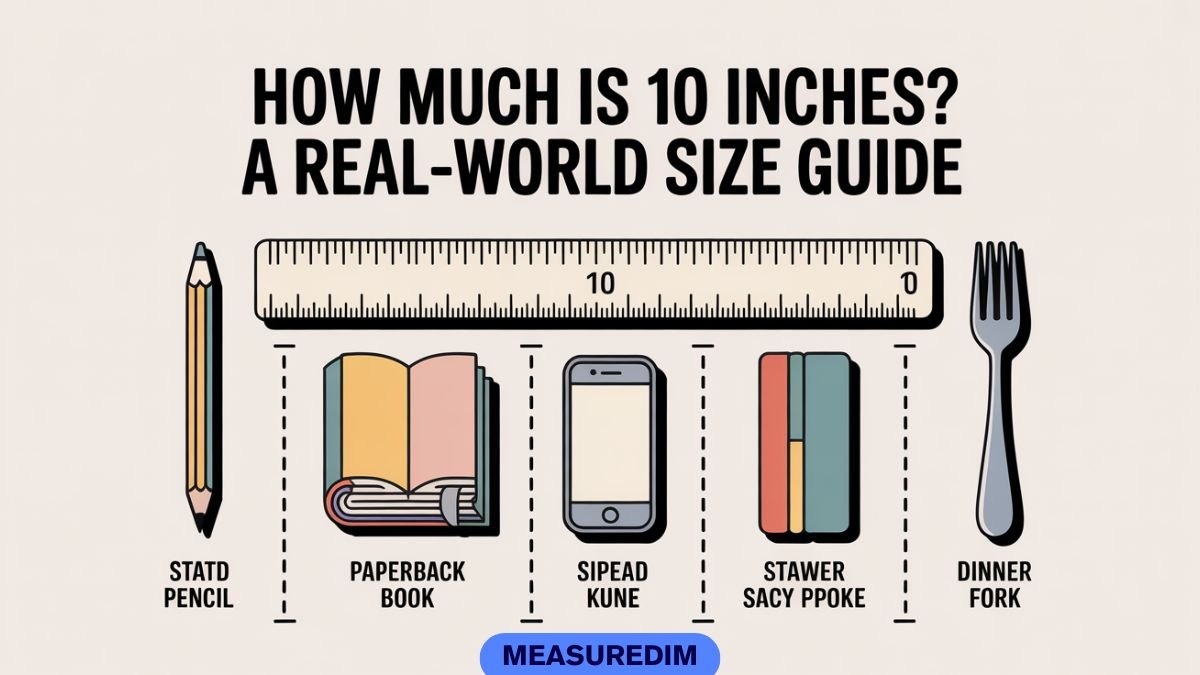
How Much Is 10 Inches? A Real-World Size Guide
Ten inches is a way to measure length. It is the same as 25.4 centimeters, or 254 millimeters. In simple words, it is a little shorter than a school ruler.
Have you ever tried to picture 10 inches in your head? It is hard to guess without a ruler nearby. But once you see it, you will spot it everywhere.
Many everyday things are about 10 inches long. A tablet screen and a big tortilla are close matches. Three bank cards in a row also reach this size.
The Short Answer
10 inches equals 25.4 centimeters — exactly, since one inch is defined as 2.54 cm. That’s the same as 254 millimeters, about 0.83 of a foot, and just over a quarter of a meter (0.254 m). In plain terms, 10 inches is two inches shy of a standard ruler, and roughly the diagonal of a small tablet screen.
10 Inches Converted to Every Unit You’ll Need
Because the imperial-to-metric relationship is fixed, these numbers never drift. Here’s the full breakdown so you can quote whichever system you’re working in.
| Unit | 10 inches equals |
| Centimeters | 25.4 cm |
| Millimeters | 254 mm |
| Feet | 0.833 ft |
| Yards | 0.278 yd |
| Meters | 0.254 m |
If you ever need to reverse it, 25.4 cm back-converts cleanly to 10 inches, and a full foot (12 inches) is 30.48 cm — so 10 inches is exactly 5.08 cm short of a foot.
What a Span of 10 Inches Actually Feels Like
Stretch a standard sheet of printer paper in front of you. The long edge runs 11 inches; the short edge runs 8.5. Ten inches sits neatly between the two — an inch shorter than the tall side, an inch and a half longer than the wide side. That single image is enough to lock the length into memory.
It’s also close to the reach of an open adult hand plus a little more. Spread your thumb and pinky as wide as they’ll go and you cover roughly 8.5 to 9 inches; add a thumb’s width and you’re there. Ten inches is generous but still one-handed territory — not something you’d struggle to hold, yet clearly longer than everyday pocket objects.
Everyday Objects That Land Right Around 10 Inches
The fastest way to internalize a measurement is to tie it to things you already handle. Below are nine reliable references, from spot-on matches to a few that sit a hair under. I’ve flagged which is which so you’re never guessing.
The Screen on a Standard iPad
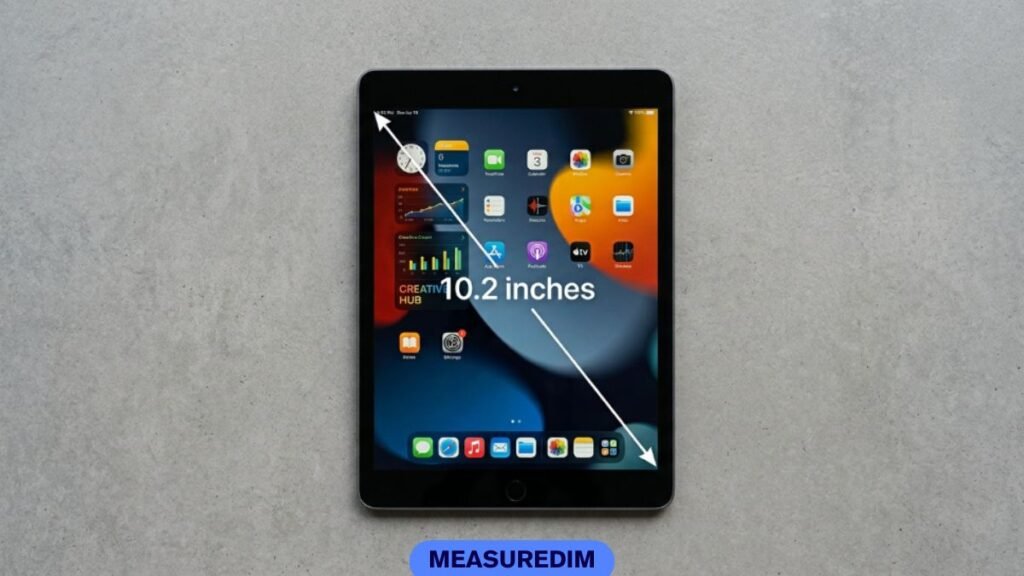
The entry-level iPad measures 10.2 inches across its display, corner to corner — that diagonal is your anchor. Ten inches is a shade under the full glass, and the tablet’s body itself stands about 9.9 inches tall, also within a whisker of the target. Both the screen and the frame put you inside a tenth of an inch of the mark.
Nearly everyone has held a tablet in this class, which makes it an easy mental yardstick. Picture the distance from one corner of the screen to the opposite corner and you’ve got 10 inches locked. It’s a handy check when you’re deciding whether a sleeve, a shelf, or a bag pocket will swallow something roughly this long.
Three Credit Cards, End to End
A credit or debit card follows a worldwide standard (ISO/IEC 7810 ID-1), so its long edge is always 3.37 inches. Line three up touching, end to end, and you reach about 10.1 inches — a whisker past the mark rather than under it. Because the card dimension is fixed across every bank and country, this is one of the most repeatable references you can physically carry.
You almost certainly have three cards in a wallet right now, which makes this trick available anywhere. Lay them in a row on a table and you’ve built a 10-inch ruler in seconds. I lean on it constantly for quick jobs — sizing up a phone, a small parcel, or the gap in a drawer when no proper ruler is within reach.
A 10-Inch Chef’s Knife Blade
Kitchen knives are sold by blade length, and a 10-inch chef’s knife has a blade measuring exactly 10 inches from heel to tip — the handle adds a few more on top. Most home cooks default to the 8-inch version, so a 10-inch blade feels noticeably longer and more commanding in the hand.
If you own one, slide it from the block and study just the steel, ignoring the handle. That gleaming stretch is 10 inches, no estimation required. It’s a precise, exact reference — useful whenever you want a real-world sense of the length rather than a rough approximation.
Read Also: How Long Is 2 Inches? Real Objects That Show You Exactly
A Burrito-Size Flour Tortilla
Flour tortillas ship in set diameters: 6-inch for tacos, 8-inch for fajitas, and the 10-inch “burrito” size. Lay a burrito wrap flat and the distance straight across is 10 inches — about as exact as a mass-produced food gets. It’s the largest common supermarket tortilla, which is exactly why it swallows a full burrito’s worth of filling.
Round objects are the trickiest to gauge by eye, so having a circular 10-inch reference is genuinely useful. Next time you’re wondering how wide a 10-inch skillet, plate, or cake pan really is, remember the burrito wrap — its edge-to-edge span answers the question. [IMAGE: a 10-inch flour tortilla beside a ruler showing the diameter]
A 10-Inch Cast-Iron Skillet
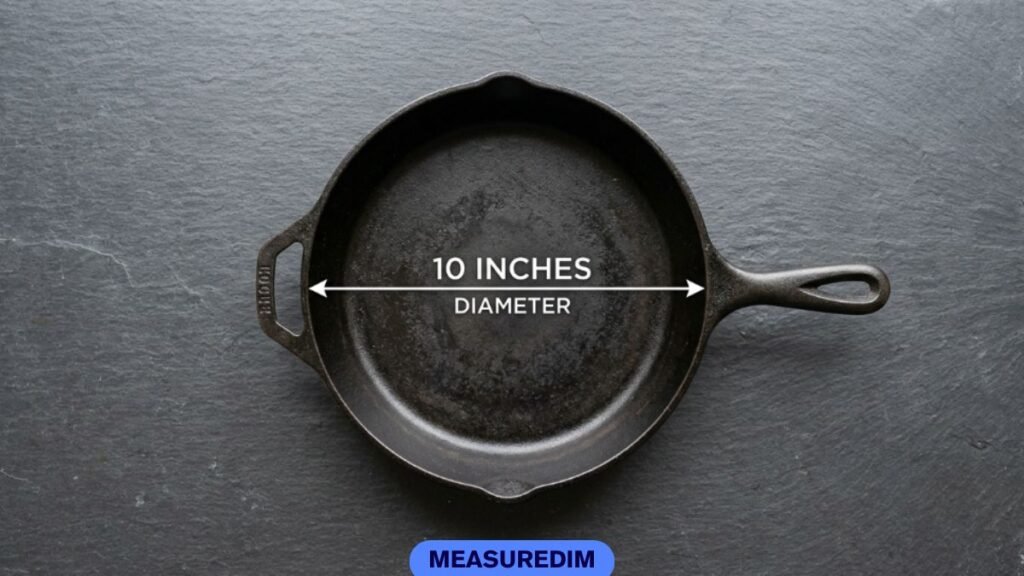
Cookware is named by the diameter measured across the top rim, so a 10-inch skillet spans 10 inches lip to lip; popular models such as Lodge’s run a touch wider at 10.25. Worth knowing: the flat cooking surface at the bottom is smaller — usually around 8 inches — which is where a lot of people misjudge the number.
Cooks handle these pans daily, so the rim is a familiar shape to visualize. Hold the image of that outer edge and you’re picturing a true 10 inches. It’s the everyday workhorse size in most kitchens, sitting between the small 8-inch egg pan and the big 12-inch family skillet.
A Compact Dinner Plate
Dinner plates cluster between 10 and 11 inches across, with most hovering around 10.5. The smaller plates in many sets — and plenty sold specifically as “10-inch” — sit right at the target, so a modest dinner plate makes a solid stand-in. Salad and luncheon plates run smaller (around 8 to 9 inches), which is why they read as noticeably daintier.
Flip a plate over and picture its width and you’ve got a quick round reference in your hands. Because place settings vary by brand, treat this one as approximate — measure yours once and you’ll know exactly where your set falls. It’s handy for judging table space or whether a plate will fit a cabinet shelf.
A Regulation Basketball — a Hair Under
A men’s size-7 basketball has a circumference of 29.5 inches, which works out to a diameter of about 9.4 inches — just shy of 10. Set the ball next to a ruler and its widest point stops a little before the 10-inch line, close but not touching it.
Sports gear is a fun way to feel a length, and a basketball is instantly familiar to most people. Just remember this is an approximation on the low side: picture the ball’s width, then mentally add a slim finger’s-width to reach a true 10 inches. Good enough for a fast estimate, not for precision work.
Two Soda Cans, Stacked
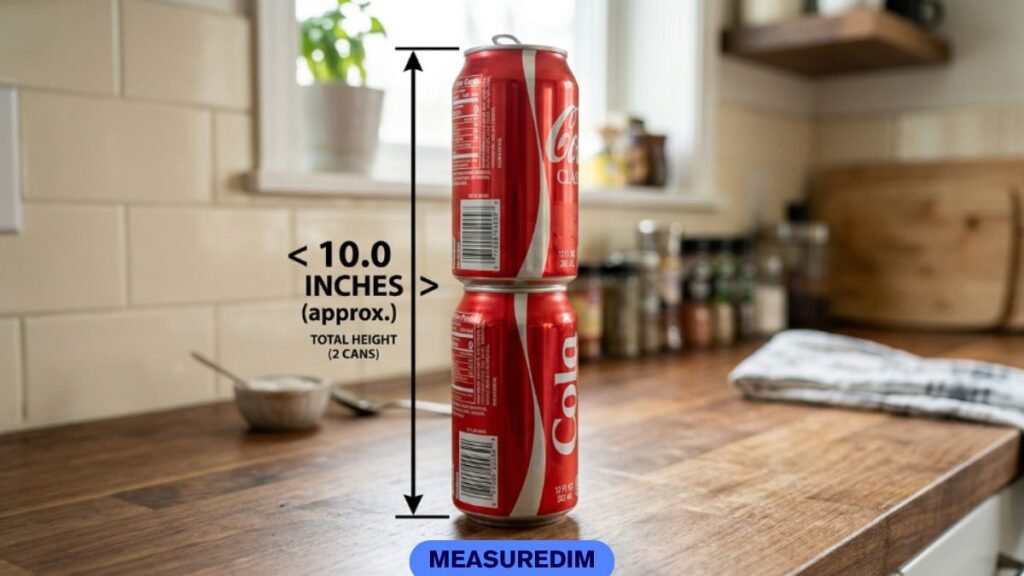
A standard 12-ounce soda can stands 4.83 inches tall. Balance one on top of another and the pair reaches roughly 9.7 inches — a touch under 10, but close enough for a ballpark gauge. Cans are everywhere, which is the whole appeal of this reference.
Stack two on a counter and eyeball the total height against whatever you’re measuring. Because you land a fraction short, add a small sliver in your head to true it up to 10. I find it most useful for guessing vertical clearance — like whether a 10-inch item will stand upright in a fridge shelf or cupboard.
A #10 Business Envelope
The everyday #10 envelope that holds a folded letter measures 9.5 inches along its long edge. That’s half an inch short of 10, so picture the envelope plus a narrow strip beyond its flap end. Despite the name, the “10” doesn’t refer to its length — it’s just the size designation.
If there’s a stack of these in a drawer, grab one and use its long side as a near-10-inch stick. It’s flat, rigid enough, and easy to line up against a package or shelf. Treat it as a slightly-under reference and nudge your estimate up by about half an inch.
Quick-Glance Size Table
Here’s everything above in one place, sorted from spot-on to slightly under, so you can pick the reference that’s closest to hand.
| Object | Real measurement | vs. 10 inches |
| iPad screen (diagonal) | 10.2 in | ~0.2 in over — near exact |
| Three credit cards, end to end | 10.11 in | ~0.1 in over — near exact |
| 10-inch chef’s knife (blade) | 10.0 in | Exact |
| Burrito-size flour tortilla | 10.0 in | Exact |
| 10-inch cast-iron skillet (rim) | 10.0–10.25 in | Exact to slightly over |
| Compact dinner plate | 10.0–10.5 in | On target at the small end |
| Basketball (diameter) | ~9.4 in | ~0.6 in under |
| Two soda cans, stacked | ~9.7 in | ~0.3 in under |
| #10 business envelope (length) | 9.5 in | ~0.5 in under |
Judging 10 Inches Without a Ruler
No measuring tool nearby? A few no-tool methods get you close:
- Printer paper trick. A letter sheet’s long edge is 11 inches. Mark or picture a point one inch in from the end and you’ve got 10.
- The card ruler. Three standard cards touching end to end make 10.1 inches — a ready-made reference living in your wallet.
- Ruler minus two. A 12-inch ruler with the last two inches ignored leaves exactly 10.
- Hand-span plus a thumb. Spread hand (about 8.5–9 inches) with one thumb-width added lands near the mark for most adults.
Each of these is an honest estimate rather than lab-grade precision — but for framing a shelf, checking a box, or teaching a kid what 10 inches looks like, they’re plenty accurate.
Where This Length Actually Comes Up
Ten inches isn’t a random number — it’s a genuine standard across several categories:
- Tech. Compact tablets and 2-in-1 devices are often described as “10-inch” by screen diagonal.
- Cookware. The 10-inch skillet or frying pan is the default everyday size in most kitchens.
- Gardening. A 10-inch nursery pot is a common container for mid-size houseplants and shrubs.
- Food. Personal and small pizzas, plus burrito-size tortillas, are frequently 10 inches across.
- Audio. Subwoofer drivers labeled “10-inch” refer to the cone diameter.
- Baking and shipping. Cake pans, wall tiles, and mailing boxes all use 10 inches as a stock dimension.
Knowing the length by feel makes online shopping far less of a gamble — you can judge whether a “10-inch” product suits your space before it ever arrives.
Read Also: How Big Is 5 Inches? 9 Everyday Objects to Picture It
10 Inches Next to Its Neighbors
Sizing is easier when you can anchor it against the lengths just above and below.
| Length | In centimeters | Everyday match |
| 8 inches | 20.32 cm | Fajita tortilla, small skillet |
| 9 inches | 22.86 cm | A dinner plate’s small cousin |
| 10 inches | 25.4 cm | iPad screen, burrito wrap |
| 11 inches | 27.94 cm | Long edge of printer paper |
| 12 inches | 30.48 cm | A full foot / standard ruler |
The jump most people notice is 10 to 12: a 12-inch pizza isn’t just “a bit bigger.” Because area grows with the square of the diameter, a 12-inch pie carries about 44% more food than a 10-inch one, even though the number only rises by two.
Slip-Ups People Make With This Measurement
Confusing inches with centimeters. Ten inches (25.4 cm) is more than two and a half times bigger than 10 cm (which is just 3.94 inches). Mixing the two is the single most common error — double-check the unit before you cut, order, or build.
Trusting the label on a screen. A “10-inch tablet” refers to the diagonal of the display, not its height or width. The device body is smaller in every straight-line dimension.
Skillet rim vs. cooking surface. A 10-inch pan measures 10 inches across the top rim, but the usable flat base is roughly two inches smaller — factor that in before assuming how much food will fit.
Assuming 25 cm is exact. Twenty-five centimeters is close but not identical: it’s 9.84 inches. The precise conversion is 25.4 cm, and that extra 0.4 cm matters for anything cut to fit.
Quick-Fire Q&A
What is an example of 10 inches?
A standard iPad screen is about 10 inches across. Three bank cards placed in a row also reach this length.
How can I measure 10 inches without a ruler?
Take a sheet of printer paper and picture one inch trimmed off the long edge. That leaves you with exactly 10 inches.
How to measure 10 inches with hand?
Spread your hand wide, which covers about 8.5 to 9 inches for most adults. Add one thumb-width and you land near 10 inches.
How much is 10 inches in hand?
Ten inches is a little more than one full adult hand-span. It works out to roughly one hand plus an extra thumb.
How long is 4 fingers in inches?
Four fingers held together measure about 3 inches for most adults. The exact width changes a little from person to person.
Locking This Size Into Memory
So now you know how much is 10 inches. It is 25.4 centimeters, or 254 millimeters. That length is a bit shorter than a ruler. You can picture it in easy ways. A tablet screen matches it well. A big tortilla shows the same width. Three bank cards in a row also reach 10 inches. These simple objects help you see the size fast. You do not need a ruler every time.
Keep these examples in your mind. They make measuring quick and easy. You can check a box, a shelf, or a plate in seconds. Ten inches sits just below a foot and above your hand. Now you understand how much is 10 inches with full confidence. Use these tricks, and you will spot this length everywhere you go.
Written from years of comparing real-world dimensions for readers who’d rather visualize a size than convert it.
Related Guides:
1: How Long Is 6 Inches? Real Objects to Picture It Fast
2: How Big Is 4 Inches? A Complete Size Guide With Real Objects
3: How Long Is 8 Inches? Everyday Objects to Picture It
4: How Big Is 7 Inches? 10 Everyday Objects to Picture It