How Big Is 3 mm? Real-World Objects and Quick Conversions
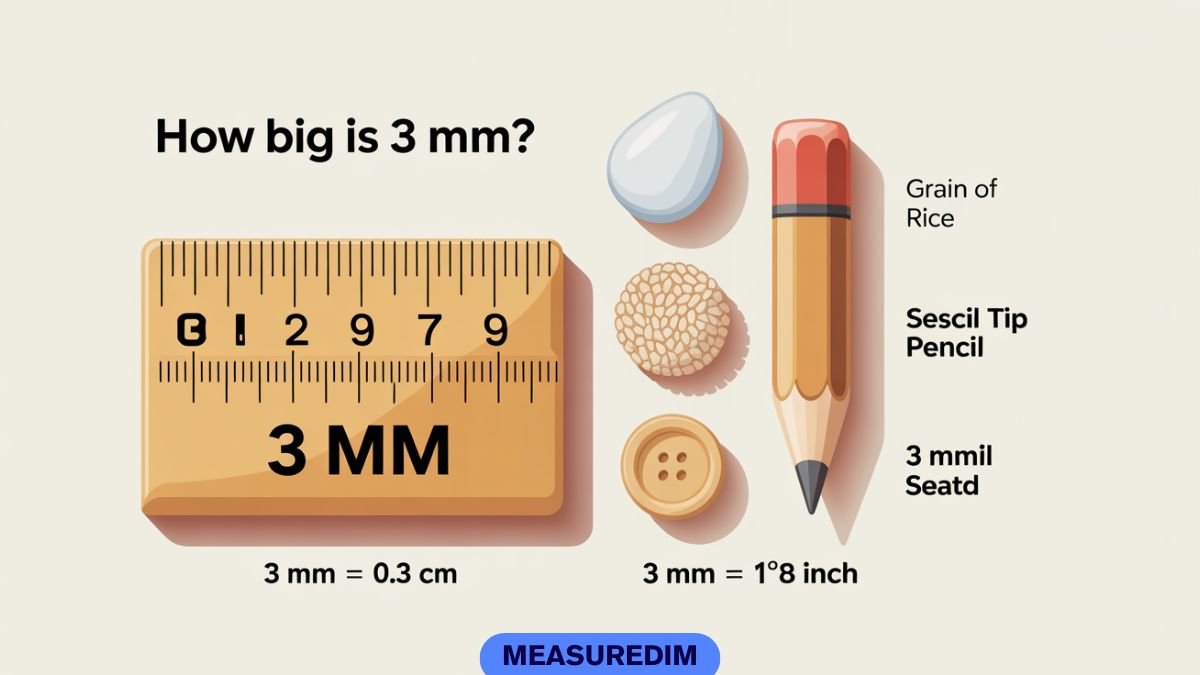
Three millimeters is a very small length. It equals about 0.3 centimeters or roughly one-eighth of an inch. In short, 3 mm is a thin, tiny size you can pinch between two fingers.
Have you ever seen a number like 3 mm and felt unsure? You are not alone. Most people cannot picture it until they compare it to something real and familiar.
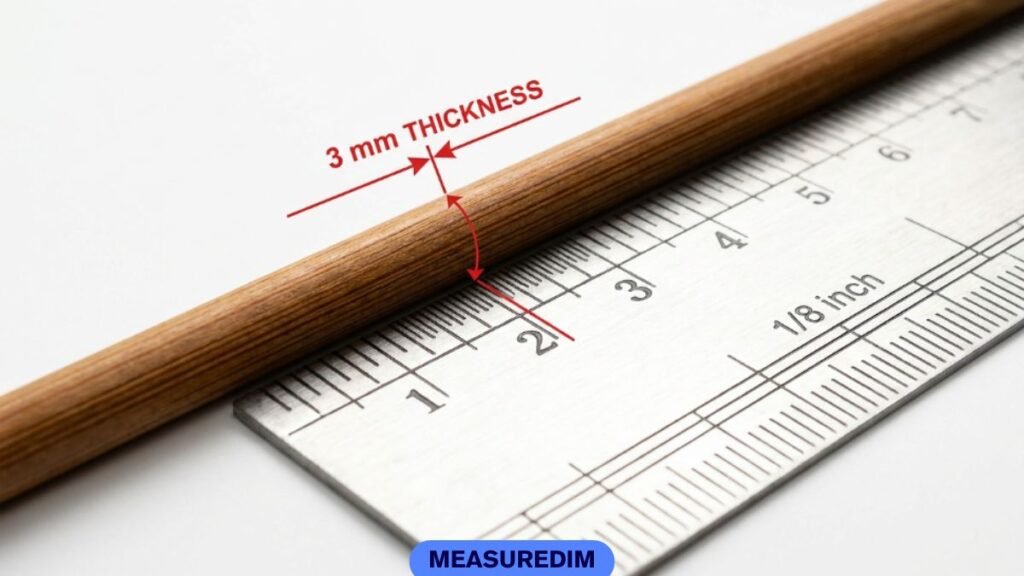
3 mm is close to the width of a bamboo skewer. It also matches two stacked pennies almost exactly. Once you link it to an object, this size becomes easy to spot anywhere.
3 mm, Answered in One Breath
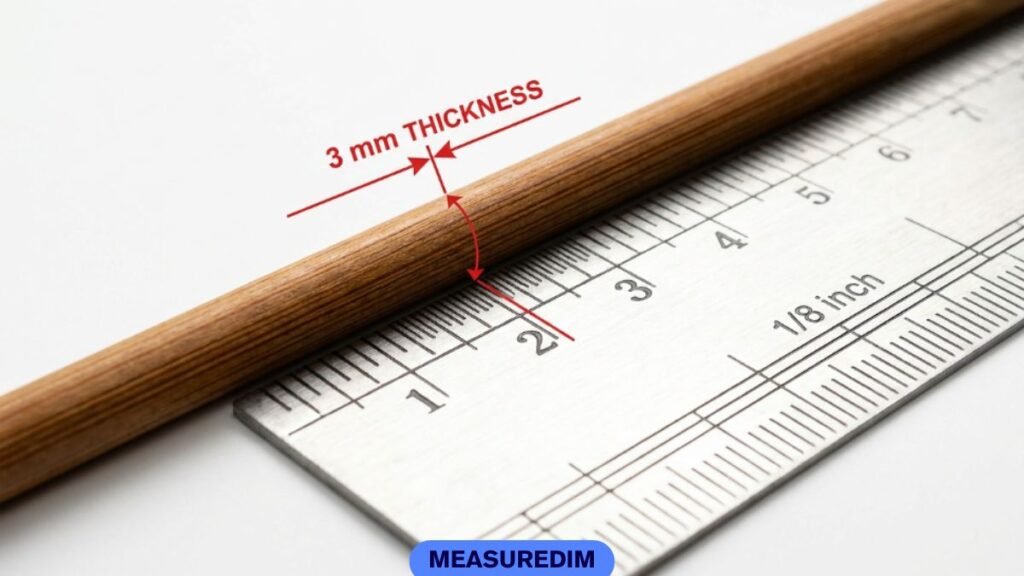
Three millimeters is about the width of a thin bamboo skewer, or two US pennies stacked flat. Converted, that’s 0.3 cm, 0.118 inches (just shy of 1/8 inch), and 0.003 meters. Picture something you can pinch between finger and thumb with only a thread of light showing through — that’s the size.
Convert 3 mm Without the Guesswork
One reason 3 mm confuses people is that it straddles the metric–imperial divide awkwardly. Here’s the full set of conversions, checked against each other so nothing contradicts.
| Unit | Value |
| Millimeters | 3 mm |
| Centimeters | 0.3 cm |
| Meters | 0.003 m |
| Inches (decimal) | 0.118 in |
| Inches (fraction) | just under 1/8 in |
| Feet | 0.0098 ft |
| Points (typography) | ≈ 8.5 pt |
| Mils (thousandths of an inch) | ≈ 118 mil |
Two conversions deserve a second look. One-eighth of an inch is 3.175 mm, so 3 mm sits a fraction below it — near enough for rough work, not for precision cuts. And a “mil” is a thousandth of an inch, not a millimeter, which makes 3 mm equal to roughly 118 mils. That gap catches out anyone shopping for plastic film or shim stock.
How Thin 3 mm Really Reads
Rest a fingertip on the table and lift it until the smallest visible gap opens underneath — that daylight is close to 3 mm. It’s the depth you’d push a pin, the thickness of firm cardboard, the height of a short coin stack. The honest read on 3 mm is slim but obvious: you can see it across a room, feel its edge, and point straight at it. Nobody needs a magnifier for this one.
Household Stand-Ins for 3 mm
Each object below lands within a whisker of the target. I’ve flagged which figures are exact and which are close, because glossing over that difference is what makes copycat articles untrustworthy.
Two Pennies, One on Top of the Other
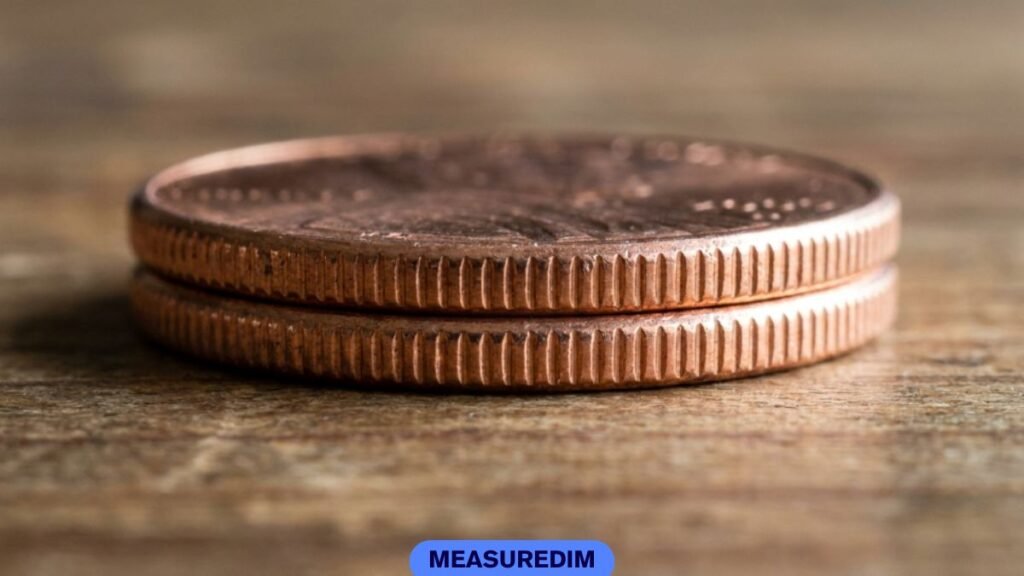
A US penny measures 1.52 mm thick, so a pair stacked flat comes to 3.04 mm — as tight a match as any everyday item offers. Because coin thickness is federally standardized, that figure barely drifts from one penny to the next.
Coins win as references precisely because they’re always nearby and dead consistent. When a product page claims a case adds “3 mm” of bulk, press two pennies against the phone’s rim and you’ll see that thickness for real instead of guessing.
A Thin Bamboo Skewer
The skinny bamboo skewers sold for kebabs run about 3 mm across at the shaft. It’s an approximate figure — skewers come in 2.5 mm, 3 mm, and 4 mm grades — but the standard thin one is right on the money.
A skewer is a rare reference that’s actually round, which makes it perfect for picturing 3 mm as a diameter rather than a flat thickness. Hold one up beside a rod, a cable, or a dowel and you can judge the fit before you buy or cut.
Read Also: How Big Is 2mm? A Down-to-Earth Guide to Picturing Two Millimeters
Bucatini Pasta
Bucatini looks like fat spaghetti with a hollow center, and its outer diameter is roughly 3 mm — noticeably thicker than the 2 mm strands of regular spaghetti. Treat it as an approximation, since extrusion and brand vary the exact figure slightly.
Pasta is a memorable stand-in because you can lay a raw strand against whatever you’re sizing up right there in the kitchen. It’s the reference I reach for when explaining 3 mm to someone who thinks in food, and it usefully contrasts with thinner 2 mm spaghetti to show how much 1 mm changes the look.
The Edge of a Shipping Box
Most single-wall shipping cartons use B-flute corrugated board, which measures about 3 mm thick through the wavy middle layer. Flute grades differ — E-flute is thinner, C-flute thicker — so this is a ballpark, but B-flute is the everyday standard.
Cardboard is worth knowing because a box is almost always within reach, and its cut edge shows the 3 mm profile plainly. Peek at the crushed edge of any parcel and you’re looking at a 3 mm reference you didn’t have to buy.
A Coriander Seed
Whole coriander seeds — the round spice, not the fresh cilantro leaf — run about 3 to 4 mm in diameter. Nature won’t give you an exact number, but a smaller seed sits right at 3 mm.
Spice-drawer references stick because they’re vivid and specific, and coriander is a genuinely honest match rather than a forced one. It’s a handy mental image for tiny spherical objects at this size — a bead, a ball bearing, a small gemstone.
A Hardcover Book’s Cover Board
The stiff board under a hardcover’s cloth or paper — bookbinders call it binder’s board — typically runs 2.5 to 3 mm thick on a sturdy book. It’s an approximate range, since publishers choose lighter or heavier board depending on the title.
A hardcover is a good reference because you can feel that board thickness at the corner where the cloth wraps around. Next time you’re gauging how thick a 3 mm panel of plywood or acrylic will feel, run your thumb along a book cover’s edge first.
A Whole Black Peppercorn
A dried black peppercorn spans roughly 3 to 6 mm, and the smaller grinder-grade berries sit right near 3 mm. This is a genuine range rather than a single figure, so I’d call it “3-ish mm” rather than exact.
Peppercorns earn their place by being both common and roughly spherical, which is exactly the shape people struggle to visualize from a flat ruler. When a listing describes a 3 mm stone or pellet, a small peppercorn gives you an instant three-dimensional sense of it.
Roughly Ten Playing Cards, Stacked
A single playing card is about 0.3 mm thick, so a neat stack of ten cards climbs to around 3 mm. Card stock varies by brand, making this a close approximation rather than a precise count.
Cards are a satisfying reference because you can build the height yourself and fan it back down to check. Deal ten off the top, square them up, and you’ve made a 3 mm gauge from a deck that was already on the shelf.
The 3 mm Lineup at a Glance
Here’s the full set sorted from spot-on to slightly over, so you can grab whichever is closest to hand.
| Object | Real measurement | Compared to 3 mm |
| Two US pennies, stacked | 3.04 mm | Practically exact |
| Ten playing cards, stacked | ~3 mm | Practically exact |
| Thin bamboo skewer (diameter) | ~3 mm | Practically exact |
| Bucatini pasta (outer diameter) | ~3 mm | Practically exact |
| B-flute shipping cardboard | ~3 mm | Practically exact |
| Hardcover book board | 2.5–3 mm | Exact to a touch under |
| Coriander seed | 3–4 mm | Exact to slightly over |
| Black peppercorn | 3–6 mm | Exact to noticeably over |
Gauge 3 mm With Nothing but Your Hands
You can hit this size with zero equipment. The quickest route: stack two pennies and feel that thickness, then transfer it to whatever you’re measuring. No coins? A wooden pencil’s graphite core is about 2 mm across — imagine that lead plus half again and you’re at 3 mm. A round toothpick (~2 mm) nudged up a hair works the same way.
Your fingernail is a built-in ruler too. The strip you snip off when trimming is often 1 to 2 mm; leave a little more and you’ve marked out 3 mm. And if there’s a phone cable in your bag, its cord is close enough to serve as an instant reference with no arithmetic at all. Whatever method you use, say plainly whether you’re being exact or just roughly right — an honest estimate beats false precision.
Read Also: How Long Is 20 Inches? 10 Everyday Objects to Picture It
Products and Projects Where 3 mm Is the Spec
Once you’re tuned to it, 3 mm turns up constantly:
- Glass and acrylic. 3 mm float glass is a standard pane for picture frames and cabinet doors, and 3 mm acrylic is a favorite for laser cutting.
- Tile work. A 3 mm tile spacer produces the classic grout line on kitchen and bathroom walls.
- Flat-pack furniture. That little folding wrench is frequently a 3 mm hex key.
- Drilling and doweling. 3 mm bits and dowels are staples for lightweight joinery and models.
- Wetsuits. 3 mm neoprene is the go-to thickness for temperate and warm water.
- Jewelry. A 3 mm round gemstone is a common accent (a 3 mm diamond is roughly 0.10 carat), and 3 mm equals about an 8-gauge in body piercings.
- Weather. “3 mm of rain” in a forecast signals a light, steady shower rather than a downpour.
Knowing the physical size lets you plan the purchase or the cut before anything arrives.
When a Scan Says 3 mm
Plenty of people land on this phrase after a report notes a 3 mm finding — a kidney stone, a lung or thyroid nodule, a small cyst or polyp. In plain terms, 3 mm is small: about a peppercorn, a coriander seed, or the tip of a skewer — clearly under the length of a grain of rice.
What the size means for you, though, depends on far more than millimeters: type, location, whether it’s changing, and your own history. Only the clinician who ordered the scan can weigh those factors, so take your questions there rather than to a comparison chart. This article can show you how big 3 mm looks; it can’t tell you what a 3 mm finding means for your health.
3 mm Against 1 mm and 5 mm
Millimeter sizes blur together, so here’s how 3 mm stacks up next to its close neighbors.
| Size | Everyday match |
| 1 mm | Slightly thicker than a single credit card; a heavy paperclip’s wire |
| 2 mm | A wooden pencil’s graphite core; a strand of dry spaghetti |
| 3 mm | Two stacked pennies; a bamboo skewer |
| 4 mm | A plump peppercorn; a dried split pea |
| 5 mm | Half a centimeter; a grain of white rice, end to end |
Notice that 2 mm to 3 mm is a single pencil-lead’s difference — tiny on paper, but side by side the skewer clearly out-fattens the spaghetti. Anchoring each step to its own object is what keeps these sizes from melting into one vague “small.”
The Slip-Ups That Make 3 mm Look Wrong
Reading it as 3 cm. The classic error. Three centimeters is 30 mm — ten times bigger, roughly the width of a US quarter. One misread unit swaps a peppercorn for a walnut, so always confirm mm versus cm.
Treating 3 mm and 1/8 inch as identical. They’re close, not equal: 1/8 inch is 3.175 mm. Fine for eyeballing, risky for a precise cut or a tight-fitting part.
Forgetting which dimension the number describes. A “3 mm skewer” means diameter, a “3 mm seed” usually means length, a “3 mm board” means thickness. Check what’s being measured before you compare.
Expecting it to vanish. Some people brace for something microscopic. Three millimeters is easy to see and hold — it just isn’t bulky.
Fast Answers to Common 3 mm Questions
What does 3 mm look like?
It looks like a tiny, thin sliver, about the width of a bamboo skewer or two stacked pennies.
Is 3 mm the size of a pea?
No. A pea is about 7–8 mm wide, so 3 mm is less than half a pea’s size.
Is 3 mm very big?
No. 3 mm is very small, equal to about 0.3 cm or just under one-eighth of an inch.
What is 3 mm comparable to?
It is comparable to two stacked pennies, a bamboo skewer’s width, or a single peppercorn.
How tiny is 3 mm?
It is tiny enough to pinch between two fingers, yet still easy to see with the naked eye.
One Line to Remember It By
So now you know how big is 3 mm. It is a small size, close to 0.3 centimeters or just under one-eighth of an inch. You can picture it as two pennies stacked on top of each other. A thin bamboo skewer shows the same width. These simple objects turn a plain number into something you can truly see and understand.
Real objects make small sizes clear. The next time you read 3 mm on a box, a ruler, or a report, you will know exactly what to expect. Keep one easy picture in your mind, like the pennies or the skewer. That single image will help you gauge this size fast. With this simple trick, you will spot 3 mm with confidence every single time.
Written by a dimensions editor who keeps a jar of pennies and a pack of skewers on the desk purely for sanity-checking comparisons like these.
Related Guides:
1: How Big Is an Inch? A Length You Can Picture Without a Ruler
2: How Much Is 10 Inches? A Real-World Size Guide
3: How Big Is 5 Inches? 9 Everyday Objects to Picture It
4: How Long Is 2 Inches? Real Objects That Show You Exactly
5: How Long Is 6 Inches? Real Objects to Picture It Fast