How Big Is 3 cm? Real-Life Examples and Conversions
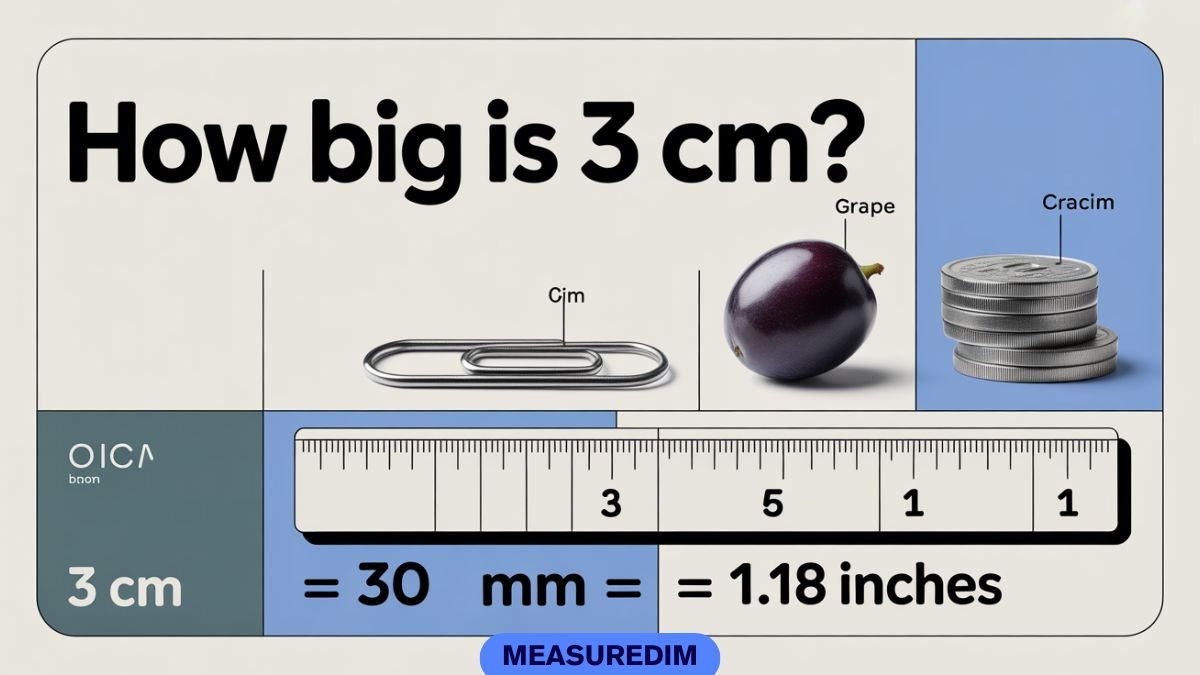
So how big is 3 cm? It is a small length equal to 30 millimeters. In inches, that is about 1.18 inches, just a bit more than one inch.
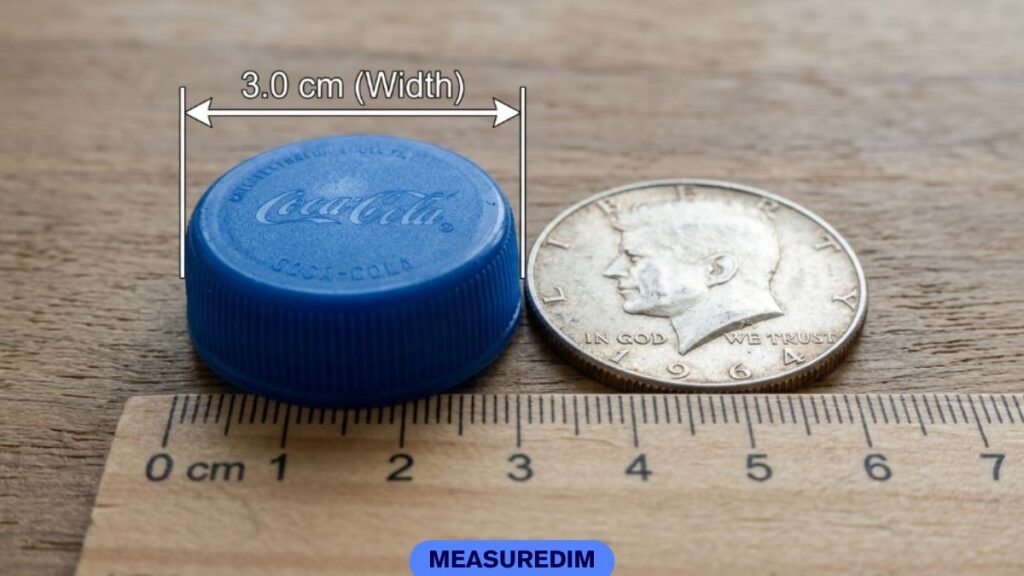
Think of the cap on a plastic water bottle. It sits right around 3 cm across, small enough to close your hand over. That cap is your instant picture of this size.
You meet 3 cm more often than you think. A large grape, a half-dollar coin, and a four-stud Lego brick all land near it. Keep the bottle cap in mind and you will spot 3 cm fast.
3 cm at a Glance
Here’s the short version for anyone who just needs the answer.
3 cm = 30 mm = 1.18 inches (about 1 3/16 in) = 0.03 m. It’s a bit longer than one inch and a touch wider than a typical soda-bottle cap. Picture a US half-dollar coin or the tip of your thumb down to the first knuckle and you’re basically there.
That’s the whole trick — a shade over an inch, and about the width of a bottle cap. Everything below just makes that stick.
3 cm in Every Unit You Might Need
Small lengths are where people fumble conversions, so here’s the full set. Two of these are exact by definition (millimeters and meters); the rest are rounded to something usable.
| Unit | Value | Notes |
| Millimeters | 30 mm | exact |
| Centimeters | 3 cm | the value you searched |
| Inches | 1.18 in | ≈ 1 3/16 in |
| Feet | 0.098 ft | ≈ 0.1 ft |
| Yards | 0.033 yd | tiny fraction of a yard |
| Meters | 0.03 m | exact |
The one worth memorizing is inches. One inch is 2.54 cm, so 3 cm clears it comfortably — you’re at roughly 1.18 inches, not “about an inch.” That gap is where most estimating errors start.
What 3 Centimeters Actually Feels Like
Numbers aside, 3 cm is a hand-scale measurement. It’s the sort of length you close your fingers around without thinking — a cap, a coin, a fat grape. Nothing at 3 cm feels large; it feels like a small, grabbable object.
It’s also the length where the metric-imperial mismatch bites. In your head, “3 of something” sounds chunky, but 3 centimeters is barely over an inch. If you’re used to inches, your instinct will overshoot. Trust the bottle cap, not the word “three.”
Everyday Things That Are About 3 cm
These are real objects with real, checkable dimensions. I’ve noted where a comparison is exact versus a close approximation, because a range that pretends to be precise is worse than an honest “roughly.”
The Cap on a Plastic Water Bottle
Grab any single-serve water or soda bottle and look at the cap. The outer diameter of a standard screw cap runs about 2.8 to 3.0 cm, which makes it one of the most reliable 3 cm references you’ll ever have on hand. It’s not an exact figure — cap designs vary slightly by brand and finish — but you’ll rarely be more than a millimeter or two off.
What makes the bottle cap so useful is that there’s always one nearby. Pull one out of the recycling, set it on top of whatever you’re sizing up, and you’ve got an instant gauge. This is the trick I reach for when a listing says a pendant or a bead is “30 mm” and I want to know, before it ships, roughly how big that’ll actually be in my hand.
A US Half-Dollar Coin
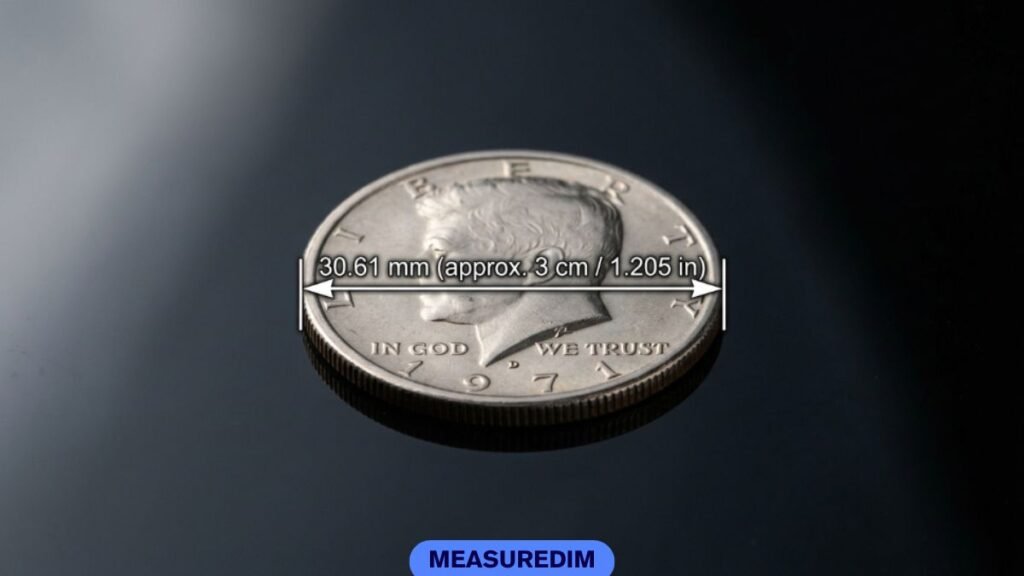
The Kennedy half-dollar measures 30.6 mm across, which is 3.06 cm — just a whisker over 3 cm and about as close to exact as a common object gets. If you happen to have one, it’s a near-perfect stand-in: lay it flat and its diameter is your target length, give or take a rounding error.
Coins are great references because their sizes are fixed by mint standards and never drift. The catch is that the half-dollar isn’t in most people’s pockets. When you do find one, though, it beats guessing — and it’s a cleaner match than the quarter, which trips people up (more on that below).
A Four-Stud Lego Brick (1×4)
A classic 1×4 Lego brick — four studs in a row — is 31.8 mm long, or about 3.2 cm. That’s slightly over 3 cm, and the beauty of Lego is its manufacturing precision: those bricks are made to tolerances tight enough that the length barely varies from one to the next.
If there’s a bin of bricks in the house, this is a surprisingly exact way to check a small length. Line the brick against your object and you’re comparing against a known 3.2 cm. It’s the reference I use when helping a kid picture a size, because the brick turns an abstract number into something they can already hold.
Read Also: How Big Is 6 cm? Compare It to Real Everyday Objects
A Standard Paperclip
The everyday small paperclip (the No. 1 size, not the jumbo) is about 3.3 cm long when measured end to end. It lands a touch above 3 cm, so treat it as “3 cm plus a hair” rather than dead-on. Jumbo clips are much longer — closer to 5 cm — so make sure you’re looking at the small one.
Paperclips earn their spot because they’re everywhere: a desk drawer, a stack of paper, the bottom of a bag. Straighten one mentally against your target and you’ve got a fast, disposable ruler. Handy when you’re sizing up something flat like a stamp, a label, or a slot on a device.
The Tip of Your Thumb
From the very tip of your thumb to the first knuckle is, for most adults, about 2.5 to 3 cm. Hands differ, so this is an estimate — but it’s the one body reference you carry everywhere, no coin or cap required.
Because it’s attached to you, it wins on convenience even if it loses a little on precision. Press your thumb tip against whatever you’re measuring and you’ll get a “yes, roughly 3 cm” read within a second. Calibrate it once against a ruler and you’ll trust it for life.
A Plump Grape
A large table grape runs about 2.5 to 3 cm across its longer axis. Smaller grapes fall short, and the exact size depends on the variety, so this is a genuine range rather than a single figure — but a big, ripe grape sits right around 3 cm.
Food references are underrated because they give you a sense of volume as well as length. Holding a grape tells you not just how long 3 cm is but how much space a 3 cm sphere takes up — useful when you’re picturing a bead, a marble, or any small rounded object.
A Metal Bottle Cap (Crown Cap)
The crimped metal cap off a glass beer or soda bottle measures roughly 2.9 to 3.2 cm across the fluted skirt. It’s approximate — the crimping and the brand both nudge the number — but it clusters tightly around 3 cm, close enough to trust.
Where this one shines is craft and DIY projects: bottle caps get reused constantly, and knowing they’re about 3 cm means you can plan spacing, drill holes, or lay out a design without hunting for a tape measure.
A Cherry Tomato
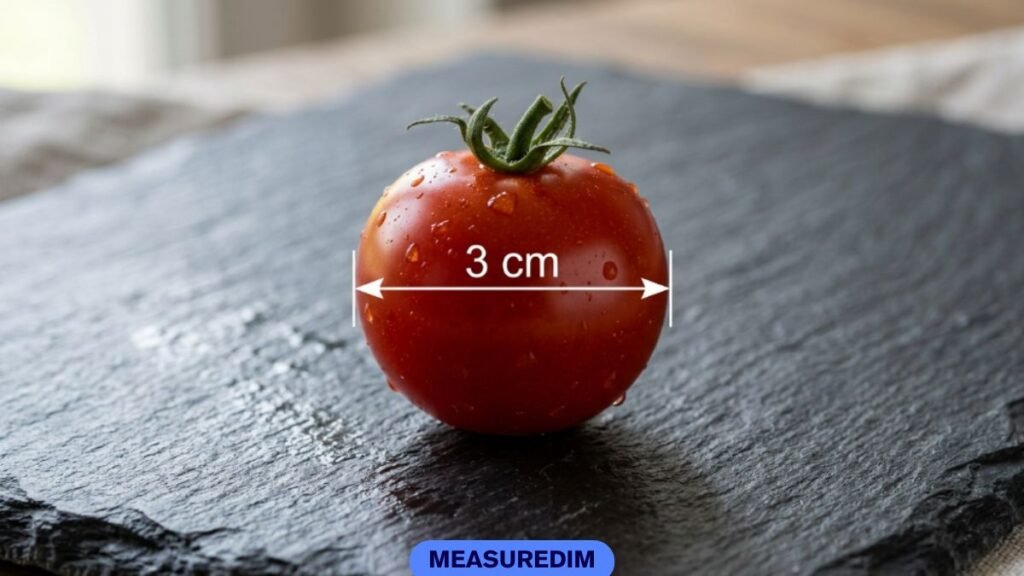
A cherry tomato spans roughly 2 to 3 cm, with the bigger ones brushing the top of that range. It’s the loosest match on this list, so I’d call it “up to 3 cm” rather than a bullseye — but a large one gives you a solid feel for the size.
Like the grape, it’s most helpful as a quick volume check when you’re at the kitchen counter and something needs sizing. It won’t win a precision contest, but it’ll tell you instantly whether “3 cm” means tiny or handful-sized. (Answer: small, but not tiny.)
3 cm Objects at a Glance
Everything above, lined up so you can scan it. “vs 3 cm” shows how each object compares to the exact target.
| Object | Real dimension | vs 3 cm |
| Plastic bottle cap | ~2.8–3.0 cm diameter | ≈ spot on |
| US half-dollar coin | 3.06 cm diameter | just over |
| Lego 1×4 brick | 3.18 cm long | slightly over |
| Small paperclip | ~3.3 cm long | a bit over |
| Thumb tip to first knuckle | ~2.5–3 cm | ≈ / just under |
| Large grape | ~2.5–3 cm | ≈ / just under |
| Crown bottle cap | ~2.9–3.2 cm diameter | ≈ spot on |
| Cherry tomato | ~2–3 cm | ≈ / under |
The tightest matches are the two caps and the half-dollar. If you want one object to remember, make it the bottle cap — it’s the most available and the most accurate.
No Ruler? Here’s How to Fake One
When there’s no tape measure in reach, you’ve still got options. These get you within a couple of millimeters of 3 cm, which is close enough for almost anything that isn’t machining.
Use your thumb tip. Tip to first knuckle is about 2.5–3 cm for most adults. Calibrate it once against a real ruler so you know whether you run short or long.
Stack two fingers. Your index and middle fingers held together are roughly 3–3.5 cm across at the base for many people — a quick “is it about this wide?” check.
Grab a bottle cap. There’s almost always one within arm’s reach, and its ~3 cm diameter turns it into a ready-made gauge you can set right on top of the thing you’re measuring.
Round up from an inch. On any ruler, 3 cm is a little past the 1-inch mark — specifically 1.18 in. If all you have is an imperial ruler, aim just short of 1 3/16 in.
Read Also: How Big Is 11 Inches? 9 Everyday Objects That Show You the Size
Where 3 cm Shows Up in Real Life
This size isn’t random — it turns up in places worth knowing about.
In online shopping, product listings love round metric figures, so “30 mm” shows up constantly for pendants, charms, buttons, buckles, drawer knobs, and phone-camera modules. Being able to picture 3 cm before you click “buy” saves a lot of returns.
In safety standards, there’s a well-known reference near this size: the small-parts test cylinder used to flag choking hazards has an inner diameter of about 3.17 cm (1.25 in). A toy piece that drops through a tube that width is considered a risk for young children — a genuinely useful thing to keep in mind around a 3 cm object and a toddler.
In medical and dermatology notes, lengths like a 3 cm mark or lesion get recorded precisely because size guides decisions. If a measurement like that applies to you personally, that’s a conversation for a clinician rather than a size chart — but it’s a reminder that 3 cm is a meaningful, noticeable length, not a trivial one.
You’ll also meet it in crafts and woodworking (a 30 mm hole saw, a 3 cm bead), in jewelry (pendant drop and width), and in packing, where a 3 cm difference decides whether something clears a slot or a mailer.
3 cm vs the Sizes On Either Side
Half the confusion around any measurement comes from its neighbors. Here’s how 3 cm sits between the size just under and the size just over.
Just below — about 2.4 to 2.5 cm (1 inch): This is exactly where the US quarter lives, at 24.3 mm. It’s a common mistake to call a quarter “about 3 cm,” but it’s noticeably smaller — closer to an inch. A standard wine cork’s diameter (~2.4 cm) sits here too.
Just above — about 4 cm: A table tennis ball is a clean 4.0 cm across, and a golf ball is 4.27 cm. A D-cell battery is 3.4 cm in diameter. Any of these will feel distinctly chunkier than a 3 cm object when you hold them.
| Size | Landmark object |
| ~2.4 cm | US quarter |
| 3 cm | bottle cap / half-dollar |
| ~3.4 cm | D battery diameter |
| ~4.0 cm | table tennis ball |
Slot 3 cm between the quarter and the ping-pong ball and you’ve got a mental bracket that’s hard to forget.
Where People Trip Up With 3 cm
A few reliable mistakes are worth calling out.
Mixing up 3 cm and 3 inches. Three inches is 7.62 cm — more than double. If a size feels way bigger than a bottle cap, check which unit you’re actually reading.
Reading 30 mm as 3 mm. A missed decimal or a misread scale turns 3 cm into a tenth of itself. Three millimeters is about the thickness of two stacked coins; keep the factor-of-ten gap straight.
Assuming a quarter is 3 cm. It’s a tempting reference because coins feel “standard,” but a quarter is 2.4 cm. Reach for the half-dollar or a bottle cap instead.
Trusting “about an inch.” People round 3 cm down to an inch and lose almost a fifth of the length. It’s 1.18 in — round up, not down.
Quick Answers to Common 3 cm Questions
What do 3 centimeters look like?
It looks like a small bottle cap or a half-dollar coin — a little longer than one inch.
What is an example of 3 cm?
A plastic water-bottle cap is a great example, sitting right around 3 cm across.
How big is 3 cm visually?
About the width of a bottle cap or a large grape — small enough to hold in your hand.
How long is 3 cm on a finger?
It runs from your thumb tip down to the first knuckle on most adult hands.
What does 3 cm look like on a ruler?
It reaches the 30 mm mark, just past the 1-inch line at about 1.18 inches.
The 3 cm Cheat Code
So now you know how big is 3 cm. It is 30 millimeters, or about 1.18 inches. That makes it a little longer than one inch. A plastic bottle cap shows this size best. The cap fits right around 3 cm across. You can hold it in your hand with ease. Keep that cap in your mind as your simple guide.
Many small things match this length too. A large grape, a half-dollar coin, and a four-stud Lego brick all sit near 3 cm. You can use any of them to check a size fast. Now you can picture 3 cm without a ruler. You will spot this length in shops, crafts, and daily life with real confidence.
Related Guides:
1: How Tall Is 60 Inches? A 5-Foot Size Guide With Real Examples
2: How Long Is 30 Feet? 10 Everyday Objects to Picture It
3: How Big Is 30cm? 11 Everyday Objects That Show the Length
4: How Big Is 20cm? 11 Everyday Objects That Nail the Size
5: How Big Is 14 Inches? Real Objects That Show You the Size