
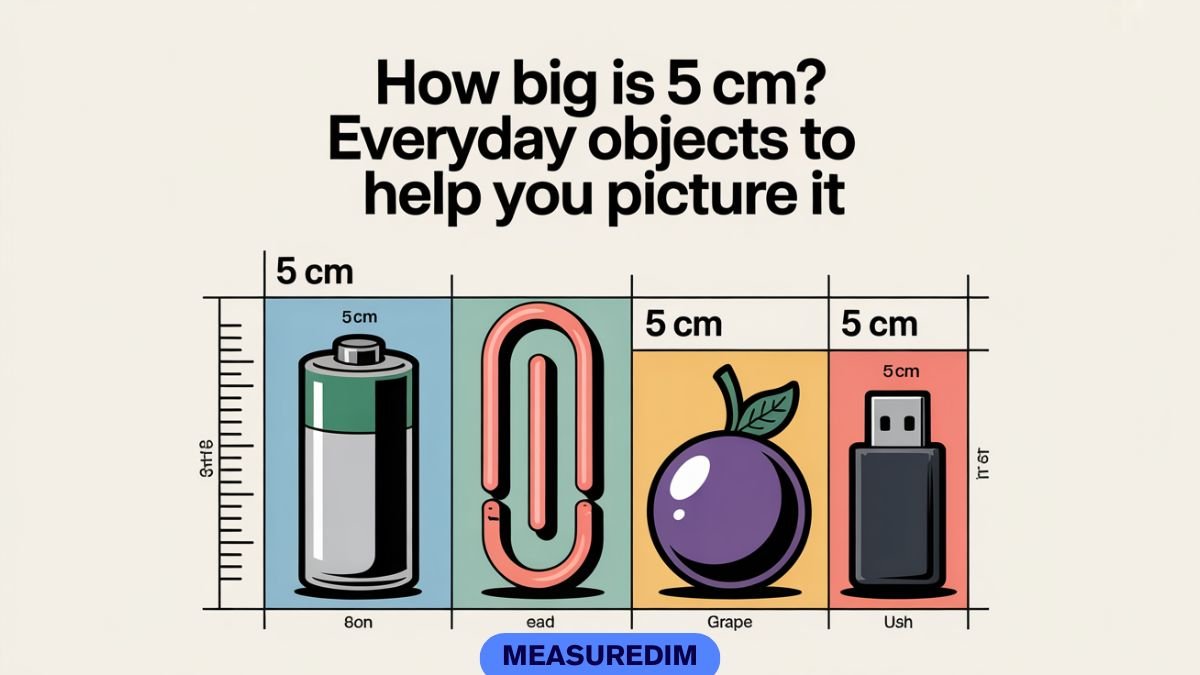
How Big Is 5 cm? Everyday Objects to Help You Picture It
Five centimeters is a small length. It equals 50 millimeters, or about 1.97 inches. That is just under two inches on a ruler.
Picture a standard AA battery in your hand. It measures almost exactly 5 cm from end to end. You already know this size better than you think.
You meet 5 cm often in daily life. A wine cork, a golf ball, and a domino tile all sit close to it. Once you link it to one object, you can judge it anywhere.
Five Centimetres at a Glance
5 cm is just under 2 inches — precisely 1.97 inches, or 50 millimetres. If you’re holding a standard AA battery, you’re already looking at almost exactly 5 cm from tip to base. Three adult fingers pressed together, measured across the knuckles, land in the same ballpark.
That’s the whole answer. Everything below is about making it stick.
5 cm in Every Unit You’ll Need
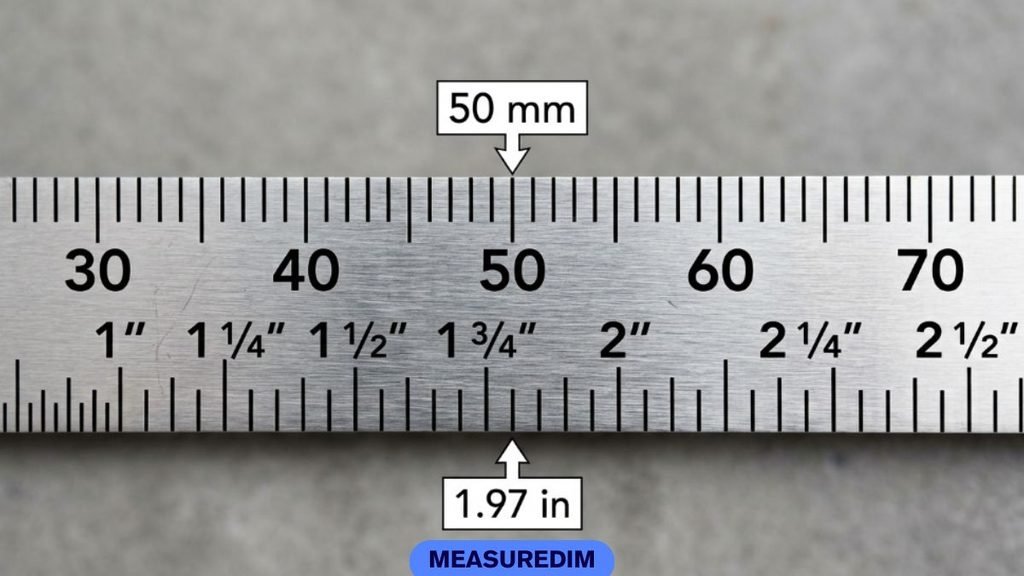
Whether you think in metric or imperial, here’s the length translated cleanly. These figures are exact conversions, rounded only where noted.
| Unit | 5 cm equals |
| Millimetres | 50 mm |
| Centimetres | 5 cm |
| Inches | 1.97 in (1.9685 exactly) |
| Feet | 0.164 ft |
| Yards | 0.0547 yd |
| Metres | 0.05 m |
The number to remember is the inch conversion: 5 cm is a shade under 2 inches, not exactly 2. That small gap trips people up constantly, and we’ll come back to it.
What 5 cm Actually Looks Like in Your Hand
Picture the width of two fingers plus a little extra. Picture the diameter of a golf ball with a few millimetres to spare. Picture the height of a wine cork, or the short edge of a business card. All of those live within a whisker of 5 cm.
It’s small enough to disappear inside a closed fist, yet large enough that you’d never confuse it with a coin or a fingernail. Think of it as the “matchbook” zone — roughly palm-fraction, comfortably visible, easy to hold between thumb and forefinger. Once you anchor it to one object you own, the estimate becomes automatic.
Everyday Objects That Measure Right Around 5 cm
Here are ten reliable references, ordered from the most exact matches to the ones that sit a little under. Each entry tells you the real measurement and how honestly it maps to 5 cm — no fudging.
AA Battery
A standard AA battery measures 50.5 mm from the flat negative end to the tip of the positive button — that’s 5.05 cm, about as close to a perfect match as any household item gets. Every AA cell on Earth follows the same IEC standard, so this reference doesn’t drift between brands or countries.
I keep one in a drawer purely as a stand-in ruler. Hold it upright against whatever you’re sizing and you’ve got a dead-accurate 5 cm gauge in your hand. It’s the reference I reach for when checking whether a small parcel will clear a size limit, or how tall a phone stand needs to be.
C Battery
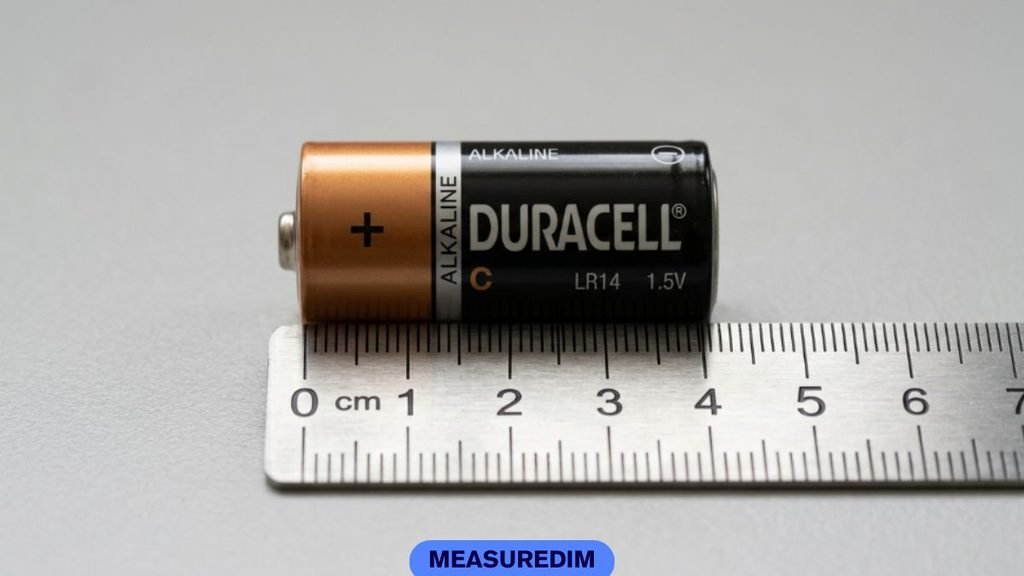
Step up to a C battery and the length is exactly 50 mm — a clean 5 cm on the nose. It’s fatter than an AA (26 mm across versus 14.5 mm), but the height is what we care about here, and it’s textbook.
Fewer homes keep C cells around than AAs, so treat this as the confirmation rather than the everyday tool. When you do have one — often lurking in a torch or an old radio — it’s the single most exact 5 cm object you’re likely to own. Stand it next to a suspected 5 cm gap and the two should line up flush.
Read Also: How Long Is 10 Feet? 10 Everyday Objects to Picture It
Jumbo Paper Clip
The oversized jumbo paper clip — the big brother of the ordinary desk clip — runs about 50 mm end to end, roughly 2 inches, which puts it right on 5 cm. A regular No. 1 clip is far shorter at around 33 mm, so make sure you’re picturing the large one.
Because clips are flat, you can lay one directly on a page, a screen, or a fabric hem and read the length off instantly. This is the one I use when marking seam allowances or spacing holes for a shelf bracket — it sits still and doesn’t roll away like a battery does.
A Business Card’s Short Edge
A US business card measures 3.5 by 2 inches, which makes its short edge 50.8 mm — call it 5.08 cm, a near-exact match. (European cards run slightly taller at 55 mm on the short side, so this one’s region-dependent.)
Almost everyone has a card wedged in a wallet or pinned to a board, which makes it a brilliant emergency ruler. Turn the card so the narrow side faces your target and you’ve got a flat, rigid 5 cm reference you can hold flush against a wall or a box. Handy when you’re checking whether a frame, a tile, or a gap in shelving clears the mark.
A Domino Tile
A standard domino is commonly cut to 2 by 1 inches, giving it a length of 50.8 mm — essentially 5 cm. Sizes do vary: mini travel sets are smaller and tournament tiles a touch larger, so this holds for the classic double-six set rather than every box on the shelf.
Stand a tile on its end and you’re looking at a solid, chunky 5 cm block — useful because, unlike flat cards, it gives you a sense of 5 cm as a real, three-dimensional height. I’ve used one to judge the clearance under a cabinet foot and to check whether a plant pot riser was tall enough.
A Wine Cork
A natural wine cork typically runs about 45 mm long, though the range spans roughly 38 to 54 mm depending on the bottle and the wine’s intended ageing. So a cork is a touch under 5 cm on average — treat it as “nearly there” rather than exact.
Still, it’s a great tactile reference because you can feel its length between finger and thumb. Next time you open a bottle, hold the cork up: it falls just short of a full 5 cm, which is a useful way to remember that 5 cm is a bit longer than the everyday cork you picture.
A Golf Ball
A regulation golf ball must be at least 42.67 mm in diameter, and most balls sit right at that minimum — about 4.3 cm. That’s noticeably under 5 cm, so a golf ball is best used as a lower bookend: 5 cm is a golf ball plus a few extra millimetres.
The value here is that a golf ball is a shape everyone can conjure instantly. Imagine one, then imagine adding about 7 mm to its width, and you’ve landed on 5 cm. It’s a quick mental correction that stops you from underestimating.
A Ping-Pong Ball
A table-tennis ball is standardised at 40 mm across — exactly 4 cm. Like the golf ball, it sits below our target, and the gap is larger: a full centimetre short.
Use it as a clear “too small” marker. If something is the size of a ping-pong ball, it is not 5 cm — it’s a fifth smaller. Picturing the ball and a golf ball together also gives you a neat sense of scale: 4 cm, then 4.3 cm, then a small step up to 5 cm.
Two Quarters, Side by Side
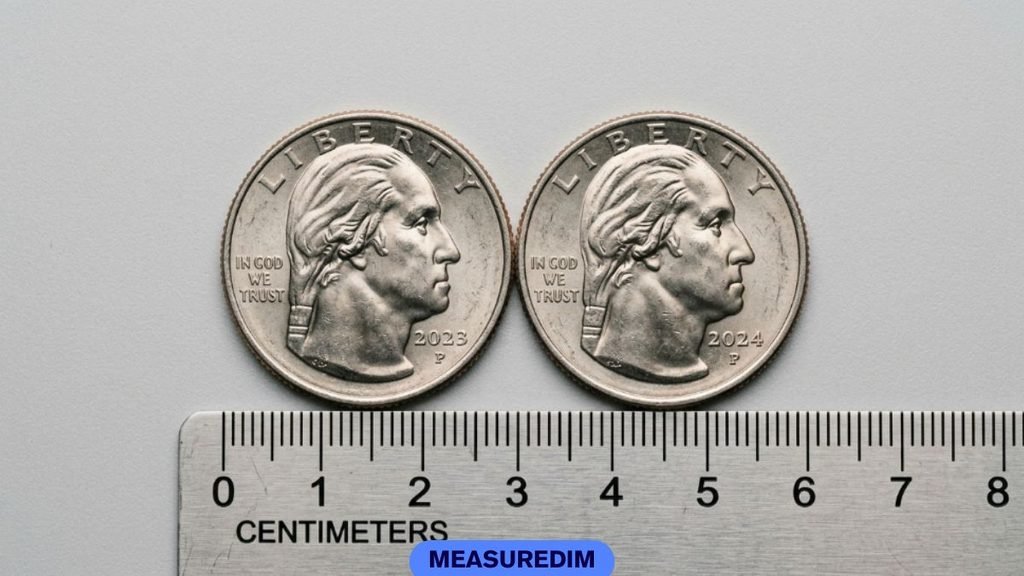
A US quarter is 24.26 mm across, so two of them touching edge to edge span about 48.5 mm — around 4.85 cm, just shy of the mark. Line up two quarters and you’re a couple of millimetres short of a true 5 cm.
Coins make good field references because you nearly always have change on you. Lay two quarters flat and butt them together on a table, and you’ve built a quick, repeatable 4.85 cm span — close enough for rough work like judging a bead, a button, or a bolt length, as long as you remember to nudge your estimate up slightly.
A 9-Volt Battery’s Height
The rectangular 9-volt battery — the one with both terminals on top — stands 48.5 mm tall, or about 4.85 cm. Its height lands a hair under 5 cm, matching the two-quarter span almost exactly.
Because it’s a solid block rather than a cylinder, it stands upright on its own, which makes it easy to compare against anything sitting on a flat surface. Smoke-alarm and multimeter owners tend to have one handy; stand it up beside your target and add a sliver to reach a full 5 cm.
Every Object Side by Side
Here’s the whole set at a glance, sorted by how each one stacks up against 5 cm. “≈ exact” means within about a millimetre.
| Object | Real dimension | Versus 5 cm |
| C battery (length) | 50.0 mm | Exact |
| AA battery (length) | 50.5 mm | ≈ exact |
| Jumbo paper clip | ~50 mm | ≈ exact |
| Business card, short edge (US) | 50.8 mm | ≈ exact |
| Domino tile (length) | 50.8 mm | ≈ exact |
| Credit card, short edge | 54.0 mm | Slightly over |
| 9-volt battery (height) | 48.5 mm | Slightly under |
| Two quarters, side by side | 48.5 mm | Slightly under |
| Wine cork (length) | ~45 mm | Under |
| Golf ball (diameter) | 42.7 mm | Under |
| Ping-pong ball (diameter) | 40.0 mm | Under |
If you want the single best pocket reference, it’s the AA battery — universal, standardised, and within half a millimetre of a true 5 cm.
No Ruler Handy? Use Your Fingers
Your own hand is a decent backup ruler once you calibrate it. These are approximate — hand sizes vary — but they’ll get you within a few millimetres.
Three fingers together. Press your index, middle, and ring fingers side by side and measure across the middle knuckles. For most adults that’s around 5 to 6 cm, so three fingers slightly overshoots 5 cm.
Two thumb-widths. An adult thumb is roughly 2 to 2.5 cm wide at the nail. Picture two of them side by side and you’re at 4 to 5 cm — a touch under the mark.
Double your thumb tip. The distance from your thumb tip to the first knuckle joint is about 2.5 cm for many people. Mentally stack two of those and you’ve got a rough 5 cm.
For anything precise, though, nothing beats grabbing an AA battery or turning a business card on its side. Calibrate your hand once against one of those and your finger-estimates get far more trustworthy.
Read Also: How Long Is 1 Meter? 7 Everyday Objects That Show It
Where People Go Wrong With 5 cm
A few mix-ups show up again and again. Sidestep these and your estimates stay honest.
Treating 5 cm as exactly 2 inches. It isn’t. 5 cm is 1.97 inches — just under. Over a single object the difference is tiny, but stack that error across a shelf run or a row of tiles and it adds up fast.
Confusing centimetres with millimetres. 5 cm is 50 mm, not 5 mm. That’s a tenfold error, and it’s shockingly easy to make when you glance at the wrong marks on a ruler. The small ticks are millimetres; the numbered lines are centimetres.
Reading the ruler from the wrong end. Some rulers have a few millimetres of blank space before the zero. Line up your object with the actual 0 mark, not the physical edge, or every measurement runs long.
Assuming a golf ball is 5 cm. It’s a common go-to, but a golf ball is only about 4.3 cm across. Reach for a battery or a card instead when you need the real thing.
Times When 5 cm Is the Number That Counts
This length turns up far more often than you’d expect, which is exactly why it’s worth being able to picture.
In online shopping, 5 cm is the difference between a pendant that reads as delicate and one that reads as a statement piece, or between earbuds that fit your ear canal and ones that don’t. Product photos lie about scale constantly; knowing 5 cm on sight helps you decode the spec sheet.
In DIY and crafting, it’s a common spacing for shelf pins, a typical hem allowance, a standard bulb-planting depth, and a frequent tile-and-grout dimension. In packing and shipping, a few carriers set small-parcel thresholds near this range, so an extra 5 cm can bump a box into a pricier bracket. And in everyday life — measuring a phone lip, a plant’s growth in a week, a wound or a bruise you’re keeping an eye on — 5 cm is a genuinely useful mental yardstick.
5 cm Versus Its Neighbours
Sizes make more sense in context, so here’s how 5 cm relates to the lengths on either side of it.
Half of 5 cm is 2.5 cm — almost exactly one inch, and close to the width of a US quarter (2.4 cm). If something is coin-sized, it’s roughly half your target.
One step down, around 4 cm, sits the ping-pong ball. One step up, around 6 cm, you’ll find the long axis of a large chicken egg (roughly 5.5 to 6 cm) or the height of a D battery (61.5 mm).
Double it to 10 cm and you’re at about the width of a credit card’s long side (8.56 cm) plus a little, or roughly the diameter of a standard drinks can (6.6 cm) with room to spare. Holding these anchors — an inch below, a golf ball just under, an egg just over — turns 5 cm from an abstract number into a spot on a familiar scale.
Sorting the Myths From the Facts
A quick round of the claims people repeat, checked against reality.
Myth: “5 cm and 50 mm are different sizes.” Fact: They’re identical. A centimetre is ten millimetres, so 5 cm is 50 mm, full stop.
Myth: “5 cm is about 2 inches, near enough.” Fact: It’s 1.97 inches. Close, but consistently just under — worth remembering on longer runs.
Myth: “A golf ball is roughly 5 cm wide.” Fact: A golf ball is about 4.3 cm across. It’s a useful lower marker, not a match.
Myth: “Any paper clip works as a 5 cm ruler.” Fact: Only the jumbo clip (~50 mm) does. A standard clip is around 33 mm — well short.
Questions People Actually Ask
How big is 5 centimeters visually?
It looks just under 2 inches — about the length of a standard AA battery or a wine cork.
How big is 5 cm compared to fruit?
It matches the width of a large strawberry or a small plum, and sits just above an average grape.
What does five cm look like?
Picture a domino tile stood on its end, or the short edge of a business card.
How long is 5 cm in fingers?
It equals roughly three adult fingers held together, measured across the knuckles.
How long is 5 cm in actual size?
Exactly 50 millimeters, or 1.97 inches — a hair under two inches on a ruler.
Locking 5 cm Into Memory
So now you know how big is 5 cm. It is a small size. It equals 50 millimeters, or just under two inches. You do not need a ruler to picture it. A standard AA battery matches it almost exactly. A C battery, a jumbo paper clip, and a domino tile all share this length. You can hold any of these and see 5 cm at once.
Keep one of these objects in your mind as your guide. An AA battery works best because it stays the same everywhere. Next time you need to measure, you will spot 5 cm fast. This small skill helps you in school, at home, and in daily tasks. Practice it once, and you will remember it for good.
Related Guides:
1: How Tall Is 40 Inches? Everyday Comparisons & Conversions
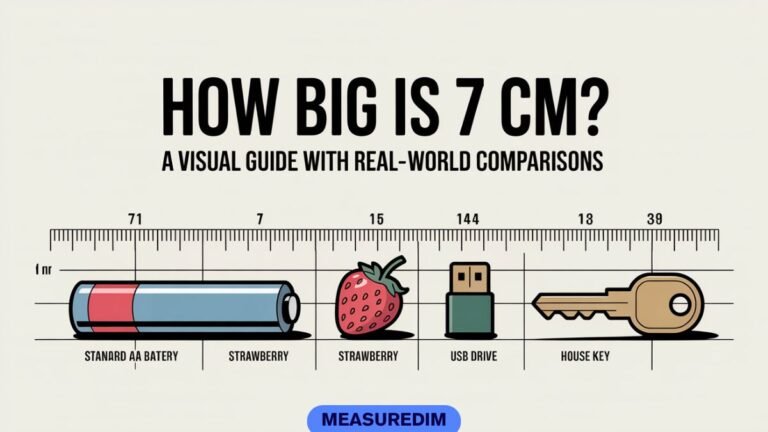
2: How Big Is 7 cm? A Visual Guide With Real-World Comparisons
3: How Long Is 20 Feet? 11 Everyday Objects Compared
4: How Big Is 3 cm? Real-Life Examples and Conversions
5: How Long Is 12 Inches? 9 Everyday Things to Picture It

One Comment