How Long Is 20 Feet? 11 Everyday Objects Compared
Twenty feet is a length. It equals 240 inches. In metric, that is 6.096 meters, or about 6.1 m. Picture a standard shipping container. The metal box on cargo trucks is exactly this long. That is what 20 feet looks like.
Ever tried to guess a length by eye? Most people get it wrong outdoors. Twenty feet always looks shorter than it is. But you already own the perfect ruler. Three queen mattresses in a row hit 240 inches exactly. Now the size clicks into place.
You meet this length more than you think. Moving trucks, boats, and garages all use it. A big pickup truck is close to 20 feet. So is a large python or a great white shark. You can also just pace it out. Eight normal steps cover about 20 feet.
The Short Answer
Twenty feet is 240 inches, or almost exactly 6.1 meters. The cleanest mental image is a standard 20-foot shipping container — the metal box you see stacked on cargo ships and trucks is exactly this long. If you’d rather stay indoors, three queen mattresses laid end to end also come to precisely 20 feet.
Every Conversion You Might Need
Here’s 20 feet expressed in every common unit, both imperial and metric. These figures are exact (rounded only where a unit doesn’t divide evenly).
| Unit | 20 feet equals |
| Inches | 240 in |
| Feet | 20 ft |
| Yards | 6.667 yd (6 yd 2 ft) |
| Centimeters | 609.6 cm |
| Meters | 6.096 m |
| Millimeters | 6,096 mm |
The one people trip over most is meters: 20 feet is 6.096 m, not 6 m flat. Close enough for a rough sketch, but if you’re ordering material or planning a boat berth, use the full figure.
What 20 Feet Actually Feels Like
Think of a distance you can walk in about eight relaxed steps. An average adult stride covers roughly 2.5 feet, so eight normal steps lands you within a foot of 20 feet — a quick trick you can do in any driveway.
Vertically, it’s a lot taller than most people picture: about two stories of a typical house, or roughly a basketball hoop stacked on top of another basketball hoop. Horizontally, it’s the width of a generous two-car garage door plus a bit of wall. It’s the kind of length that feels short outdoors and surprisingly long inside a room — which is exactly the illusion that trips people up.
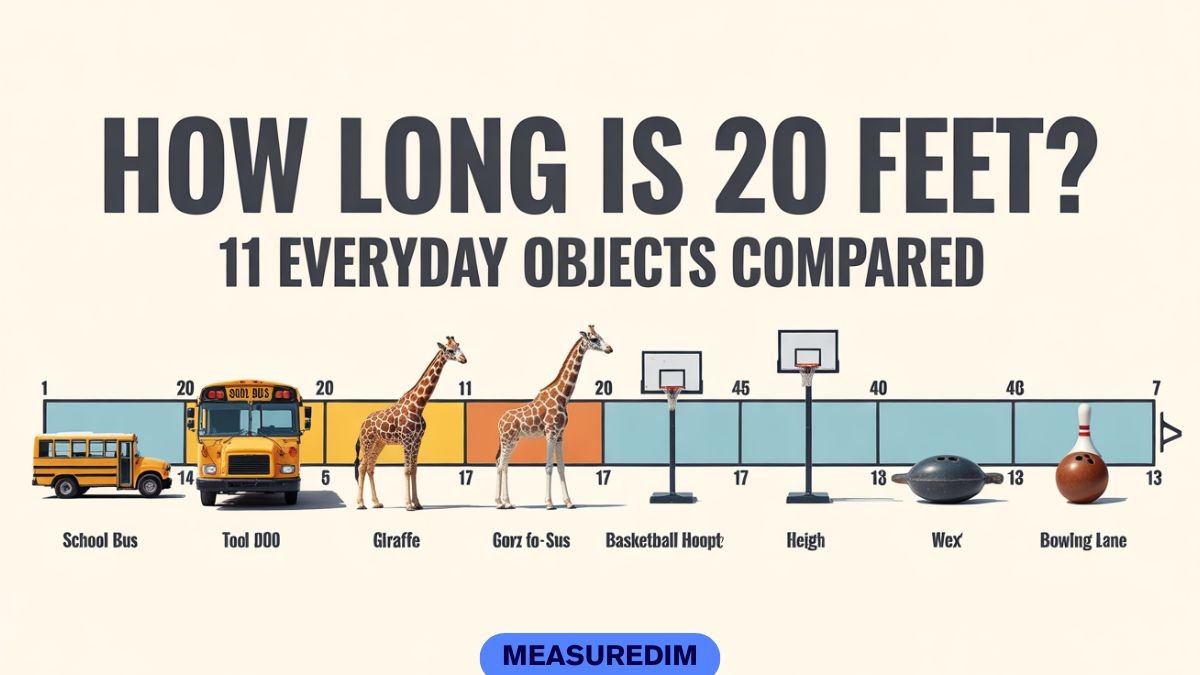
11 Real Things That Are About 20 Feet Long
Each object below is measured against the 20-foot mark, with a note on whether the match is exact or approximate.
A Standard 20-Foot Shipping Container

The intermodal shipping container comes in one iconic size that shares its name with our target: the 20-foot container, whose external length is exactly 20 feet (6.096 m). This is the “TEU” — the twenty-foot equivalent unit — that the entire global freight industry uses as its base counting block. Width sits at 8 feet and standard height at 8 feet 6 inches, so the box you’re picturing is long, narrow, and boxy.
This is the single most reliable 20-foot reference on the planet because the dimension is defined by international standard, not by a manufacturer’s whim. One small caveat worth knowing: the interior length is about 19 feet 4 inches, since the corrugated walls and end frames eat a few inches. If you’re renting one for storage and need to fit exactly 20 feet of shelving, that gap matters.
Three Queen Mattresses End to End
A queen mattress measures 80 inches long. Line up three of them nose to tail and you get 240 inches — 20 feet on the nose, with zero rounding. It’s the tidiest piece of math in this whole list.
Most households already own at least one queen, so this is an easy one to feel. Picture your own bed, then imagine two more clones extending off the foot of it down a hallway. That’s the reference I reach for when someone needs to sanity-check a room measurement at home, because nearly everyone has a queen-sized mental yardstick already installed.
Read Also: How Big Is 3 cm? Real-Life Examples and Conversions
A Crew-Cab Full-Size Pickup Truck
A full-size crew-cab pickup like the Ford F-150 SuperCrew runs roughly 19.5 to 21 feet bumper to bumper, depending on bed length. The short-bed version measures about 19.3 feet; the longer 6.5-foot-bed configuration stretches to nearly 20.9 feet. Split the difference and a typical crew-cab F-150 sits within inches of 20 feet.
This is a great outdoor reference precisely because these trucks are everywhere — spot one in a parking lot and you’re looking at almost exactly 20 feet of vehicle. It’s the comparison I lean on when someone’s judging whether a trailer, a boat, or a parking stall will clear a full-size truck’s footprint. Just remember the figure covers the truck alone; add a hitch or tailgate-down and you’re past 20.
A “20-Foot” Moving Truck’s Cargo Box
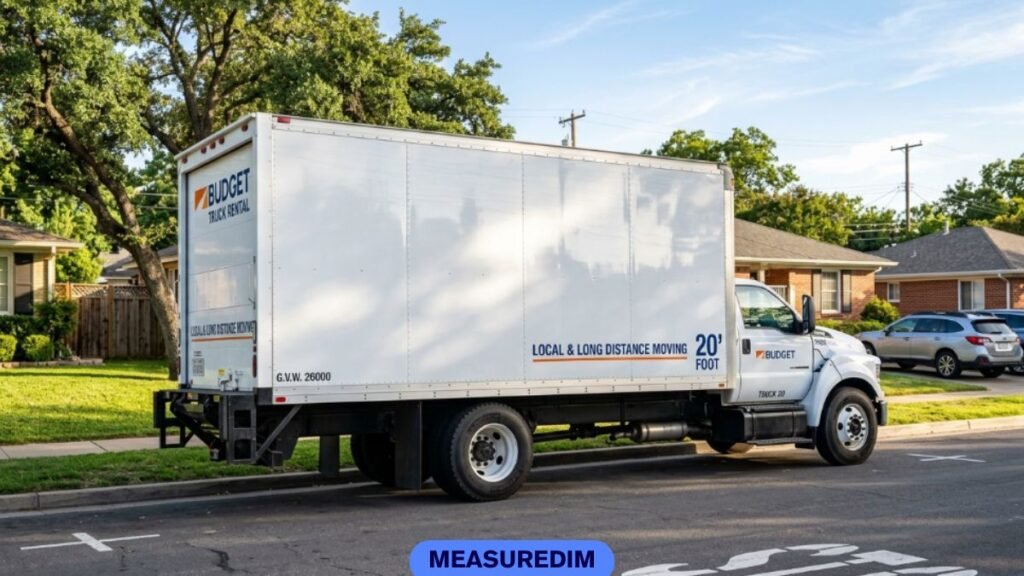
Rental companies label a popular mid-size moving truck the 20-foot truck, and the name comes from its cargo box — the enclosed area behind the cab runs about 19 feet 6 inches long. That’s where the marketing number lands, not the whole vehicle.
The trap here is assuming the truck itself is 20 feet. It isn’t — with the cab out front, the total length is closer to 23 feet. I flag this because people rent these to move and then discover the vehicle won’t fit a tight alley or a compact driveway. When you hear “20-foot truck,” think 20 feet of loading space, and add several feet for the cab and mirrors before you plan the route.
A Roomy Car Parking Space
A standard car parking bay is typically 16 to 20 feet long, with 18 feet being the most common stall depth and 20 feet reserved for generous, well-designed lots. So a full-length space represents the upper end of everyday parking geometry.
Because you interact with parking lines constantly, they make a handy real-world ruler. Next time you’re on foot, walk the length of a single stall heel to toe — if it’s a roomy lot, you’ve just paced out close to 20 feet. This comparison is genuinely useful when you’re weighing whether a long vehicle or a small trailer will overhang a standard space. [IMAGE: a parking bay with a 20-foot dimension arrow along its length]
The Depth of a Two-Car Garage
Most two-car garages are built 20 to 24 feet deep, with 20 feet being the practical minimum to park a mid-size car and still shut the door behind it. So the run from the garage door to the back wall is a solid stand-in for 20 feet.
If you’ve got a two-car garage, you have a built-in reference you can walk any day. Stand at the closed door, take those eight relaxed steps toward the back wall, and you’ve physically traced the distance. This one earns its place when you’re planning storage racks, a workbench, or figuring out whether a longer vehicle will clear the door on a shallow-depth garage.
A Mid-Length Cargo Van
A Mercedes-Benz Sprinter on the 144-inch wheelbase measures about 19.4 feet long overall — just under our target. Fleet vans, camper conversions, and delivery vehicles in this class hover right around the 19-to-20-foot band.
These vans are a familiar sight on any street, which makes them a quick gut-check for the length. Picture a standard delivery Sprinter parked at the curb and mentally add a few inches — that’s your 20 feet. It’s the reference I use when comparing how much longer something is than a “normal” work van, since most people underestimate just how much road one of these occupies.
A 20-Foot Pontoon Boat

Recreational pontoon boats cluster around a few standard lengths, and the 20-foot pontoon is one of the most popular family sizes, comfortably seating eight to ten people. Here the hull length matches the label closely, so the deck you’d stand on runs the full 20 feet.
Boaters know their footage cold, which makes a pontoon a natural yardstick around any lake or marina. The practical payoff: dock slips and boat trailers are sized by the foot, so knowing that a 20-foot pontoon needs a slip and trailer rated for at least that length saves an expensive mismatch. If you can picture a mid-size pontoon gliding across a lake, you can picture 20 feet.
A Large Great White Shark
Adult great white sharks typically run 15 to 16 feet, but the largest reliably documented individuals reach about 20 feet — the famous specimen nicknamed Deep Blue is estimated at roughly this length. So a truly big great white is a living, swimming 20-foot ruler, though it sits at the top end of the species’ range rather than the average.
This one is memorable more than practical, but memorable is exactly what helps a size stick. Imagine an apex predator as long as a shipping container cruising past — that mental image tends to lodge itself permanently. Label it honestly, though: most great whites you’d read about are shorter, and 20 feet represents an exceptional adult, not a typical one.
A Big Reticulated Python
The reticulated python is the longest snake on Earth, and a large wild adult comfortably reaches 20 feet, with record captive specimens measured past 25 feet. A 20-foot individual is well within the believable range for a mature snake of this species.
Snakes stretch the imagination in a way rigid objects don’t, which is why this comparison sticks. Picture a serpent long enough to span three queen mattresses and you’ve fused two references from this list into one. It’s a vivid reminder that 20 feet, laid out in a straight line, is a genuinely long distance — longer than most people’s living rooms.
A Record-Class Saltwater Crocodile
The saltwater crocodile is the largest living reptile, and while big males usually top out around 14 to 17 feet, the longest verified individual on record measured just over 20 feet (about 6.17 m). That places a record-class saltie right at our mark.
Like the shark and the python, this is a top-of-range figure, not an everyday one — worth stating plainly so the number stays honest. But it does something useful: it anchors 20 feet as the ceiling of “enormous animal” territory, the length where even nature rarely goes bigger. Once you’ve pictured a crocodile as long as a pickup truck, the scale of 20 feet clicks into place.
The 20-Foot Lineup at a Glance
Here’s every object above, sorted from the closest exact match to the rougher approximations.
| Object | Approx. length | Match to 20 ft |
| 20-foot shipping container (exterior) | 20 ft | Exact |
| Three queen mattresses end to end | 20 ft (240 in) | Exact |
| 20-foot pontoon boat | ~20 ft | Very close |
| Saltwater crocodile (record) | ~20.2 ft | Very close |
| Reticulated python (large adult) | ~20 ft | Close (range up to 25+ ft) |
| Great white shark (large adult) | ~20 ft | Top of range |
| Crew-cab F-150 pickup | 19.3–20.9 ft | Close |
| “20-foot” moving truck box | 19.5 ft | Slightly under |
| Two-car garage depth | 20–24 ft | At the low end |
| Cargo van (Sprinter 144) | 19.4 ft | Slightly under |
| Parking space (roomy) | 18–20 ft | Upper end |
Estimating 20 Feet With No Tape Measure
When you’re caught without a tool, your own body and a few household objects will get you close.
Walk it. A relaxed adult stride is about 2.5 feet. Count eight normal steps and you’ve covered roughly 20 feet — the fastest field estimate there is.
Use your arm span. Your fingertip-to-fingertip reach is close to your height, so for many adults that’s about 5.5 to 6 feet. Three and a half arm spans, laid end to end, lands near 20 feet.
Stack people. Three and a half average adults lying head to toe come to about 20 feet. Easier to imagine than to arrange, but it’s a solid mental yardstick.
Borrow a mattress. If you’re indoors, remember the queen-mattress trick: three of them equal exactly 20 feet, so half of that (10 feet) is one and a half mattresses.
Read Also: How Long Is 12 Inches? 9 Everyday Things to Picture It
Mistakes People Make With This Measurement
Confusing 20 feet with 20 square feet. These aren’t remotely the same. Twenty linear feet is a straight line the length of a shipping container. Twenty square feet is a tiny area — roughly a 4-by-5-foot patch, about the size of a small bathroom floor. Always check whether a listing means length or area.
Assuming a “20-foot truck” is 20 feet long. As covered above, that number describes the cargo box, not the vehicle. The truck with its cab is several feet longer, which catches out plenty of first-time movers.
Mixing up a container’s inside and outside. The 20-foot container is 20 feet on the outside but only about 19 feet 4 inches inside. If you’re packing to the inch, plan around the interior figure.
Underestimating it outdoors. Open space compresses distance to the eye. People routinely guess an outdoor 20 feet as more like 15. When it matters, pace it out rather than trusting a glance.
Where 20 Feet Comes Up in Real Life
This particular length shows up constantly once you notice it. Global shipping is literally counted in 20-foot units. Boat classes, moving-truck rentals, and RV lengths cluster around it. In home projects, 20 feet is a common deck span, a typical fence run between posts, and roughly the depth builders allow for a two-car garage. Cable and network installers think in 20-foot cable runs. Even sports lean on it — an NBA free-throw line sits 15 feet from the backboard, so 20 feet is a step or two beyond a free throw.
How 20 Feet Compares to Nearby Lengths
To lock the scale in, it helps to bracket it.
15 feet (just below) is 180 inches, or 4.57 meters — about the length of a large family sedan, or two and a half queen mattresses. Noticeably shorter, and the difference is easy to see side by side.
25 feet (just above) is 300 inches, or 7.62 meters — roughly the length of a school bus’s shorter cousin or a mid-size RV. That’s five queen mattresses, and it reads as clearly longer than our target.
A giraffe’s height is a fun near-miss: the tallest bull giraffes stand about 18 to 19 feet, just shy of 20. So a full-grown giraffe stood on end comes close to our mark without quite reaching it — a reminder that even the tallest land animal falls a hair under 20 feet.
Quick-Fire Q&A
What does 20 feet long look like?
It looks like a standard 20-foot shipping container, or three queen mattresses lined up end to end. Both measure exactly 240 inches.
How long is twenty feet visually?
Picture a crew-cab pickup truck or the depth of a two-car garage. Both sit right around 20 feet, or 6.1 meters.
How long is 20 feet to walk?
About eight normal adult steps, since one relaxed stride covers roughly 2.5 feet. It takes only a few seconds.
What is 20 feet compared to a human?
Roughly three and a half average adults lying head to toe. One person is about 5.5 to 6 feet tall.
How far is a 20 feet example?
It is the length of a 20-foot pontoon boat, or a large reticulated python stretched out straight — both close to 6.1 meters.
Locking This Size Into Memory
So now you know how long is 20 feet. It is 240 inches. It is also 6.096 meters, or about 6.1 m. The best picture to keep is a shipping container. That metal box measures exactly 20 feet. You can also line up three queen mattresses. They come to 240 inches on the nose. Both give you a clear, exact match.
You can also judge this length with your own body. Take eight normal steps and you cover close to 20 feet. Remember that outdoors this distance looks shorter than it really is, so pace it out when it matters. Keep the shipping container and the three mattresses in mind. With these simple tricks, you will spot 20 feet every time.
Related Guides:
1: How Big Is 10mm? Everyday Objects, Conversions & Size Comparisons
2: How Big Is 16 Inches? 8 Everyday Objects to Picture It
3: How Big Is 40 cm? Real Objects to Picture It Instantly
4: How Big Is 7mm? A Plain-English Guide to a Very Small SizeAa
5: How Tall Is a Monster Can? Every Size, Measured