
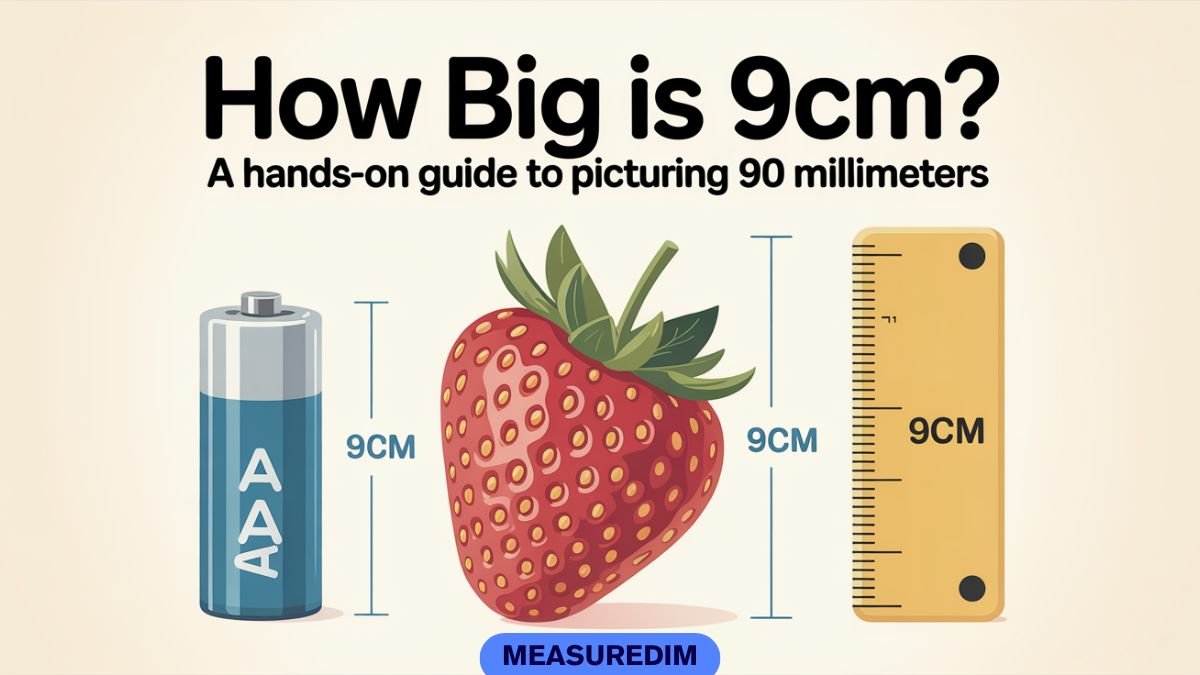
How Big Is 9cm? A Hands-On Guide to Picturing 90 Millimeters
So how big is 9cm? It is a small length equal to 90 millimeters. In inches, 9cm is about 3.54 inches, just over three and a half. It is roughly the size of the long edge of a playing card.
Someone says “9cm” and your mind draws a blank. Is that a finger, a phone, or a small jar? You cannot picture it, so a plain number stays useless. Let’s fix that with objects you already own.
You meet 9cm more often than you think each day. A fresh crayon, a bar of soap, and a small plant pot all sit near it. It is hand-sized, so it hides in a closed fist. Once you see it, you will spot it fast.
9 cm, Stripped Down to the Essentials
Here’s the direct answer: 9 centimeters is 90 millimeters, or just over 3½ inches — 3.54 inches, to be precise. Picture the long edge of a playing card and add a sliver, and you’re basically there. It’s a hand-sized length: small enough to hide in a closed fist, big enough to span most of your palm.
| Unit | 9 cm converts to |
| Millimeters | 90 mm |
| Centimeters | 9 cm |
| Inches | ≈ 3.54 in (a touch over 3½ in) |
| Feet | ≈ 0.30 ft |
| Yards | ≈ 0.098 yd |
| Meters | 0.09 m |
Keep that middle row in mind — 90 mm and 3.54 inches are the two figures you’ll actually use when comparing against a product listing or a craft pattern.
What 9 Centimeters Actually Feels Like
Length on paper is abstract; length in the hand isn’t. Nine centimeters is the reach from the base of your palm to about the middle of your fingers — the part of your hand that grips a doorknob. Lay it flat and it covers a coaster. Stand it up and it’s roughly the height of a squat spice jar.
It sits in that friendly “everyday small” band: longer than a AA battery, shorter than a soda can standing upright. If a number ever feels slippery, anchor it to your own hand — you carry that reference everywhere.
Everyday Objects That Sit Right Around 9 cm
These are the references I reach for most, ordered from the ones that match almost exactly to the ones that need a small mental adjustment. Each entry notes whether it’s a spot-on match or a close approximation.
The Long Edge of a Business or Playing Card
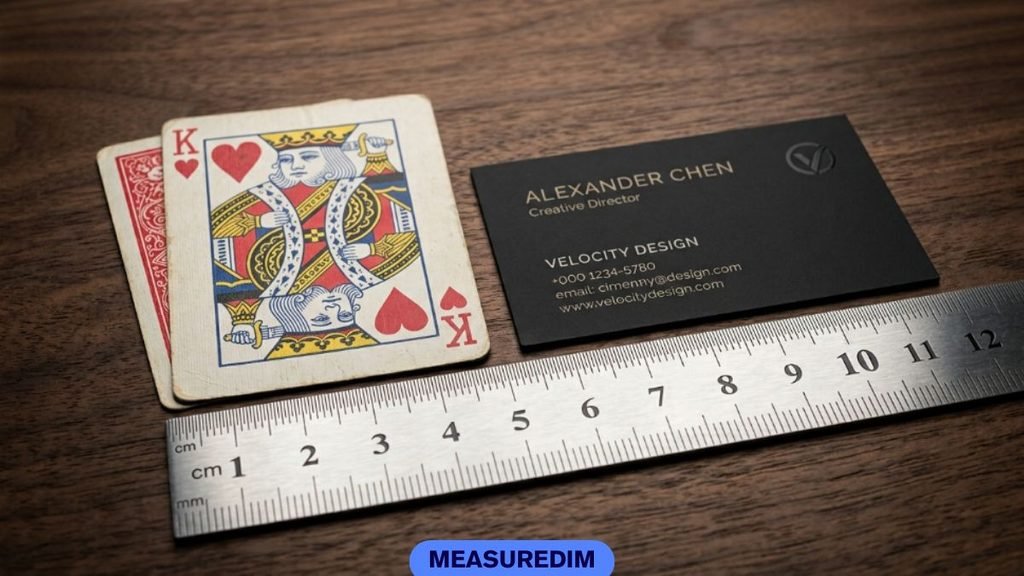
A standard business card and a poker-size playing card share the same long dimension: 3.5 inches, which works out to 8.89 cm — a single millimeter shy of 9 cm. For everyday estimating, that gap is invisible; the card is your 9 cm ruler. Bridge-size cards are narrower but keep the identical length, so any card from a shuffled deck does the job.
This is the reference I trust most because the size is standardized worldwide, not left to a manufacturer’s whim. Hold a card by its short ends and the span between your thumbs is essentially 9 cm. It’s the handiest cross-check when a marketplace listing quotes a length in centimeters and you want to know if the item will slot into a card wallet or a small frame.
A 3.5-Inch Floppy Disk
Here’s the pleasant surprise: the classic “3.5-inch” floppy disk is actually 90 mm wide — exactly 9.0 centimeters. The nickname refers to the disk inside; the rigid plastic shell measures a clean 9 cm across, making it one of the few household objects that hits the mark dead-on rather than close.
If you’ve got one rattling around in a drawer, it’s a perfect no-argument calibrator. Set it against anything you’re measuring and the outer edge draws a precise 9 cm line. Even for people too young to have used one, a photo makes the point instantly — that square everyone recognizes as the “save icon” is a 9 cm tile.
Read Also: How Big Is 4 cm? Nine Everyday Objects That Nail This Size
A Fresh Bar of Soap
A full-size bar of bath soap — think a 90-to-100-gram bar straight out of the wrapper — typically runs about 9 cm along its longest side. This one’s an approximation: brands vary, and a well-used bar shrinks fast, so treat a new bar as your reference rather than the sliver by the sink.
What makes soap useful is that most of us have one within arm’s reach in the bathroom. Cup it in your hand and notice how the long axis fills your palm — that’s your 9 cm. It’s a quick sanity check when you’re eyeing a soap dish, a travel tin, or a drawer compartment and wondering whether the bar will actually fit.
A Brand-New Crayon
An unsharpened, standard-length crayon measures roughly 9 cm (about 3½ inches) from tip to tip. Call it an approximation — crayon lengths drift a little by brand — but a fresh one out of the box is a dependable stand-in and a great teaching prop for a child learning centimeters.
Because kids’ supplies are everywhere in homes and classrooms, the crayon turns an abstract measurement into something a five-year-old can hold. Line one up against a worksheet margin or a small toy and you’ve got an instant, kid-friendly 9 cm gauge. It’s also why so many pencil cases and craft tins are built around this length.
The Width of Your Palm
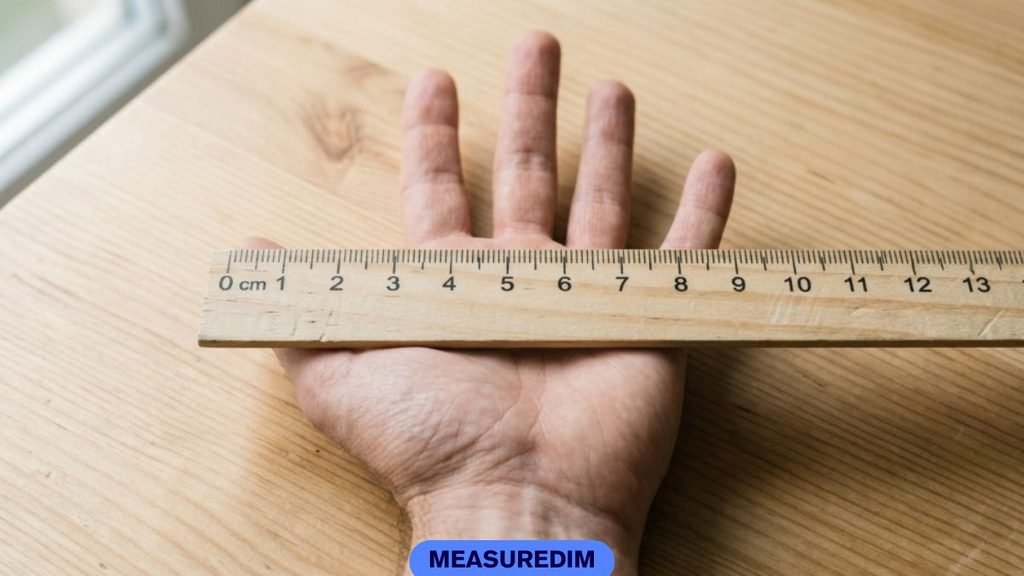
For a lot of adults, the distance across the four knuckles — the widest part of a flat hand, thumb tucked away — runs about 8.5 to 9 cm. It varies by person, so this is an estimate, not a spec sheet; measure your own once and you’ll know your personal offset forever.
The beauty here is that you never leave it at home. Press your hand flat against a box, a shelf gap, or a plant pot, and the span of your knuckles reads out roughly 9 cm. Once you’ve calibrated your own hand against a card or a floppy disk, it becomes the fastest field measurement you own.
A Credit Card, End to End
A bank card follows the ISO ID-1 standard, so its long side is 85.6 mm — about 8.56 cm, or roughly 4 to 5 millimeters short of 9 cm. It’s close, but be honest about the shortfall: a credit card’s length plus the width of a pinky finger lands you right at 9 cm.
I include it because a card is the single most reliable object anyone carries — same size in every wallet on Earth. Use the long edge as “just under 9 cm,” and when you need the full nine, tack on a fingertip. It’s the go-to when you’re standing in a store with no ruler and only your wallet.
Two Golf Balls, Nose to Nose
A regulation golf ball is 42.67 mm across at minimum, so two of them touching span about 8.5 cm — a shade under 9 cm. This is an approximate, playful reference, but a sturdy one, since golf-ball diameter is fixed by the rules of the sport and doesn’t wander.
Set two balls side by side on a table and the outer edges mark a hair below 9 cm; nudge a third a little apart and you can bracket the length. It’s a handy mental image for anyone with a bag of golf balls in the garage, and a fun way to show that “9 cm” is about the width of two clustered eggs’ worth of ball.
A Round Drink Coaster
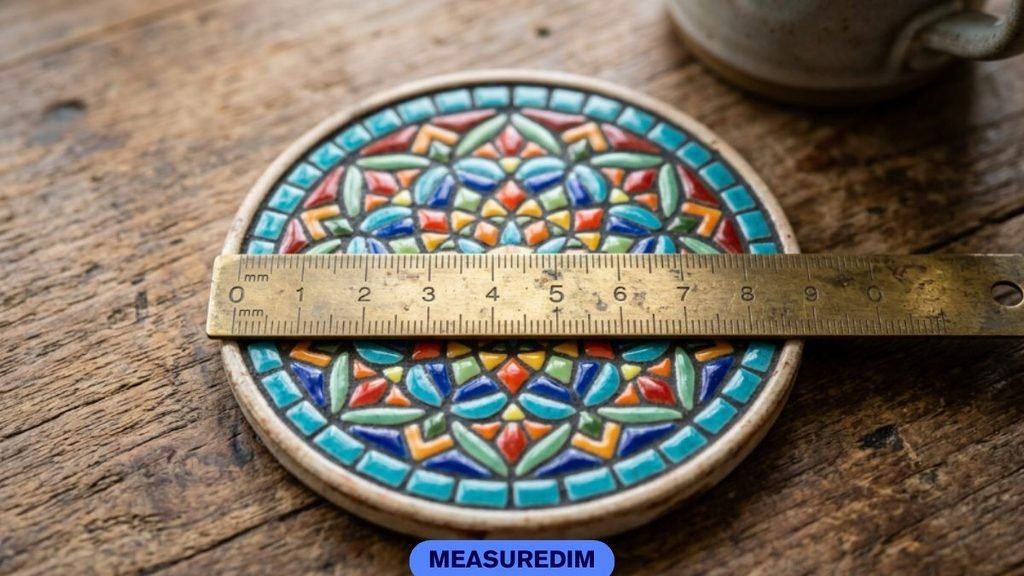
Many round coasters run 9 to 10 cm in diameter, with the smaller ones sitting right at 9 cm. Square coasters cluster near the same width. Because sizing isn’t fully standardized, check yours — but the common café-style circular coaster is a solid 9 cm disc.
Coasters are useful because they’re flat, rigid, and often within reach on a desk or table. Rest one against whatever you’re sizing up and its diameter gives you a quick circular 9 cm. It’s especially handy for judging round objects — mug bases, jar lids, small bowls — where a straight card feels awkward.
The 9 cm Reference List at a Glance
| Object | Real measurement | Match to 9 cm |
| Business / playing card (long edge) | 8.89 cm | ~1 mm under — near-exact |
| 3.5-inch floppy disk (width) | 9.0 cm | Exact |
| Fresh bar of soap (length) | ~9 cm | Approximate, varies by brand |
| New crayon | ~9 cm | Approximate |
| Adult palm width (knuckles) | ~8.5–9 cm | Approximate, personal |
| Credit card (long side) | 8.56 cm | ~4–5 mm under |
| Two golf balls side by side | ~8.5 cm | Approximate |
| Round drink coaster (diameter) | 9–10 cm | Smaller ones ≈ 9 cm |
Guessing 9 cm With No Ruler in Sight
No measuring tool nearby? You still have three reliable options.
First, pull out any card — bank card, loyalty card, business card. A business or playing card’s long edge is basically 9 cm on the nose; a credit card’s long edge is just under, so add a fingertip’s width to close the gap.
Second, use your hand. Flatten it, tuck the thumb, and read the width across your knuckles — around 8.5 to 9 cm for most adults. Calibrate it once against a card and you’ll trust it for life.
Third, count coins in a pinch. A small stack of everyday coins laid edge-to-edge in a short row can bracket the length, though this is the roughest of the three — reach for the card first.
Read Also: How Long Is 2 cm? Real-Life Size Comparisons + Chart
Where 9 cm Turns Up in the Real World
This length shows up more often than you’d expect once you start noticing it.
In gardening, the 9 cm plant pot is a genuine industry standard — the square or round nursery pot that seedlings and small perennials ship in. If you buy young plants, you’re handling 9 cm constantly without realizing it.
In shipping and stationery, plenty of small parcels, card blanks, and photo mats are built around a 9 cm side. In the kitchen, it’s the diameter neighborhood of small ramekins, cookie cutters, and mug bases. And on product pages, cosmetics tubes, figurines, phone accessories, and pocket gadgets frequently list a dimension right around this figure — which is often what sends people searching “how big is 9cm” in the first place.
8 cm, 9 cm, 10 cm: Telling the Neighbors Apart
Sizes this close are easy to mix up, so here’s how the immediate neighbors compare.
| Length | In inches | Everyday anchor |
| 7.6 cm | 3 in | A classic Post-it note edge / a hockey puck’s diameter |
| 9 cm | ~3.5 in | Business or playing card, long edge |
| 10.2 cm | 4 in | Short side of a 4×6 index card / a cassette tape (10 cm) |
The jump from a Post-it edge to a card’s long side is a little over a centimeter, and from there to an index card’s short side is barely more. They feel nearly identical in the hand, which is exactly why a fixed reference object beats eyeballing.
Slip-Ups People Make When Picturing 9 cm
The single biggest error is confusing 9 cm with 9 inches. Nine inches is 22.86 cm — more than double. When a measurement looks surprisingly large or small, check the unit before anything else.
A close second: rounding 9 cm up to “about 4 inches.” It’s 3.54 inches, sitting just past the 3½-inch line, not near 4. That half-inch of drift matters when something has to fit a slot.
People also assume a credit card’s long side is a full 9 cm — it’s 8.56 cm, and treating it as exactly nine will leave you a few millimeters short. And finally, don’t confuse 9 cm of length with 9 cm² of area or 9 cm³ of volume; a length is a single straight line, nothing more.
Quick-Fire Questions About 9 cm
What is 9 cm comparable to?
9 cm is comparable to the long edge of a playing card or a fresh crayon. It equals 90 mm, or about 3.54 inches.
What does 9cm look like?
It looks like a short, hand-sized line that fills most of your flat palm. Picture a bar of soap or a 3.5-inch floppy disk.
How big is 9cm in fruit?
9 cm is about the width of a large orange or a medium apple. It also matches a small banana’s short curve.
How big is a 9cm?
A 9 cm length is 90 millimeters, just over three and a half inches. It is small enough to hide inside a closed fist.
Is a 9 cm middle finger long?
Yes, a 9 cm middle finger is on the longer side. Most adult middle fingers measure about 7.5 to 8.5 cm.
Locking 9 cm Into Your Mind’s Eye
So now you know how big is 9cm. It is 90 millimeters, or about 3.54 inches. That is just over three and a half inches. Picture the long edge of a playing card, and you have it. A fresh crayon, a bar of soap, and a small plant pot all match this length too. You can also use your own hand. Nine centimeters spans most of your flat palm. Keep one of these pictures in your mind, and the number will feel clear.
The next time you read 9cm on a box or a label, you will picture it right away. You hold a ready ruler in your pocket and your hand. That makes 9cm easy to judge anywhere, anytime.
Related Guides:
1: How Big Is 8 cm? A Clear Look With Everyday Objects
2: How Big Is 3 Inches? Real Objects, Sizes & Conversions
3: How Long Is 18 Inches? 10 Objects to Picture It Fast
4: How Big Is 5 cm? Everyday Objects to Help You Picture It
5: How Long Is 10 Feet? 10 Everyday Objects to Picture It

2 Comments