
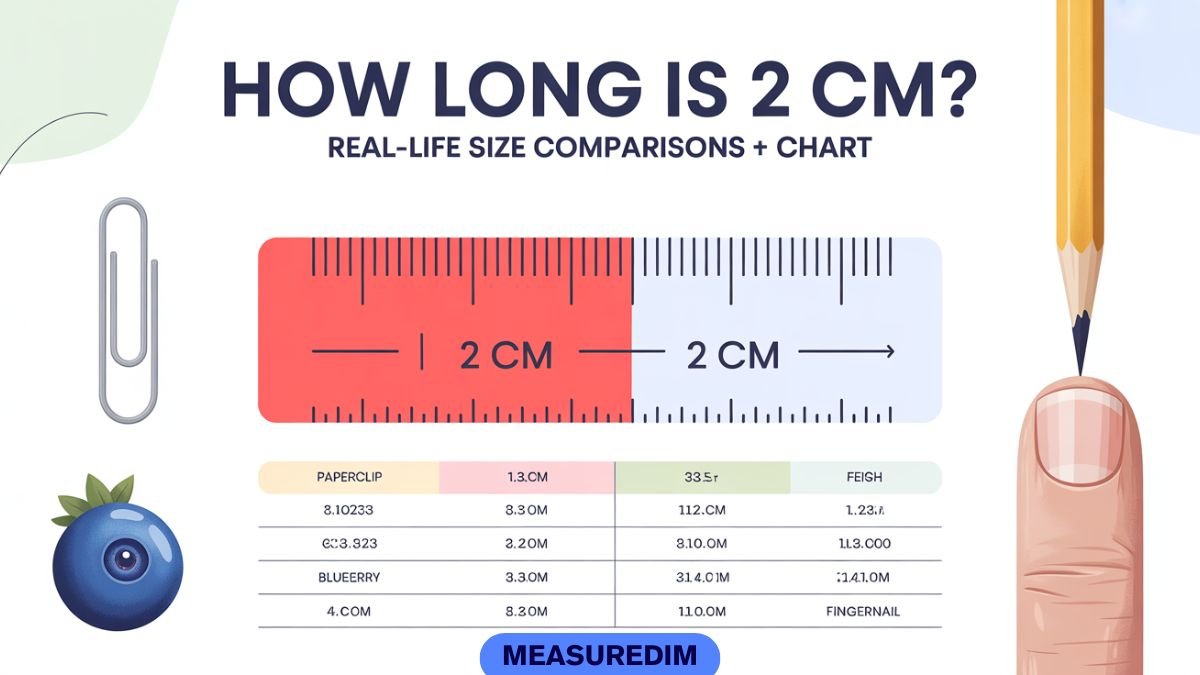
How Long Is 2 cm? Real-Life Size Comparisons + Chart
Two centimeters is a small, exact length. It equals 20 millimeters. In inches, it is about 0.79 — just over three-quarters of an inch. The easiest picture is a penny, which is nearly 2 cm wide. Hold a coin and you are looking at this size.
Ever read “2 cm” on a label and felt stuck? A ruler helps, but only if one is near. Most of the time, you just want a picture in your head. That is the real problem this size creates. The good news is you already own the answer in your pocket.
You will meet 2 cm more often than you think. It shows up in bead sizes, coat buttons, and seam allowances. Doctors use it too, for things like a small stone or a nodule. A penny’s width or your own thumbnail matches it well. Learn one of those, and 2 cm sticks for good.
The Short Answer: 2 cm at a Glance
Two centimeters is 20 millimeters, or about 0.79 inches — just a hair over three-quarters of an inch. The fastest mental image: it’s almost exactly the width of a U.S. penny (19 mm), or the width of a typical adult thumbnail. Hold a penny up and you’re looking at roughly 2 cm.
That’s the whole answer for most people. If you want to lock it in and never second-guess it again, the rest of this page builds the intuition out with real objects and conversions.
2 cm Converted Into Every Unit You’ll Need
Whether you’re switching between metric and imperial for a sewing project or a shipping label, here’s 2 cm expressed across the common units. Every figure below is rounded sensibly and stays consistent throughout this article.
| Unit | 2 cm equals |
| Millimeters | 20 mm |
| Centimeters | 2 cm |
| Inches | ≈ 0.787 in (about ¾ in) |
| Feet | ≈ 0.0656 ft |
| Yards | ≈ 0.0219 yd |
| Meters | 0.02 m |
One conversion worth memorizing: 1 inch = 2.54 cm, so 2 cm falls a little short of an inch — right around four-fifths of an inch. And ¾ inch is exactly 1.905 cm, which means 2 cm is a whisker more than three-quarters of an inch, not less.
What 2 Centimeters Actually Feels Like in Your Hand
Numbers are abstract; your hands aren’t. Two centimeters is roughly the distance across the nail on your thumb. It’s the length of a short fingernail clipping. Stack two dimes flat and slide them edge to edge — that pair is close. Pinch your finger and thumb just barely apart, the way you’d signal “a little bit,” and you’re often hovering right around this gap.
It’s small, but not tiny. A single centimeter reads as “fingernail-thin”; 2 cm reads as “coin-sized.” That’s the mental jump to make — from a thin sliver to a small, solid, roundish thing you could pick up and roll between two fingers.
10 Everyday Things That Land Right Around 2 cm
Here are ten common objects clustered near this length. I’ve flagged which are dead-on and which sit slightly under or over, so you’re never working from a fuzzy guess.
A U.S. Penny
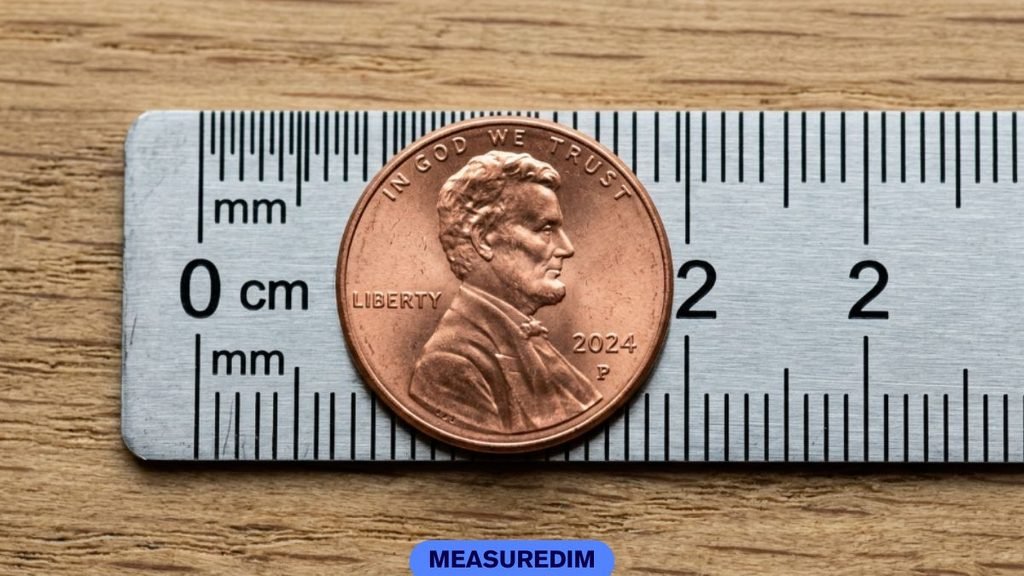
A penny measures 19.05 mm across — that’s 1.9 cm, a fraction under our target. By pure coincidence it’s also exactly ¾ inch wide, which makes it a handy dual-purpose reference for both metric and imperial. A British 1p coin is even closer at 20.3 mm, essentially spot-on 2 cm, and a Canadian penny matches the U.S. one almost to the millimeter.
Coins are the most reliable pocket ruler you own because their diameters are fixed by law and never drift. When you’re online shopping and a listing says a charm, button, or stone is 2 cm, set a penny next to your screen — what you see is what arrives. I reach for this one constantly when sizing jewelry findings.
A Scrabble Tile
A standard Scrabble tile is about 19 mm square, or roughly ¾ inch per side — again just shy of 2 cm. Deluxe and travel sets vary, but the classic wooden tile has been this size for decades. Line the edge of one up against a ruler and you’ll see it stop a touch before the 20 mm mark.
Tiles work well as a reference precisely because they’re square and flat, so you can lay one directly over a diagram or a printout to check a dimension. If you’re framing small artwork or spacing letters in a craft project, a spare tile is a quick stand-in for “about 2 cm.”
Read Also: How Big Is 8 cm? A Clear Look With Everyday Objects
A Standard Die
A casino-grade die is machined to 19 mm (¾ inch) per edge — 1.9 cm — while the smaller dice in most board-game boxes run closer to 16 mm. So the answer depends on which die you grab: a proper poker or craps die is nearly 2 cm on each side, a Monopoly die a bit less.
Because a die is a cube, it’s a rare three-dimensional reference — useful when you need to picture 2 cm as a volume rather than a flat length, like judging the size of a gift box compartment or a cube of cheese. Roll one across your palm and you’ll feel exactly how much space 2 cm claims in every direction.
A U.S. Nickel
A nickel comes in at 21.21 mm — 2.1 cm, just over the mark. It’s the coin that overshoots 2 cm by the smallest sliver, which makes it the perfect “slightly bigger than” anchor. A 5-euro-cent coin behaves almost identically at 21.25 mm.
Having one reference just under (the penny) and one just over (the nickel) is genuinely useful: whatever you’re measuring, if it’s bigger than a penny but smaller than a nickel, it’s basically 2 cm. I use that penny-to-nickel bracket to eyeball things without ever touching a ruler.
Your Own Thumbnail
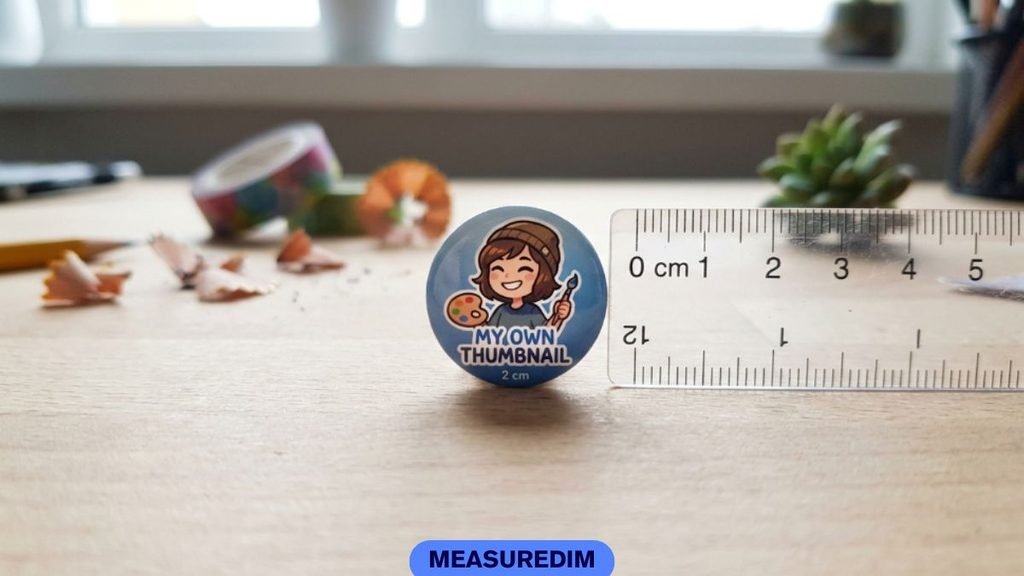
The nail on an adult thumb typically spans 1.6 to 2 cm across, depending on hand size. It won’t be laboratory-precise — nails vary from person to person — but it’s the reference you literally always have on you, which is why it beats a ruler you left in a drawer.
Calibrate it once: measure your own thumbnail against a ruler and remember the number. Mine sits at almost exactly 2 cm, so I can drop my thumb onto a screen or a shelf edge and read the length instantly. For a rough field estimate while packing or gardening, nothing’s faster.
A Whole Almond, End to End
A shelled almond runs about 1.8 to 2.5 cm along its long axis, with a typical nut sitting right at 2 cm. It’s an approximate reference — nature doesn’t do tight tolerances — but a medium almond lined up lengthwise is a dependable “about 2 cm.”
Food references shine when you’re describing a size to someone over the phone or in a recipe, since almonds are near-universally familiar. Telling a kid that a 2 cm object is “as long as an almond” lands far better than quoting millimeters, and it’s a satisfying way to teach measurement at the kitchen table.
A Coat Button
Larger coat and jacket buttons commonly measure around 2 cm across. In the button trade, sizes are counted in lignes, and a 32-ligne button works out to 20.3 mm — dead-on 2 cm. Shirt buttons are smaller (usually 10–12 mm), so aim for the chunky outerwear kind.
If you sew or replace buttons, this is a working reference you can keep in a jar. Matching a 2 cm buttonhole, spacing plackets, or judging whether a fastener will fit a loop all get easier when you can hold a known 2 cm button against the fabric. It’s the kind of everyday check where a coin feels too cold and a button feels just right.
A Table Grape
A single table grape measures roughly 1.8 to 2.2 cm in diameter, with a standard supermarket grape landing near 2 cm. Larger cultivars push past it and smaller ones fall short, so treat this as an approximate — but it’s a vivid one.
Grapes are perfect for conveying a round 2 cm rather than a flat line. If a doctor or a hobbyist mentions something “about the size of a grape,” you now have the number: close to 2 cm across. It’s also an easy way to picture the diameter of a small ball, a marble, or a bead without hunting for the actual object.
A Gummy Bear
A classic gummy bear stands roughly 2 cm from foot to head — the well-known Haribo Goldbear is about this tall, give or take by brand. It’s a soft, squishy reference, so don’t expect precision, but stood upright it’s a friendly stand-in for 2 cm.
The value here is memorability. Once you’ve paired “2 cm” with “one gummy bear tall,” the size sticks in a way a dry conversion never will. It’s especially handy for explaining small measurements to children, who will happily remember a candy long after they’ve forgotten the number.
A Hazelnut
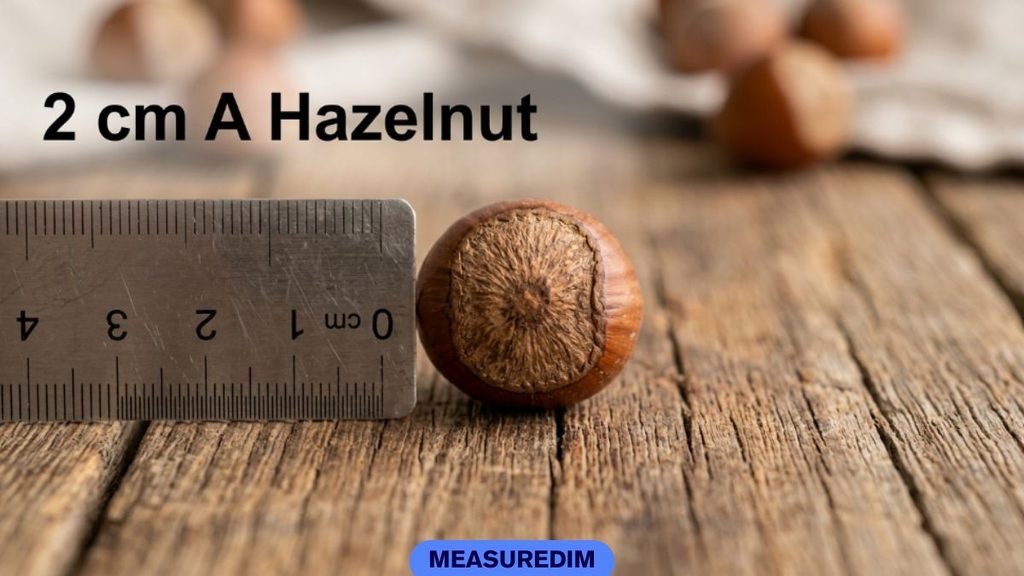
A whole hazelnut in its shell is about 1.8 to 2 cm across at its widest. Shelled kernels are a touch smaller, so picture the nut still in its rounded shell for the best match. Like other natural references, it’s approximate — but consistently in the right neighborhood.
Because a hazelnut is roughly spherical, it doubles as a reference for the width of a small round object — a large bead, a cherry pit, a chunky ring stone. Next time a listing quotes a 2 cm gemstone, imagine a hazelnut sitting in your palm and you’ll know instantly whether that’s the size you expected.
All Ten References, Side by Side
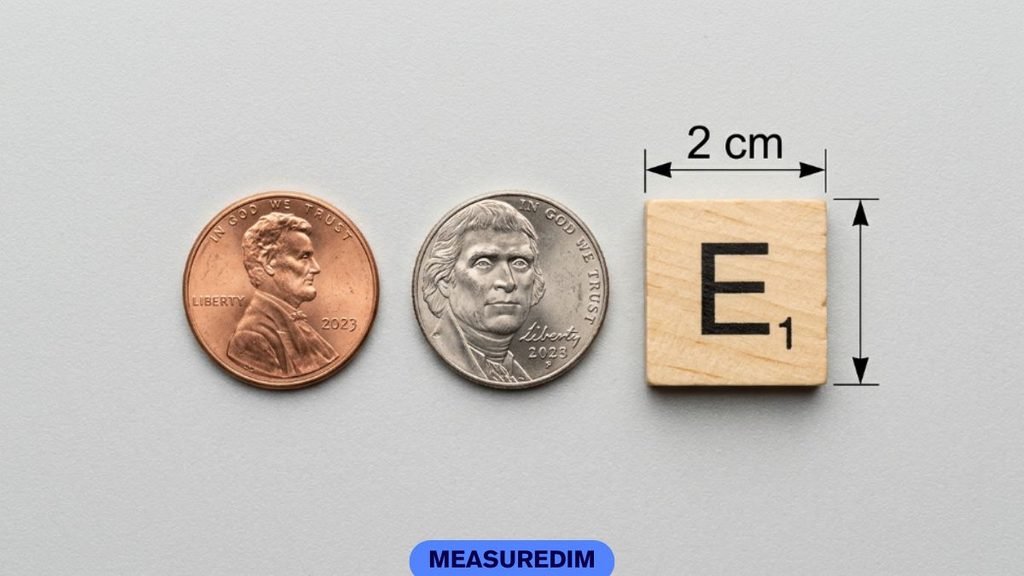
Here’s the quick-scan version. Notice how tightly everything clusters between about 1.6 and 2.1 cm — that’s your 2 cm zone.
| Object | Real measurement | Versus 2 cm |
| U.S. penny | 19.05 mm (1.9 cm) | Just under |
| Scrabble tile | ~19 mm (1.9 cm) | Just under |
| Standard casino die | 19 mm per edge (1.9 cm) | Just under |
| U.S. nickel | 21.21 mm (2.1 cm) | Just over |
| Adult thumbnail | ~1.6–2 cm | Right around |
| Whole almond (length) | ~1.8–2.5 cm | Right around |
| Coat button (32-ligne) | 20.3 mm (2.0 cm) | Spot on |
| Table grape (diameter) | ~1.8–2.2 cm | Right around |
| Gummy bear (height) | ~2 cm | Right around |
| Hazelnut (width) | ~1.8–2 cm | Right around |
Judging 2 cm Without a Ruler
No tape measure? You have three fast options.
Use a coin. A penny is 1.9 cm and a nickel is 2.1 cm, so the true 2 cm sits neatly between them. Keep one of each in mind and you can bracket almost anything.
Use your thumbnail. Measure it once against a ruler, remember the figure, and from then on your thumb is a portable gauge. Press it flat against whatever you’re checking.
Use two dimes. A dime is 17.9 mm across. Lay two side by side and the pair spans about 3.6 cm — too wide — but a single dime plus a small gap gets you close to 2 cm, and a dime’s own diameter (1.8 cm) is itself a decent “just under 2 cm” marker.
For anything where being off by a millimeter or two matters, grab a real ruler. These tricks are for quick, in-the-field estimates, not machining tolerances.
Read Also: How Big Is 3 Inches? Real Objects, Sizes & Conversions
Where People Get 2 cm Wrong
The most common slip is confusing centimeters with inches. Two inches is 5.08 cm — more than twice 2 cm — so misreading a spec can leave you badly off. Always check which unit you’re actually looking at.
A second trap is assuming 2 cm equals a full inch because both feel “small.” It doesn’t; an inch is 2.54 cm, so 2 cm is about four-fifths of an inch. Rounding it up to an inch introduces a 27% error, which adds up fast across a row of measurements.
People also over-trust body references without calibrating them. Thumbnails, finger widths, and knuckles vary a lot between individuals. The trick isn’t to avoid your hands — it’s to measure them once so you know your personal numbers.
Places 2 cm Turns Up in Real Life
This length shows up more than you’d think. In crafting and jewelry, 2 cm is a common bead, charm, and pendant-drop size. In sewing, it’s a typical seam allowance and the width of a mid-size button.
In shipping and packaging, 2 cm often marks the thickness threshold that separates a “large letter” from a small parcel in many postal systems — worth knowing before you pay. In home and DIY work, it’s a standard tile grout depth range, a common dowel diameter, and roughly the thickness of a chunky butcher-block edge.
You’ll also hear 2 cm in health contexts — the size a clinician might quote for a cyst, a nodule, a kidney stone, or early cervical dilation. Those are simply size descriptions, and a penny’s width is the easy visual. (For anything about your own health, the number is just context — a medical professional is the one to interpret what it means for you.)
2 cm Beside Its Neighbors: 1 cm, 3 cm, and 1 Inch
Sizes make more sense in a lineup. Here’s how 2 cm compares to the lengths on either side of it.
1 cm (0.39 in) is half of 2 cm and reads as “fingernail-thin.” Picture a green pea, the diameter of a standard pencil-top eraser, or the width of an average pinky nail.
3 cm (1.18 in) is half again as long. A U.S. half-dollar coin is 30.6 mm — essentially 3 cm — and so is a smallish strawberry or a large grape. That extra centimeter over our target is more noticeable than it sounds.
1 inch (2.54 cm) sits just above 2 cm by about half a centimeter. A U.S. quarter, at 24.3 mm, is a touch under an inch and a clear step up from a penny. If you can feel the gap between a penny and a quarter, you can feel the gap between 2 cm and an inch.
Quick-Fire Questions About 2 cm
What is an example of 2 cm?
A U.S. penny is the classic example, measuring 1.9 cm across. A coat button or your own thumbnail also sits right around 2 cm.
What does 2 cm look like in inches?
Two centimeters equals about 0.79 inches — just over three-quarters of an inch. To convert, divide any centimeter figure by 2.54.
How big is 2 cm visually?
Picture a penny’s width or a single grape. It is coin-sized: small enough to roll between two fingers, big enough to pick up easily.
Is 2 cm equal to 1 inch?
No. One inch is 2.54 cm, so 2 cm is smaller — about 79% of a full inch, or roughly four-fifths of one.
How small is 2 cm?
It is quite small, about the width of a fingernail or a coin. It fits neatly inside the coin pocket of your jeans.
Fixing 2 cm in Your Mind’s Eye
So how long is 2 cm? It is a small length, equal to 20 millimeters or about 0.79 inches. That is just over three-quarters of an inch. The best picture to remember is a penny, because a penny is almost exactly 2 cm wide. You can also use your thumbnail, since it lands very close to this size. Keep one of these in mind and you will always know this length.
Now you can spot 2 cm without a ruler. A penny sits just under it, and a nickel sits just over it. Together they make a simple bracket for this size. You will see 2 cm in beads, buttons, and small everyday things. Learn it once, and you will picture it every single time with ease.
Related Guides:
1: How Long Is 18 Inches? 10 Objects to Picture It Fast
2: How Big Is 5 cm? Everyday Objects to Help You Picture It
3: How Long Is 10 Feet? 10 Everyday Objects to Picture It
4: How Long Is 1 Meter? 7 Everyday Objects That Show It
5: How Tall Is 40 Inches? Everyday Comparisons & Conversions

2 Comments