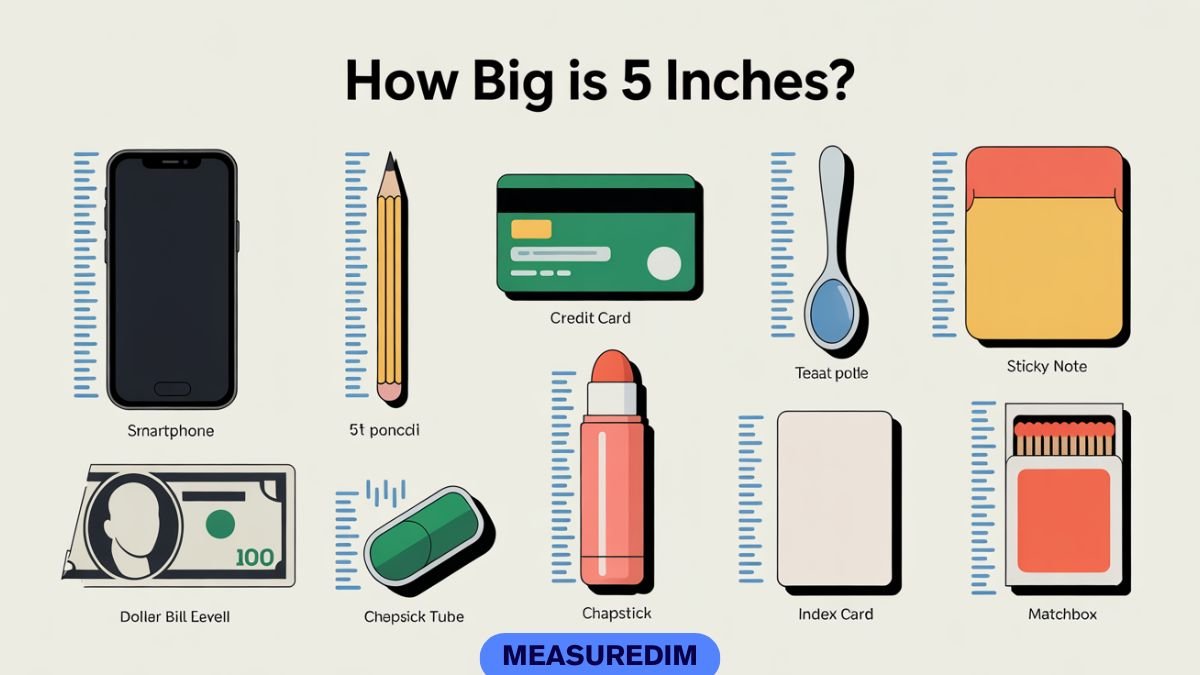
How Big Is 5 Inches? 9 Everyday Objects to Picture It
Five inches is a small length that equals 12.7 centimeters. It is a little less than half a foot. The long side of a 3×5 index card is exactly 5 inches.
Have you ever read “5 inches” online and had no idea how big that really is? You are not alone. The trick is to picture a real object instead of a number.
Five inches shows up more than you think. It is the size of a photo print, a soda can, and a passport. Once you match it to things you own, you will spot 5 inches right away.
The Short Answer: 5 Inches at a Glance
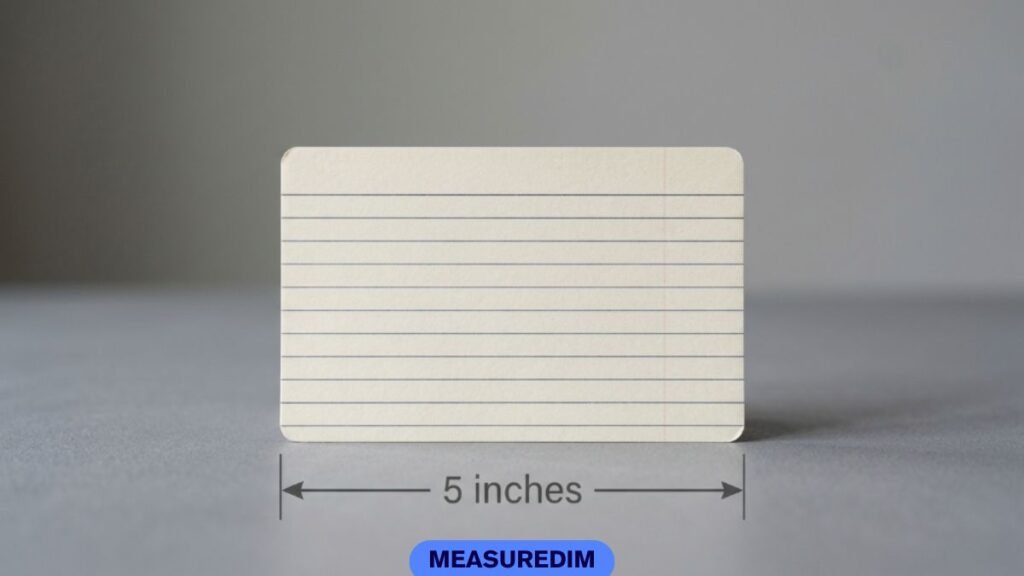
Five inches equals 12.7 centimeters — a touch over an inch shy of half a foot. The cleanest mental image is the long edge of a 3×5 index card, which is 5 inches exactly. If you’d rather picture something in your pocket, it’s roughly one and a half bank cards laid end to end.
- 5 in = 12.7 cm = 127 mm
- 5 in = 0.417 ft (5⁄12 of a foot)
- 5 in = 0.127 m
5 Inches in Every Unit You’ll Need
The imperial-to-metric jump is where most people stumble, so here’s the full conversion in one place. One inch is exactly 2.54 cm, which makes 5 inches a clean 12.7 cm — no rounding required.
| Unit | Value for 5 inches |
| Centimeters | 12.7 cm |
| Millimeters | 127 mm |
| Feet | 0.417 ft |
| Yards | 0.139 yd |
| Meters | 0.127 m |
Because the inch-to-centimeter factor is exact, you can trust 12.7 cm anywhere. If a source rounds it to 13 cm, that’s a small convenience — it drifts the length by about 0.1 inch.
What 5 Inches Actually Feels Like
Think of half a foot, then take one inch back. That’s 5 inches. It’s the width of a small paperback, the reach across a coffee mug plus a bit, the height of a soda can with a little to spare.
It’s long enough to feel substantial in your hand but short enough to hide behind it. Hold a pen upright and 5 inches lands roughly at the clip. Set your palm flat on a table and 5 inches runs from your wrist crease to just past your knuckles. Small, but not tiny — this is the scale of phones, photo prints, and pocket tools, not furniture.
9 Everyday Things That Land Right Around 5 Inches
Every object below is something you’ve handled this week. They span from 4.5 to 5.4 inches, so together they bracket the target from both sides — two of them hit it exactly.
The Long Edge of a 3×5 Index Card
A standard index card measures 3 inches by 5 inches, so its longer side is exactly 5 inches (12.7 cm) — no estimation involved. This is the reference to memorize, because index cards live in almost every desk drawer, classroom, and kitchen. Recipe cards and flashcards use the same footprint.
The reason it beats a hand or a guess is that it’s a manufactured standard — every card in the pack is cut to the same 5-inch edge. Keep one pinned near your workspace and you’ve got a permanent, ruler-free yardstick. It’s the go-to when you’re checking whether something will fit in a small mailer or a card slot.
The Short Side of a 5×7 Photo Print
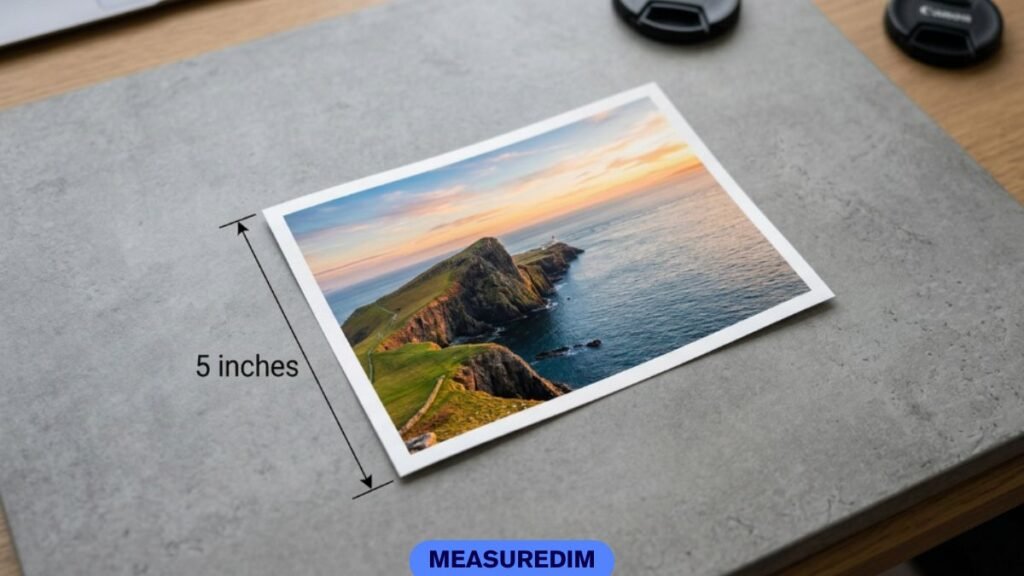
A 5×7 print — the most common “big” photo size for frames and mantels — has a shorter edge of exactly 5 inches. Its long side is 7 inches, so the print itself is a ready-made ruler with two known lengths on it. Grab one from an album and you’ve got 5 inches on demand.
Photo prints are handy because they’re rigid and flat, which makes them easier to lay against an object than a floppy card. If you frame or print at home, a stack of 5×7s gives you a repeatable reference. This one earns its keep whenever you’re eyeballing frame openings, mat borders, or shelf clearance.
Read Also: How Long Is 6 Inches? Real Objects to Picture It Fast
A Passport Booklet
A standard passport follows the international ID-3 format: 125 mm tall, which works out to 4.92 inches — essentially 5 inches, just eight-hundredths short. Nearly every country issues the same size, so this reference travels well, literally.
What makes a passport reliable is that the spec doesn’t wander between models the way a phone or marker does; the booklet height is fixed by treaty. Pull yours out and its top-to-bottom height gives you a dependable near-5-inch gauge. It’s genuinely useful at a check-in desk when you’re sizing up whether a document sleeve or travel wallet will hold everything.
A 12-Ounce Soda Can
The classic aluminum soda can stands 4.83 inches tall (122.6 mm) — a hair under 5 inches, off by about a sixth of an inch. Diameter is a separate 2.6 inches, so it’s the height you want here, not the width.
Cans are everywhere and consistent, which is exactly what a good reference needs. Set one on the counter and its height reads as “just shy of 5 inches” — mentally add a fingernail’s width and you’re spot on. This comes in handy when you’re guessing shelf heights in a fridge or the clearance inside a cooler or lunch bag.
A Stick of Butter
An Eastern-style (Elgin) stick of butter measures 4.75 inches long, a quarter inch under the mark. Western “stubby” sticks hold the same quarter-pound but come shorter and fatter, so this trick assumes the long, slim style common on the East Coast and in most recipe photos.
Butter is a surprisingly good ruler because the wrapper is printed with tablespoon lines, giving you sub-inch increments too. Unwrap one in your mind’s eye and picture adding a thin slice to reach 5 inches. It’s a kitchen-native cue — useful when you’re checking whether a utensil, container, or gadget will tuck into a drawer.
A CD or DVD
A standard optical disc is 120 mm across, or 4.72 inches in diameter — about a quarter inch below 5 inches. Discs are fading from daily life, but most homes still have a few in a drawer or an old case.
The advantage of a disc is that it’s a perfect circle, so any line across the center gives you the same 4.72 inches — no need to line up an edge. Hold one up and imagine nudging the rim out by a pencil’s width to hit a full 5 inches. It’s a quick check for round objects like jar lids, coasters, and small plant-pot mouths.
A Compact Smartphone
A small modern phone — think an iPhone mini — stands about 5.18 inches tall (131.5 mm), landing just over the mark by less than two-tenths of an inch. Be careful here: most mainstream phones today are 6 inches or taller, so this only works for the genuinely compact models.
Phones vary far more than index cards, so treat this as a “close enough” cue rather than a precise one. Still, if you own a small handset, its height is a familiar, always-on reference. This helps most when you’re sizing phone cases, screen protectors, or the pocket of a bag.
A Sharpie Permanent Marker
A capped fine-point Sharpie runs about 5.4 inches long — the first object on this list that’s clearly over 5 inches, by roughly four-tenths of an inch. Pop the cap off and the barrel alone drops closer to the target.
Markers are useful because they’re stiff, straight, and easy to lay flat against something. Keep the “capped is a bit long, uncapped is about right” rule in mind and you’ve got a two-in-one gauge. It’s a natural pick when you’re at a desk sizing up envelopes, labels, or the gap on a shelf.
A Single-Gang Wall Plate
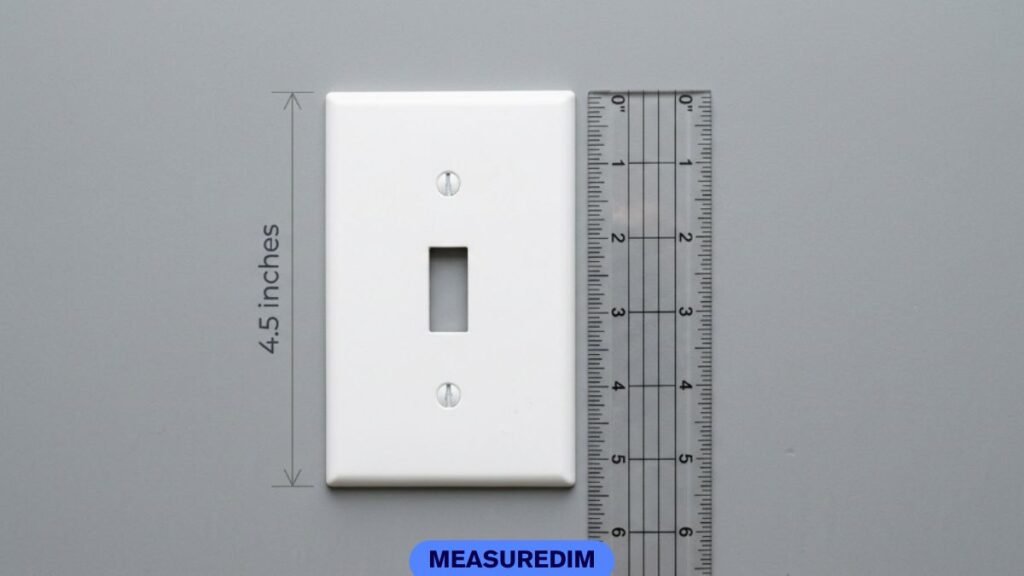
The standard light-switch cover plate measures 4.5 inches tall and 2.75 inches wide. That’s half an inch under 5 inches — the lowest object on this list, and a good anchor for the bottom of the range.
Wall plates are bolted to a fixed electrical standard, so the 4.5-inch height barely varies across brands. If you’re already looking at a wall, you’ve got a built-in ruler at eye level. This is a quiet lifesaver during DIY, when you need a rough vertical measure and your tape is in another room. [IMAGE: a switch plate beside a ruler showing 4.5 inches]
The 5-Inch Lineup, Side by Side
Here’s the whole set ranked from shortest to longest, so you can pick the reference closest to whatever you’re measuring.
| Object | Real measurement | Vs. 5 inches |
| Single-gang wall plate (height) | 4.5 in | 0.5 in under |
| CD / DVD (diameter) | 4.72 in | 0.28 in under |
| Stick of butter (length) | 4.75 in | 0.25 in under |
| 12-oz soda can (height) | 4.83 in | 0.17 in under |
| Passport (height) | 4.92 in | 0.08 in under |
| 3×5 index card (long edge) | 5.0 in | exact |
| 5×7 photo (short edge) | 5.0 in | exact |
| Compact phone / iPhone mini (height) | 5.18 in | 0.18 in over |
| Sharpie marker (capped) | 5.4 in | 0.4 in over |
No Tape Measure? Fake It With Your Hands and Wallet
You almost always have a body part or a card on you, and both make solid stand-ins once you know your own numbers.
The wallet trick is the most reliable: a bank or credit card is 3.37 inches long, and one and a half of them end to end come to 5.06 inches — essentially spot on. Lay a card down, mark its end, then add half a card again.
For a hands-only estimate, the average adult hand length (wrist crease to middle-fingertip) is about 7.5 inches, so 5 inches is roughly two-thirds of your hand — from the wrist to the base of your fingers, plus one finger segment. Your own hand may run a little larger or smaller, so measure it once against a ruler and remember the figure. An adult palm width across the knuckles sits near 3.3–3.5 inches, which means 5 inches is about a palm and a half. None of these are exact, but they’ll get you within a fingernail’s width, which is usually all you need.
Read Also: How Long Is 2 Inches? Real Objects That Show You Exactly
Where People Trip Up on 5 Inches
The single biggest mix-up is length versus screen diagonal. A “5-inch phone” is measured corner to corner across the display, not top to bottom — a 5-inch 16:9 screen is only about 4.36 inches tall and 2.45 inches wide, and the phone body is bigger still. So the screen spec and the physical height are two different numbers.
The second trap is inches versus centimeters. Five centimeters is only about 1.97 inches — less than half of what people expect when they see “5.” Always confirm which unit a listing uses before you picture it. Finally, plenty of folks assume 5 inches is half a foot; it isn’t. Half a foot is 6 inches, so 5 inches falls one inch short.
Quick Myth Check
| Myth | Fact |
| “A dollar bill is about 5 inches long.” | It’s actually 6.14 inches — closer to half a foot. |
| “12.7 cm and 13 cm are the same thing.” | They differ by about 0.1 inch; 12.7 cm is exact. |
| “A 5-inch screen phone is 5 inches tall.” | The 5 inches is the screen’s diagonal; the body is larger. |
How 5 Inches Compares to 4 and 6 Inches
Sizes make more sense next to their neighbors. One inch in either direction changes the feel more than you’d think.
| Length | Centimeters | Quick picture |
| 4 inches | 10.16 cm | A soup can’s height; a small sticky-note pad |
| 5 inches | 12.7 cm | Long edge of an index card |
| 6 inches | 15.24 cm | Half a foot; a standard sub-sandwich length |
So 5 inches sits neatly between a stubby can and a classic six-inch sub — bigger than a coaster, smaller than a dollar bill.
When 5 Inches Actually Matters
This length turns up more than you’d guess. Photo printing leans on it constantly — the 5×7 is a framing staple. Compact screens on older or budget phones and small e-readers are quoted at 5-inch diagonals. In shipping, a 5-inch dimension decides whether an item slides into a padded mailer or bumps you up a box size.
It also shows up in kitchen and craft tools — a 5-inch utility knife blade, a nursery plant pot measured 5 inches across the rim, index and recipe cards, and small cutting boards. Knowing the size on sight saves you from unpacking a ruler every time a product page lists “5 in” and expects you to know what that means.
Questions People Actually Ask
How can I measure 5 inches without a ruler?
Lay one and a half bank cards end to end (about 5.06 inches), or use the long edge of a 3×5 index card, which is exactly 5 inches.
How big is an inch in fingers?
One inch is roughly the width of one adult thumb, or about three-quarters of an average index finger’s width.
Is 5 inches considered big or small?
It is a small, hand-sized length — bigger than a coaster but shorter than a dollar bill, at 12.7 cm.
How big is 5 inches with fingers?
Four fingers held together span about 3 inches, so 5 inches is roughly four fingers plus one more finger’s width.
Is a 5 inch hand small?
Yes — average adult hand length runs about 7.5 inches, so a 5-inch hand is on the small side, closer to a child’s.
Locking 5 Inches Into Memory
So now you know how big is 5 inches. It is 12.7 centimeters, or 127 millimeters. It sits one inch below half a foot. The best picture to keep in mind is a 3×5 index card. Its long side measures exactly 5 inches. You can also think of one and a half bank cards in a row. Both tricks give you a fast answer without a ruler. Everyday items make this length easy to learn.
Keep one clear object in your head and the size will stick. An index card works best for most people. A soda can and a passport both come very close too. Match 5 inches to things you already own. After a little practice, you will spot this length on sight.
Written by a measurement writer who has spent an embarrassing amount of time holding household objects up to a ruler so you don’t have to.
Related Guides:
1: How Big Is 4 Inches? A Complete Size Guide With Real Objects
2: How Long Is 8 Inches? Everyday Objects to Picture It
3: How Big Is 7 Inches? 10 Everyday Objects to Picture It