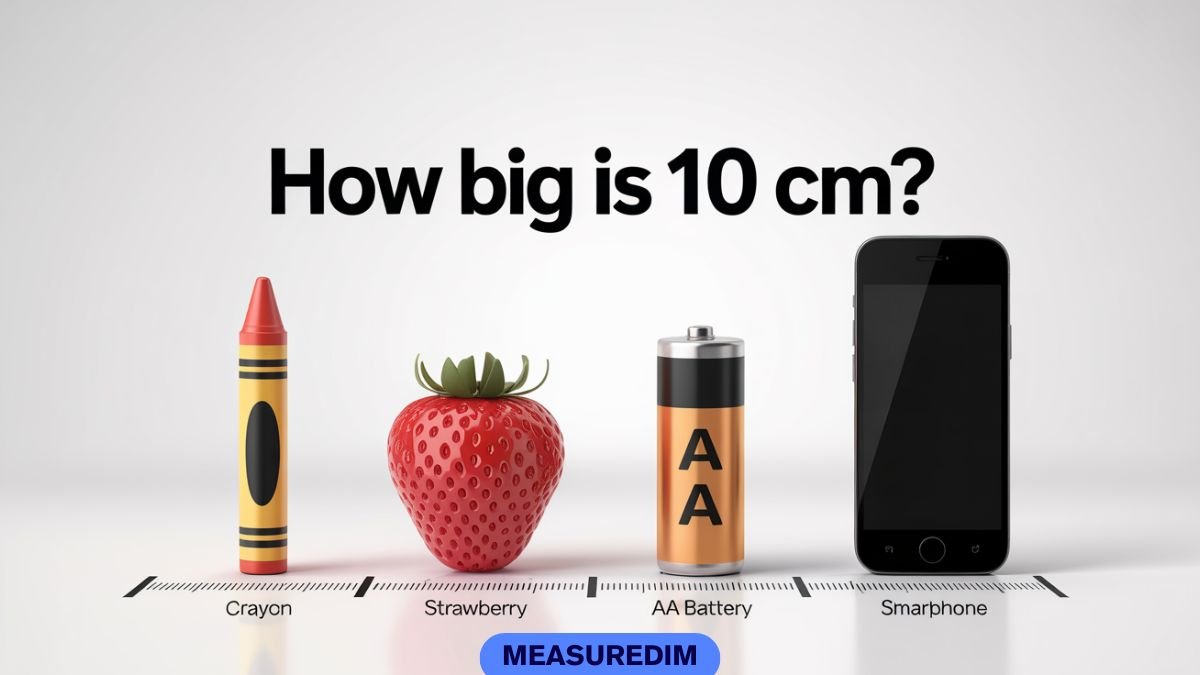
How Big Is 10 cm? Visualize It With Everyday Objects
Ten centimeters is a small unit of length in the metric system. It equals 100 millimeters, or just under 4 inches. In simple terms, it is about the length of two AA batteries placed end to end.
Have you ever tried to picture 10 cm without a ruler? It is easier than you think. Once you learn a few everyday objects, you will spot this size in a second.
You meet 10 cm more often than you notice. A large sticky note, a small grapefruit, and a bank card plus a fingertip all sit near this size. Knowing it helps with shopping, packing, and quick home measuring.
The Short Answer: 10 cm at a Glance
Ten centimeters is just under 4 inches — precisely 3.94 inches, or 100 millimeters. The fastest mental image: line up two AA batteries end to end and you’re within a millimeter of 10 cm. It’s a small-to-medium length — wider than a golf ball, shorter than a standard school ruler.
10 cm in Every Unit You’ll Need
Here’s 10 cm converted across the metric and imperial systems. These figures stay fixed throughout the article — no contradictions, no rounding surprises.
| Unit | 10 cm equals |
| Millimeters | 100 mm |
| Centimeters | 10 cm |
| Inches | 3.94 in (just under 4) |
| Feet | 0.33 ft |
| Yards | 0.11 yd |
| Meters | 0.1 m |
Picture It: What 10 Centimeters Really Looks Like
Think of 10 cm as a short, confident span — about the distance from the base of your palm to the tip of your middle finger on an average adult hand, give or take. It’s long enough to matter and short enough to hold in one hand.
The trick most people miss: 10 cm reads very differently in a straight line versus a circle. As a length it looks modest, almost small. As a diameter — a jar lid, a small grapefruit, a candle base — that same 10 cm suddenly feels chunky. Keep both mental images handy, because you’ll use them in different situations.
Everyday Objects That Are Almost Exactly 10 cm
Each reference below is measured against real-world dimensions, with a clear note on whether it’s spot-on or a touch off.
Two AA Batteries End to End
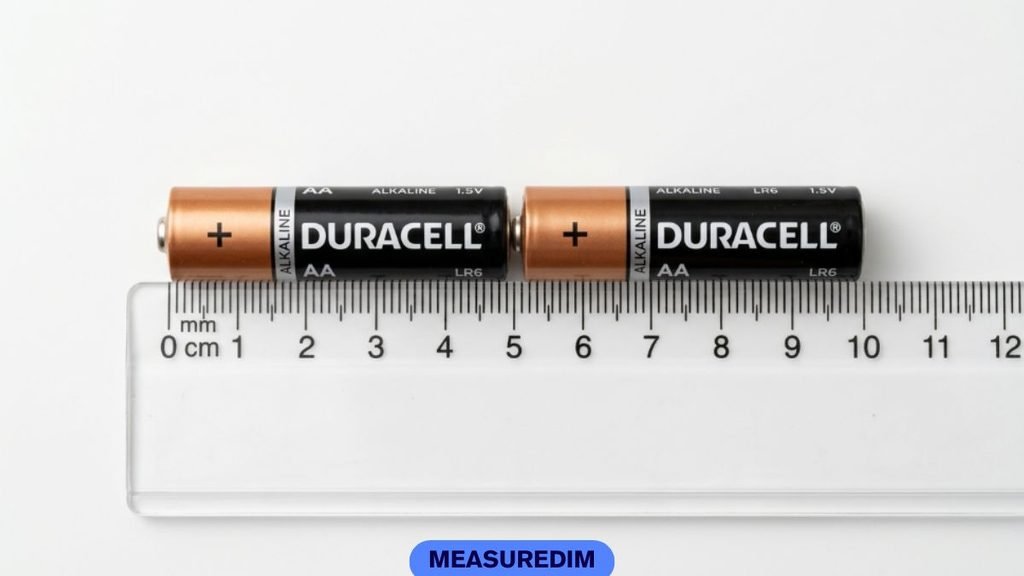
A single AA battery is 50.5 mm (5.05 cm) long under the IEC standard. Set two of them nose to tail and the pair spans 10.1 cm — within one millimeter of our target. As household references go, this is about as exact as it gets.
Nearly every home has a couple of AAs rattling in a drawer or living inside a TV remote. Pull two out, touch the flat end of one to the button end of the other, and you’ve built a pocket 10 cm ruler in two seconds. I reach for this trick whenever I need to check if a phone stand or small box will clear a shelf.
A Large 4×4 Inch Sticky Note
The classic Post-it square is 76 mm, but the big-format sticky note runs 4 inches per side — 10.16 cm. That’s 10 cm plus a hair, close enough to eyeball without a second thought.
Because it’s flat and square, a large sticky note hands you a length and a width reference at the same time. Press one to a wall and you can preview how a 10 cm tile, a logo, or a photo print will actually read from across the room before you commit.
Read Also: How Long Is 19 Inches? 10 Everyday Objects That Show You
The Width of a Toilet Paper Roll
A standard roll of toilet paper sits close to 10 cm wide, and the cardboard tube inside runs about the same length. Brands drift between 9.5 and 11.5 cm, so treat this as a solid ballpark rather than a precision tool.
It’s an object you handle constantly without ever clocking its size. Next time you swap a roll, glance at the tube — that end-to-end length is your instant 10 cm gauge. It’s genuinely useful for judging things like a pipe diameter or the gap behind a cistern.
A Softball
A regulation softball has a 12-inch circumference, which works out to a diameter of about 9.7 cm — a whisker under 10 cm. It’s one of the few round references that lands this close.
Unlike a flat card, a ball shows you 10 cm as three-dimensional bulk instead of a straight line. Cup one in your palm and you’re feeling roughly the footprint a 10 cm sphere takes up — think a large orange or a fist-sized ornament. That’s the mental model to use when you’re sizing anything round.
A Drink Coaster
A typical round or square coaster measures about 9 to 10 cm across. The cork and pulpboard ones you find in cafés and pubs sit right near the top of that range.
Since a coaster is built to sit under a glass, it maps cleanly onto other round objects — mug bases, tea light holders, small plant saucers. Lay one flat and you’ve got a ready-made 10 cm disc to hold things up against.
A Credit or Bank Card, Plus a Little
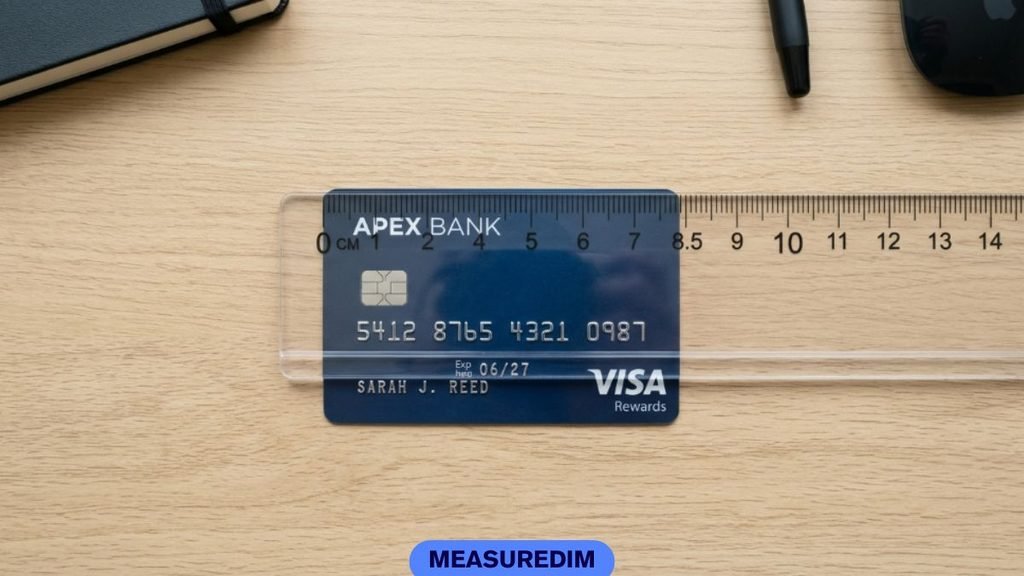
Every ID-1 card — credit, debit, gym pass, hotel key — is 85.6 mm (8.56 cm) long by international standard. So 10 cm is one card end to end, plus about the width of your fingertip laid alongside.
The appeal here is pure availability: a card is always in your wallet. Set it down, mark the far end, add roughly 1.5 cm, and you’ve stepped off 10 cm with zero tools. Perfect for a quick check on whether something fits a slot, an envelope, or a phone pocket.
A Standard Playing Card
A poker-size playing card measures 88.9 mm (8.9 cm) on its long edge. Ten centimeters is that edge plus a little over a centimeter — so a card gets you most of the way there.
Fan one out and its longer dimension is close enough to sanity-check a small measurement at a glance. If you’re trimming a bookmark or sizing a gift tag, the card tells you fast whether you’re in the right zone.
Four U.S. Quarters in a Row
A U.S. quarter is 24.26 mm across. Slide four together, edge to edge, and the line spans about 9.7 cm — just shy of 10.
Coins make a surprisingly precise ruler because the mint controls their diameters tightly. When you’ve got loose change but no tape measure, four quarters (or the coin equivalents wherever you are) give you a repeatable, pocket-sized 10 cm stand-in.
A Small Grapefruit or Large Orange
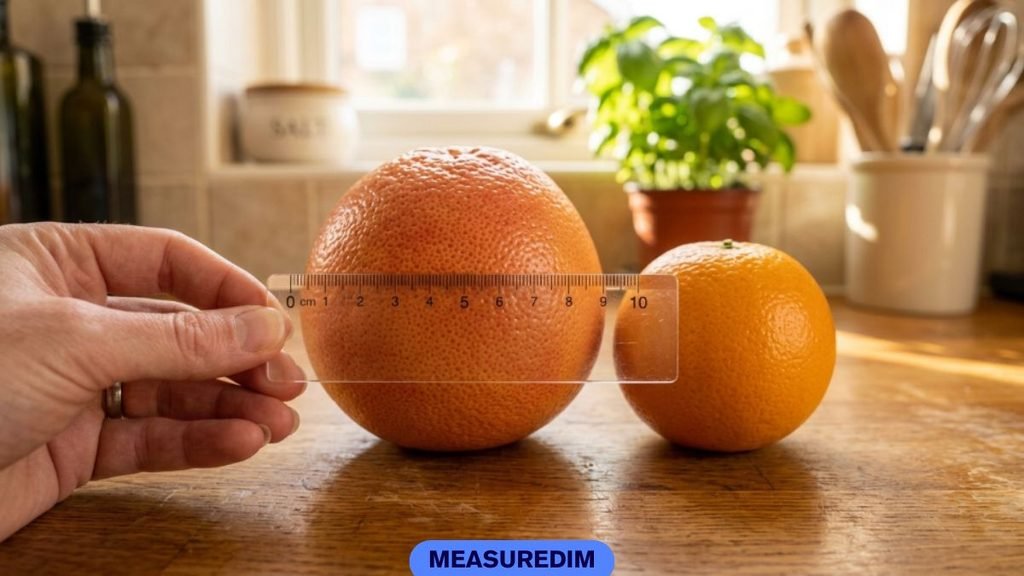
Navel oranges usually run 7–8 cm across, while a small grapefruit lands around 10 cm in diameter. Produce varies by variety and season, so this one is an honest approximation, not a fixed figure.
Fruit works because it’s familiar and handheld. Picture holding a grapefruit — that width across the middle is close to 10 cm, which helps when you’re imagining the size of a fat candle, a wide jar lid, or a cluster of drawer knobs.
All the References Side by Side
| Object | Real dimension | Compared to 10 cm |
| Two AA batteries, end to end | 10.1 cm | Practically exact |
| Large 4×4 in sticky note | 10.16 cm | Exact, a touch over |
| Toilet paper roll width | ~10 cm | Close (varies by brand) |
| Drink coaster | 9–10 cm | Close |
| Softball diameter | 9.7 cm | Slightly under |
| Four U.S. quarters in a row | 9.7 cm | Slightly under |
| Small grapefruit diameter | ~10 cm | Close (varies) |
| Credit card long side | 8.56 cm | Under — add ~1.5 cm |
| Playing card long side | 8.9 cm | Under — add ~1.1 cm |
No Ruler Handy? Use Your Hands
Your body is a measuring kit you always carry. A few calibrations that get you to 10 cm:
Palm plus a thumb. An adult palm, measured across the knuckles (not counting the thumb), is roughly 8.5–9 cm for men and 7.5–8 cm for women. Add about a thumb’s width and you’re close to 10 cm. Measure your own palm once against a ruler and you’ll own this reference for life.
Half a hand span. Spread your hand wide, from the tip of your thumb to the tip of your little finger — that span is around 20–22 cm for most adults. Halve it and you land near 10 cm. It’s a rougher gauge than the palm method, but it’s fast for a quick sanity check.
Stacked references. No hand nearby? Two AA batteries, four quarters, or a bank card plus a fingertip all get you there. Keep the one that suits whatever’s in reach.
A quick honesty note: hand sizes genuinely differ from person to person, so body-based estimates are approximate. For anything where a millimeter or two matters, fall back on the battery or coin trick.
Read Also: How Long Is 15 Inches? Everyday Objects to Visualize It
Where People Get 10 cm Wrong
A handful of slips come up again and again:
Confusing 10 cm with 10 inches. Ten inches is 25.4 cm — two and a half times bigger. Mixing the units up is the single most common error, and it wrecks any estimate.
Treating 10 cm as exactly 4 inches. It’s 3.94 inches — just under 4. Close for rough work, but if you round up on every measurement, small gaps add up.
Reading 10 cm as 10 mm. Ten millimeters is only 1 cm. A misplaced decimal here shrinks your object to a tenth of its size.
Mixing length with area. Ten centimeters (a length) is not 10 square centimeters (an area roughly 3.16 cm on a side). Different beasts entirely.
When 10 cm Actually Matters
This measurement shows up more than you’d expect once you start looking:
- Nursery plant pots. The standard seedling pot is a “4-inch” pot — about 10.16 cm across. If you garden, you already handle 10 cm constantly.
- Photo prints. The classic small print is 10 × 15 cm (6 × 4 inches). Its short side is exactly 10 cm, which is why the number feels familiar on photo paper and frames.
- Tiles and mosaics. A 10 × 10 cm tile is a common size for splashbacks and feature walls, so picturing 10 cm helps you plan a layout.
- Small parcels. Many “small packet” and letterbox postal limits hover around the 10 cm mark on one side, so it’s worth being able to judge by eye before you pay for postage.
10 cm Versus Its Neighbors
Sizes make more sense in context, so here’s what sits on either side.
Half of it — 5 cm. That’s a hair over a golf ball’s diameter (4.27 cm), or roughly two inches. Two stacked quarters get you close, too.
Just above — 12 cm. A CD or DVD is exactly 12 cm across, and a standard soda can stands 12.2 cm tall. Both are clean “a bit bigger than 10 cm” references.
A common step up — 15 cm. That’s the length of a standard 6-inch school ruler (15.24 cm). If 10 cm is “just under 4 inches,” 15 cm is your familiar half-ruler.
Quick-Fire Questions
How big is a 10 cm object?
A 10 cm object is just under 4 inches, or 100 millimeters, long. It is about the size of two AA batteries placed end to end.
What is an example of 10 cm?
A large 4×4 inch sticky note is a close example, measuring 10.16 cm. Two AA batteries end to end (10.1 cm) are even more exact.
How big is 10 cm compared to a fruit?
A small grapefruit is about 10 cm across, so it matches well. A large navel orange is a little smaller, at roughly 8 cm.
How many fingers is 10 centimeters?
About four adult fingers held together measure close to 8 cm, so 10 cm is a touch wider. Add a bit past your four fingers to reach it.
How long is 10 cm in hand?
It is roughly your palm width across the knuckles plus a thumb. For most adults, that palm alone spans about 8.5 cm.
Fixing 10 cm in Your Mind
So now you know how big is 10 cm. It is a short length, just under 4 inches, or 100 millimeters. You can picture it with simple things around you. Two AA batteries end to end give you almost the exact size. A large sticky note and a small grapefruit match it too. Your palm plus a thumb gets you close as well. These easy tricks help you measure without a ruler.
Keep one clear picture in your mind and you will remember this size for life. Two AA batteries side by side equal 10 cm. Use this trick at home, at school, or at the shop. You will judge small sizes with more confidence now. This simple skill saves you time every single day.
Related Guides:
1: How Tall Is 30 Inches? Real Objects That Show You
2: How Long Is 17 Inches? Objects, Conversions & Examples
3: How Big Is 9cm? A Hands-On Guide to Picturing 90 Millimeters
4: How Big Is 4 cm? Nine Everyday Objects That Nail This Size
5: How Long Is 2 cm? Real-Life Size Comparisons + Chart