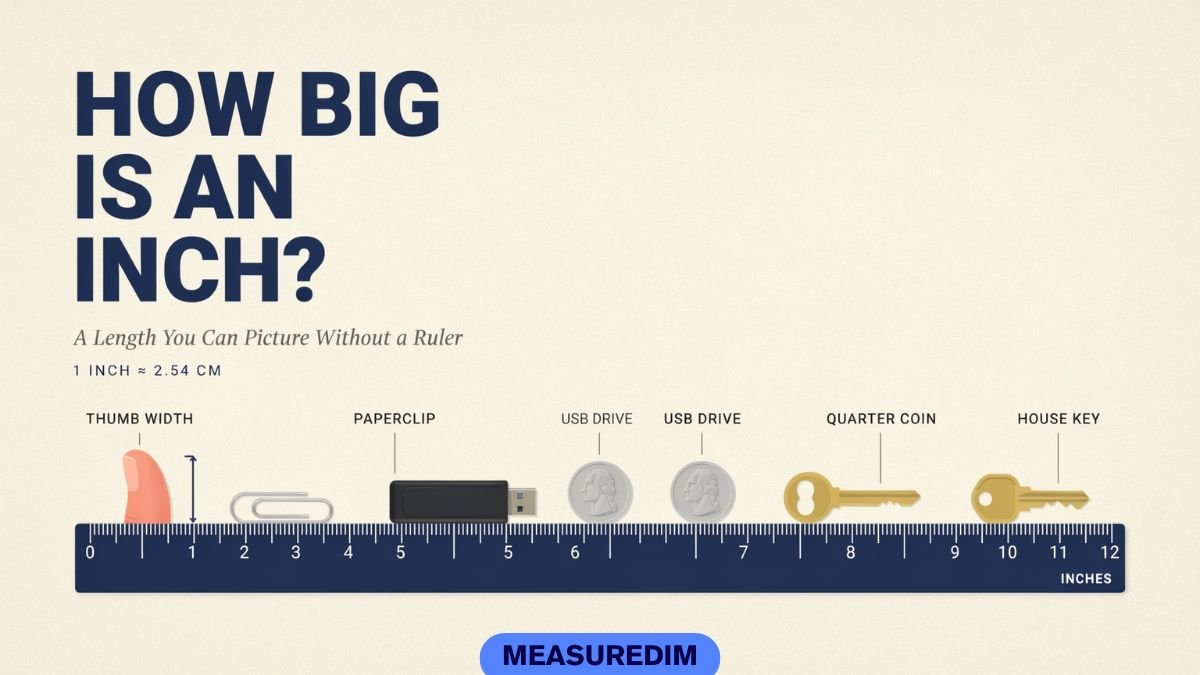
How Big Is an Inch? A Length You Can Picture Without a Ruler
An inch is a small unit of length. One inch equals 2.54 centimeters, or 25.4 millimeters. It is also one-twelfth of a foot, which makes it easy to use.
Ever ordered something online and guessed the size wrong? A “1-inch” hook or knob can look tiny or huge in your head. Knowing how big an inch really is fixes that guessing game for good.
You do not need a ruler to picture an inch. It is about the width of your thumb, or a little more than a US quarter. A hockey puck’s thickness is exactly one inch, which makes a handy reference.
An Inch in One Breath
An inch is 2.54 centimeters — exactly, by international agreement — which is the same as 25.4 millimeters, one-twelfth of a foot, and roughly the width of an adult thumb. That’s the complete answer. Everything below just makes that length stick, so you can picture it, estimate it, and convert it on the fly.
Every Way to Write One Inch
The reason people trust the inch for precise work is that its conversions aren’t messy approximations — most are exact by definition. Here’s the full picture.
| Unit | One inch equals | Exact? |
| Centimeters | 2.54 cm | Exact |
| Millimeters | 25.4 mm | Exact |
| Feet | 0.0833 ft (1/12) | Exact fraction |
| Yards | 0.0278 yd (1/36) | Exact fraction |
| Meters | 0.0254 m | Exact |
| Typographic points | 72 pt | Exact (PostScript) |
| Picas | 6 picas | Exact |
Two things worth flagging. First, 2.54 cm is not a rounded value — since 1959 the inch has been defined as precisely that. Second, the foot and yard relationships are clean fractions, which is why builders and machinists can move between inches and feet without accumulating error.
If you work with small fractions of an inch, this second table saves a lot of squinting at ruler marks:
| Fraction of an inch | Millimeters | Centimeters |
| 1/16 in | 1.59 mm | 0.159 cm |
| 1/8 in | 3.18 mm | 0.318 cm |
| 1/4 in | 6.35 mm | 0.635 cm |
| 1/2 in | 12.7 mm | 1.27 cm |
| 3/4 in | 19.05 mm | 1.905 cm |
| 1 in | 25.4 mm | 2.54 cm |
What One Inch Actually Feels Like in Your Hand
An inch is small, but it isn’t tiny. It’s a confident, deliberate length — big enough to see clearly across a room, small enough to fit under your thumb. Picture the short side of a large postage stamp, or the height of a stack of quarters four coins tall. Line up twelve inches end to end and you’ve drawn a foot; line up two and you’ve got the diameter of a golf ball plus a little. Once you’ve matched it to a couple of physical objects, the abstract “2.54 cm” turns into something you can feel.
Thumbs, Barleycorns, and a 1959 Handshake
The inch has a surprisingly human origin. The word descends from the Latin uncia, meaning “a twelfth” — the same root that gave us ounce — because an inch was one-twelfth of a Roman foot. For centuries, though, its length was tied to the body: in French an inch is still a pouce (thumb), and many old measuring systems set the inch at roughly the width of a man’s thumb.
Then things got agricultural. A medieval English statute, traditionally attributed to the reign of King Edward II in the early 1300s, defined the inch as three grains of barley, dry and round, laid end to end. That barleycorn is not entirely dead, either — the 1/3-inch barleycorn still quietly governs UK and Irish shoe-size increments today.
The modern, boringly precise inch arrived in 1959, when the US, UK, and other English-speaking nations signed the International Yard and Pound Agreement and fixed the inch at exactly 25.4 mm. Before that, the American inch was a whisker longer, derived from the meter, and the two differed by about two parts per million — invisible for a bookshelf, but enough to matter for continent-spanning surveys. The old US survey inch was finally retired at the end of 2022, leaving one inch for everyone.
Ten Everyday Things That Land Right Around an Inch
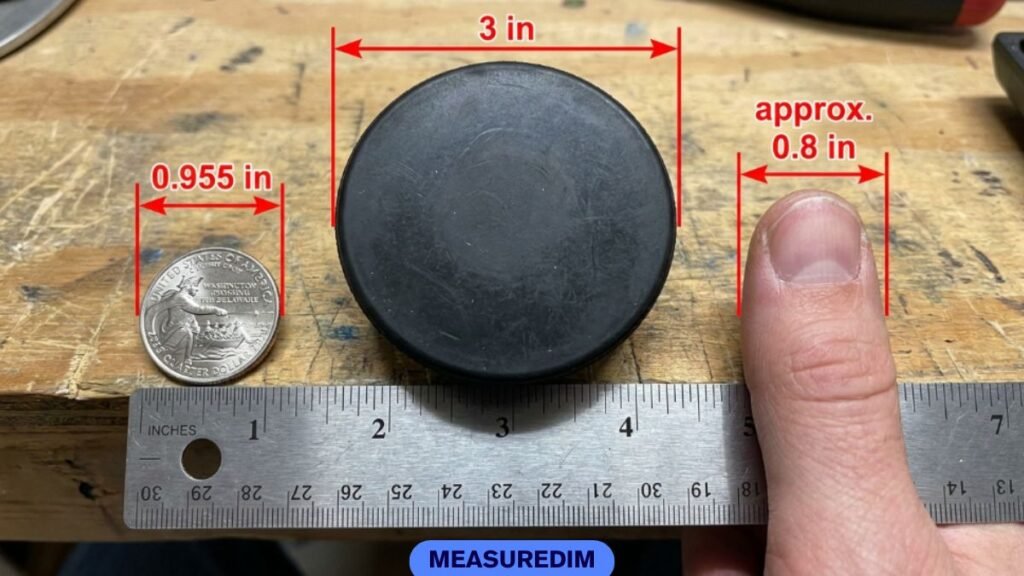
Numbers are exact; intuition needs objects. Here are ten references that sit on or near an inch, from spot-on to slightly-off — I’ve labeled each so you know exactly how close it really is.
The Width of Your Thumb
Look at your thumb at its widest point, just below the nail. For most adults it spans close to 1 inch — the very reason “inch” and “thumb” overlap in so many languages. It’s an approximate match, not an exact one: slimmer hands run nearer 0.8 in, broader ones push past 1.1 in.
The advantage is that your thumb is always with you. Press it flat against a shelf edge, a bolt, or a gap and you’ve got an instant gauge good to within a couple of millimeters. I reach for it constantly when hanging frames — thumb off a rough inch of clearance, then confirm with a tape only if the job demands it.
Read Also: How Much Is 10 Inches? A Real-World Size Guide
A US Quarter
A US 25-cent piece measures 0.955 inch across — 24.26 mm, a hair under a full inch. Rest one on a table and you’re looking at about 96% of an inch, close enough that the naked eye can’t spot the shortfall.
Coins beat body parts for consistency, because every quarter is milled to the identical diameter and never changes with the hand holding it. Keep one in a drawer as a pocket ruler. It’s my default check for whether a cabinet knob or a rubber grommet is “about an inch” before I commit to an online order.
The Thickness of a Hockey Puck
A regulation ice-hockey puck is exactly 1 inch thick and 3 inches in diameter — a spec both the NHL and the IIHF lock down. Stand one on its edge and its height is a true, rules-tested inch, no rounding involved.
Unlike the thumb or the quarter, this match is engineered on purpose, which makes it a satisfying mental anchor. If you’ve ever held a puck, you already know the heft of an inch of solid vulcanized rubber. It’s a great yardstick for judging the thickness of a butcher-block counter or a short stack of coasters.
A 2-Euro Coin
For readers outside the States, the 2-euro coin is almost custom-built for this job: 25.75 mm across, or 1.01 inch — within a rounding error of the real thing. Its smaller sibling, the 1-euro coin, sits at 23.25 mm (0.92 in) and is noticeably tighter.
That near-perfect fit makes the two-euro piece the cleanest coin reference in circulation anywhere. Trace around one on a scrap of paper and your circle is an inch wide, give or take a whisker. Travelers can lean on it exactly the way Americans lean on a quarter.
A Golden Dollar Coin
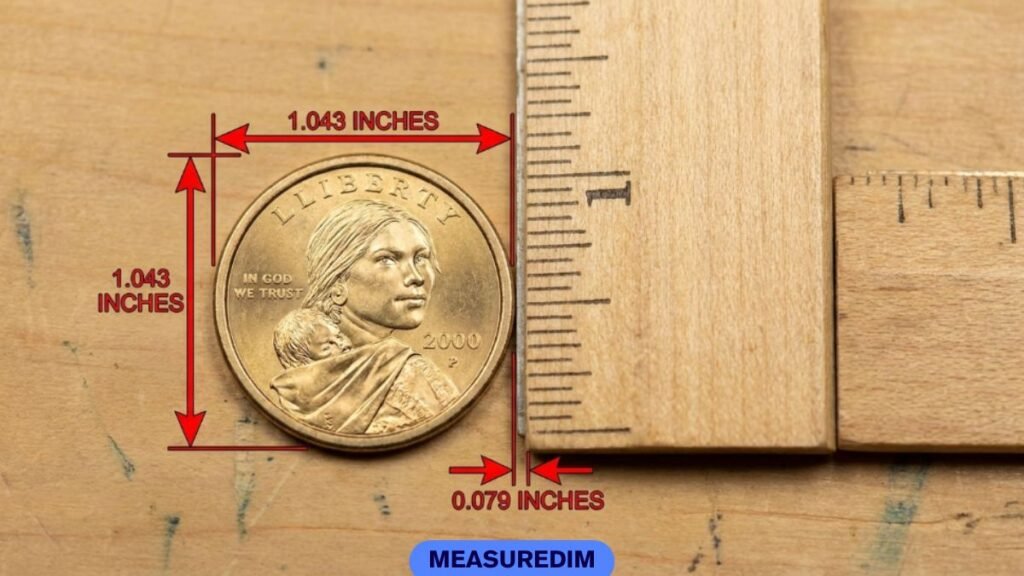
The Sacagawea and Presidential US dollar coins measure 1.043 inch (26.49 mm) in diameter — just a touch over an inch. It overshoots by roughly a millimeter, a neat mirror image of the quarter’s slight undershoot.
Hold the two together in your mind and you bracket an inch perfectly: the quarter falls just short, the dollar coin runs just long, and the truth sits squarely between them. That bracketing trick beats any single object when you’re trying to size something up by eye.
A Full-Size SD Card
A standard SD memory card is 24 mm on its short edge — 0.945 inch, a shade under an inch. (Its long side is 32 mm, about 1.26 in.) Don’t confuse it with the fingernail-sized microSD, which is far too small to help here.
Mass-produced to tight tolerances, SD cards double as quietly precise little rulers. If one’s sitting on your desk, its narrow edge shows you an inch minus a sliver. That’s genuinely useful for eyeballing a camera-gear cutout or the width of a slot in a drawer divider.
The Diameter of a Wine Cork
A natural wine cork is typically 24 mm wide — 0.94 inch — before it’s compressed into the bottle neck. It’s longer than it is wide, around 45 mm (1.77 in), so it’s the round end you want for an inch, not the side.
Corks turn up on every dinner table and are surprisingly uniform in girth. Stand one on end and the top face is your near-inch reference. I’ve grabbed a cork more than once to sanity-check whether a curtain-rod bracket or a pipe fitting was in the right ballpark.
A Stack of Sixteen Pennies
A single US penny is 1.52 mm thick, so sixteen of them stacked reach about 24.3 mm — roughly 0.96 inch. It’s an approximate count: coin wear and tiny minting differences mean 16 or 17 both land near the target.
This one’s more demonstration than everyday tool, but it drives the scale home — an inch is a lot of pennies. Build the tower beside a ruler once and the height lodges in memory. It’s a fun, hands-on way to show a child what an inch means without handing them a tape measure.
The Width of a C Battery
A C-cell battery is 26.2 mm in diameter — 1.03 inch, just over. (Its length, around 50 mm, is closer to two inches.) Reach for the fat cylinder from the flashlight drawer, not the skinny AA, which is only 0.57 in wide.
C batteries live in flashlights, older radios, and toys, so most people can picture one. Roll it under a finger and you’re feeling a shade past an inch. That makes it a handy stand-in when you need to imagine the bore of a tube or the mouth of a small jar.
A Forever Stamp
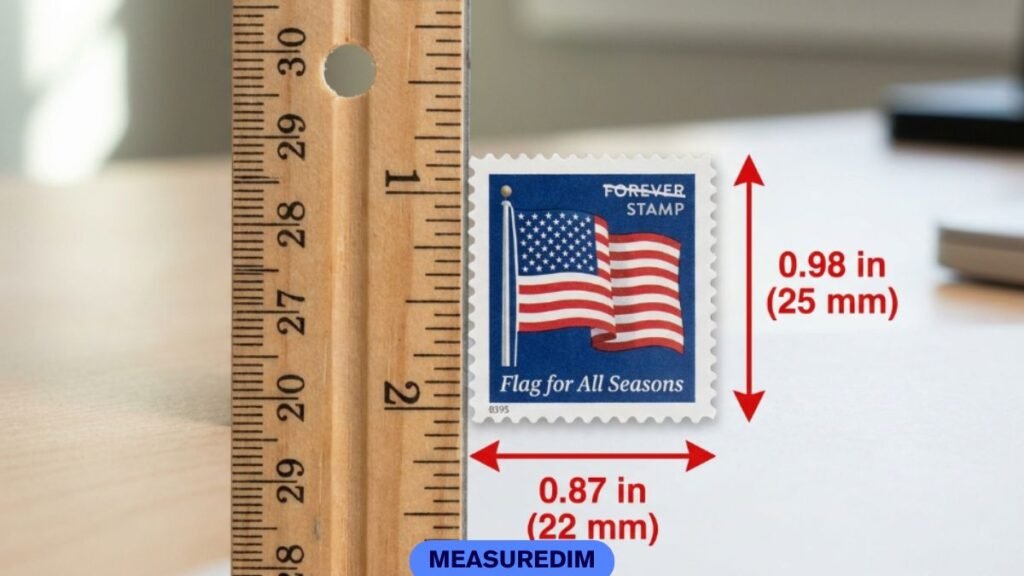
A standard US Forever stamp measures roughly 0.87 by 0.98 inch, so its taller side is just under an inch — about 25 mm. Dimensions shift a little across stamp designs, so treat this as a close estimate rather than a guarantee.
Stamps are dead flat, which makes them easy to lay against a straight edge for a quick read. Next time you seal an envelope, you’re holding a near-inch square between your fingers. It’s a reasonable proxy when you’re judging a small label, sticker, or logo.
The Inch Line-Up at a Glance
Here’s the whole cast in one place, sorted by how they stack up against a true inch. Notice that most everyday objects cluster just under — a useful thing to remember.
| Object | Real measurement | Versus 1 inch |
| Hockey puck (thickness) | 1.00 in / 25.4 mm | Exact |
| 2-euro coin (diameter) | 1.01 in / 25.75 mm | Almost exact |
| C battery (diameter) | 1.03 in / 26.2 mm | Just over |
| Golden dollar coin (diameter) | 1.04 in / 26.49 mm | Just over |
| Thumb width | ~1 in | Close (varies) |
| Forever stamp (long side) | ~0.98 in / 25 mm | Just under |
| Stack of 16 pennies | ~0.96 in / 24.3 mm | Just under |
| US quarter (diameter) | 0.955 in / 24.26 mm | Just under |
| SD card (short edge) | 0.945 in / 24 mm | Just under |
| Wine cork (diameter) | 0.94 in / 24 mm | Just under |
No Ruler Handy? Use Your Body
Your hand is a rough measuring kit you never leave at home. Two tricks get you closest to an inch.
The first is thumb width, covered above — flatten it against whatever you’re sizing. The second is even more reliable for many people: the distance from the tip of your thumb to its first knuckle is, for a typical adult, right around 1 inch. Curl your thumb and that top segment becomes a little built-in inch-block you can walk along an edge.
Want to calibrate yourself once and for all? Lay your thumb against a ruler tonight, note whether you run a touch under or over an inch, and remember the correction. From then on your personal thumb-inch is a genuinely dependable field tool. Failing that, almost any coin in your pocket gets you within a couple of millimeters.
Read Also: How Big Is 5 Inches? 9 Everyday Objects to Picture It
Reading the Small Marks: Half, Quarter, and Eighth
Most confusion with the inch happens between the whole numbers. On a standard imperial ruler, the inch is chopped into halves, quarters, eighths, and sixteenths, with the tallest tick after the inch line marking the half.
A half inch (12.7 mm) is about the diameter of that same golden dollar coin cut in half, or roughly the width of a standard pencil laid across your view. A quarter inch (6.35 mm) is close to the width of a fat drinking-straw or two stacked pennies plus a bit. A sixteenth (1.59 mm) is thinner than a credit card’s edge is wide — genuinely small.
Stepping the other way: two inches (5.08 cm) is roughly a golf ball’s diameter, and it’s worth knowing the neighbors so you don’t confuse an inch with the sizes just above and below it.
Where Getting an Inch Right Actually Counts
The inch quietly runs a lot of everyday specs, and mistaking it costs real money.
Screens are the obvious one: a “55-inch TV” refers to the diagonal, not the width, so a 55-inch set is only about 48 inches wide — a gap that has ruined more than one wall-mount plan. Printing and design lean on the inch too, since resolution is measured in dots per inch and a page is 72 points tall per inch. In the workshop, pipe, screw, and drill-bit sizes are almost all inch-based, and screen or window dimensions are quoted width-by-height in inches. Even shoe sizes trace back to the inch through that stubborn 1/3-inch barleycorn. If you ship anything, carriers price by inch-based box dimensions, so being an inch off on a measurement can bump you into a higher rate.
Where People Trip Up on the Inch
A handful of mistakes come up again and again.
The biggest is swapping inches for centimeters. They’re not close — an inch is about two and a half centimeters, so reading “2.54” as if the units were interchangeable throws you off by 150%. Order a 24-inch shelf thinking in centimeters and you’ll be badly surprised.
The second is trusting nominal lumber sizes. A “one-inch” pine board from the hardware store is really about 3/4 inch (19 mm) thick once it’s planed, and a “2×4” is closer to 1.5 by 3.5 inches. The name is a leftover from the rough-cut dimension, not the finished one.
Third, don’t assume a quarter is exactly an inch — it’s 0.955 in, close but consistently short, which matters if you daisy-chain several coins to estimate a longer span. And when someone says “SD card,” picture the full-size card, not the tiny microSD, or your inch estimate collapses to a third of the real thing.
Quick-Fire Questions
How big is an inch in fingers?
About one thumb width, or roughly the width of one adult finger at the knuckle.
How does 1 inch look like?
It looks like the top segment of your thumb, from the tip to the first knuckle.
How big is an inch visually?
Picture a US quarter with a tiny bit to spare, or a hockey puck’s thickness.
How big is one inch example?
A US quarter is 0.955 inch, and a regulation hockey puck is exactly 1 inch thick.
Is 2 fingers 1 inch?
No. Two fingers side by side measure closer to 1.5 inches; one finger is nearer an inch.
Now You’ll Spot an Inch Instantly
So now you know how big is an inch. An inch is 2.54 centimeters, or 25.4 millimeters. It is one-twelfth of a foot. That number stays the same everywhere, so you can always trust it. You can picture an inch in easy ways too. Your thumb is close to one inch wide. A US quarter comes very near an inch. A hockey puck measures exactly one inch thick.
Keep one of these objects in your mind. Then you will spot an inch fast, even without a ruler. This skill helps you with school projects, art, and small building tasks. It also helps you shop online with more care. Practice once with a real ruler. Soon you will judge an inch with full confidence.
Written by a measurement-and-dimensions editor who has measured more everyday objects against a caliper than is strictly reasonable. Figures cross-checked against coin-mint, sporting, and hardware-standard specifications.
Related Guides:
1: How Long Is 2 Inches? Real Objects That Show You Exactly
2: How Long Is 6 Inches? Real Objects to Picture It Fast
3: How Big Is 4 Inches? A Complete Size Guide With Real Objects
4: How Long Is 8 Inches? Everyday Objects to Picture It
5: How Big Is 7 Inches? 10 Everyday Objects to Picture It