
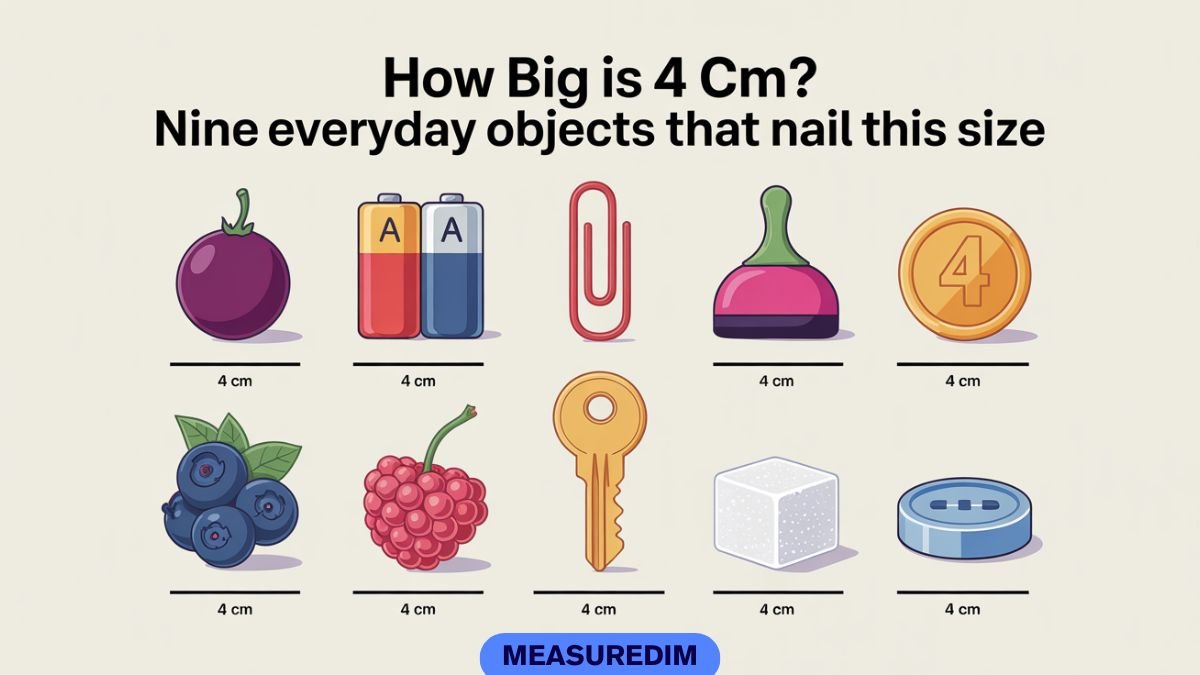
How Big Is 4 cm? Nine Everyday Objects That Nail This Size
How Big Is 4 cm simply means the size of a 4-centimeter length. In plain terms, 4 cm equals 40 mm, or about 1.57 inches. It is a small size, close to the width of a table tennis ball.
Ever tried to picture 4 cm and drawn a blank? A number alone never tells you the real size. But hold up two fingers together, and that gap is almost exactly 4 cm.
You will find 4 cm all around your home once you look. It matches a poker chip, a golf ball, and a AAA battery’s length. Knowing this helps you measure small things fast, even without a ruler.
The Short Answer
4 cm is 40 mm, or about 1.57 inches — a hair over one and a half inches. The cleanest object to picture is a regulation table tennis ball, which measures exactly 40 mm across. If you’d rather use your body, press your index and middle fingers together: for most adults that’s right around 4 cm wide.
4 cm Converted Into Every Unit You’ll Need
Centimeters sit in the metric system, so if you think in inches or feet you need a quick bridge. Here’s 4 cm expressed across the units people actually search for.
| Unit | 4 cm equals |
| Millimeters | 40 mm |
| Centimeters | 4 cm |
| Inches | ≈ 1.57 in (about 1 ⁹⁄₁₆ in) |
| Feet | ≈ 0.13 ft |
| Yards | ≈ 0.044 yd |
| Meters | 0.04 m |
Two conversions are worth memorizing because they never change: 4 cm = 40 mm exactly, and 4 cm ≈ 1.57 in. Everything else is downstream of those two.
What Four Centimeters Actually Feels Like
Four centimeters is a small measurement — smaller than most people guess when they hear “four” of anything. It’s a bit more than one and a half inches, not quite two. Held between your thumb and forefinger, 4 cm is roughly the gap you’d leave to grip a thick marker. It’s the diameter of a small round thing you could close your whole hand around: a large gumball, a chunky bead, a lid. Keep that scale in mind as we walk through the objects — none of them is chunky, and that’s the point.
Nine Everyday Things That Are About 4 cm
I’ve ordered these from most exact to most approximate. Where a real range exists, I’ve given it, and I’ve flagged plainly when a comparison is an estimate rather than a spec.
The Regulation Table Tennis Ball
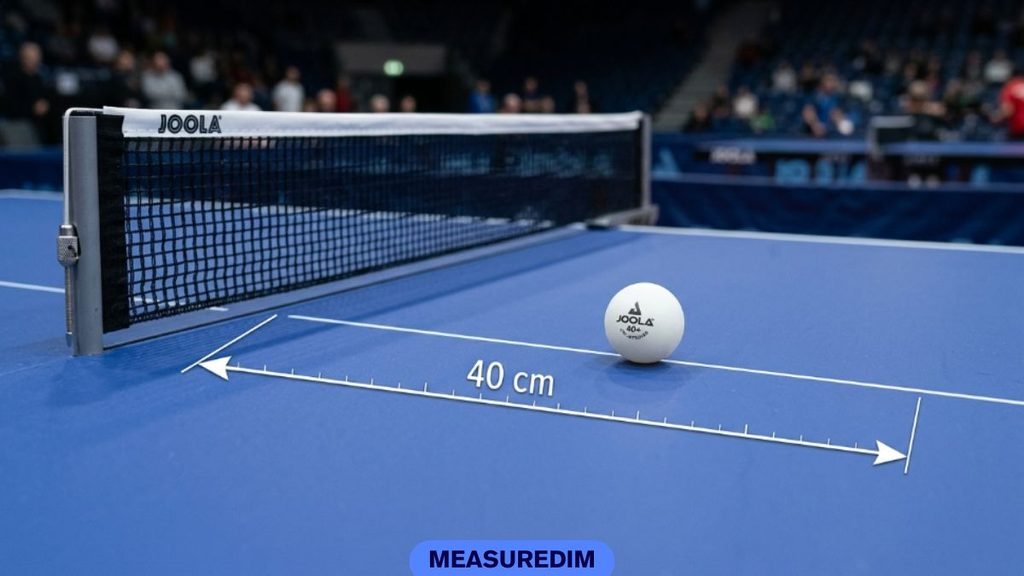
A modern table tennis ball measures exactly 40 mm across, which lands on 4 cm with no rounding. The International Table Tennis Federation fixed this size, so every tournament-legal ball you pick up is the same width to the millimeter. That rule-bound consistency makes it the single most precise everyday stand-in for 4 cm you can physically hold.
Because the diameter is set by regulation rather than by a factory’s whim, it’s a reference you can trust without checking twice. Roll one into your palm and you’re feeling 4 cm directly. When you’re squinting at whether a knob, grommet, or drilled hole is about that wide, mentally drop a ping pong ball beside it — a trick that earns its keep when you’re shopping for cabinet pulls and left the tape measure in the garage.
A Standard Casino Poker Chip
A casino-grade poker chip runs about 39 mm in diameter — a whisker under 4 cm, close enough that the one-millimeter gap is invisible to the naked eye. Cheaper home-set chips wander a little, but the heavy clay ones cluster tightly around this figure.
The flat disc shape makes a chip easy to summon from memory, and almost everyone can picture one instantly. Stack a few and you also get a feel for small thicknesses. When you need to judge the width of something round and coin-like — a large button, a jar lid, a watch face — a poker chip beats an actual coin as a reference, because it already sits right at the 4 cm mark instead of well below it.
Read Also: How Long Is 2 cm? Real-Life Size Comparisons + Chart
A Golf Ball
The rules of golf set a minimum diameter of 42.67 mm, and manufacturers build right to that floor, so a golf ball measures about 4.3 cm — a touch over 4 cm, not exactly on it. Think of it as “4 cm plus a sliver” and you’ll never overstate it.
Golf balls are everywhere and their size barely drifts, which makes them a dependable, if slightly generous, yardstick. Picture one when you want a rough upper bound: if an object is clearly smaller than a golf ball but bigger than a ping pong ball, it’s parked almost exactly in the 4 cm zone. That sandwich is handy for guessing produce — a small plum or a fat cherry tomato lives right in there.
A AAA Battery, Standing on End
Stand a AAA battery upright and it’s about 44.5 mm tall — roughly 4.4 cm, so a little longer than 4 cm. Don’t confuse dimensions here: its diameter is only about 10.5 mm, nowhere near the target.
Nearly every household has a AAA within arm’s reach, and that availability is the whole appeal. To approximate a true 4 cm, imagine the battery with the last few millimeters shaved off the top. It’s a solid gauge when you’re measuring a short length rather than a diameter — the depth of a shallow slot, the reach of a small screw — and want more than a blind guess.
Two U.S. Pennies Side by Side
A single penny is 19.05 mm wide, so two of them touching edge to edge span 38.1 mm — about 3.8 cm, just shy of 4 cm. Line the pair up and you’re looking at very nearly the target length, short by only a couple of millimeters.
Coins are the ultimate no-excuses reference, since there’s almost always loose change in a pocket or a drawer. Two pennies won’t hand you an exact 4 cm, but they get you within roughly 2 mm, which is plenty for a casual estimate. This is the move when you’re describing a size down the phone: “about two pennies across” lands with someone instantly, no ruler required.
A Wooden Safety Match
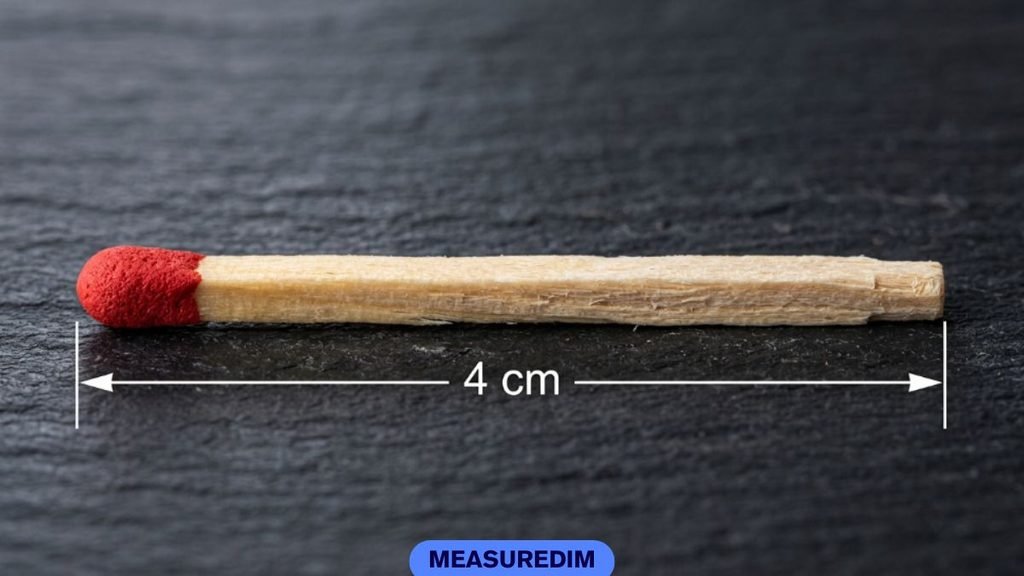
A standard wooden safety match is roughly 4 cm long — most fall in the 40–45 mm range depending on the box, so treat this as approximate rather than exact. The slim cardboard matches from a matchbook tend to run a touch shorter.
What makes a match useful is that it measures a length, not a diameter, so it complements all the round objects on this list. Lay one flat and you’ve got a quick horizontal ruler for short spans. I reach for this mental image when I’m checking whether a narrow gap, a keyhole, or a hinge slot falls in the 4 cm ballpark.
A LEGO Minifigure, Head to Feet
A classic LEGO minifigure stands right around 4 cm tall, measured from the soles of its feet to the top of its head with hair and hats left off. It isn’t a precision instrument — call it “about 4 cm” — but the height is remarkably consistent from set to set.
The minifigure works as a reference because it’s a familiar shape with a clear top and bottom, easy to stand mentally against whatever you’re sizing up. If a kid’s LEGO bin is nearby, you literally have a 4 cm gauge in your hand. It’s also a painless way to show a child what a few centimeters looks like without producing a ruler and a lecture.
A French Macaron
A classic Parisian macaron typically runs 4 to 4.5 cm across, with many bakeries piping their shells to hit right about 4 cm. Sizes shift by pastry chef, so this is a friendly estimate, not a published spec.
Food references stick in the memory far better than bare numbers, and a macaron gives you a round, fingertip-sized sense of 4 cm. Next time one’s on a plate, notice how it nearly fills the circle your thumb and index finger make. It’s a pleasant reference for picturing the footprint of anything small and round — a spice jar lid, a large decorative coin, a shirt button.
Two Adult Fingers Held Together
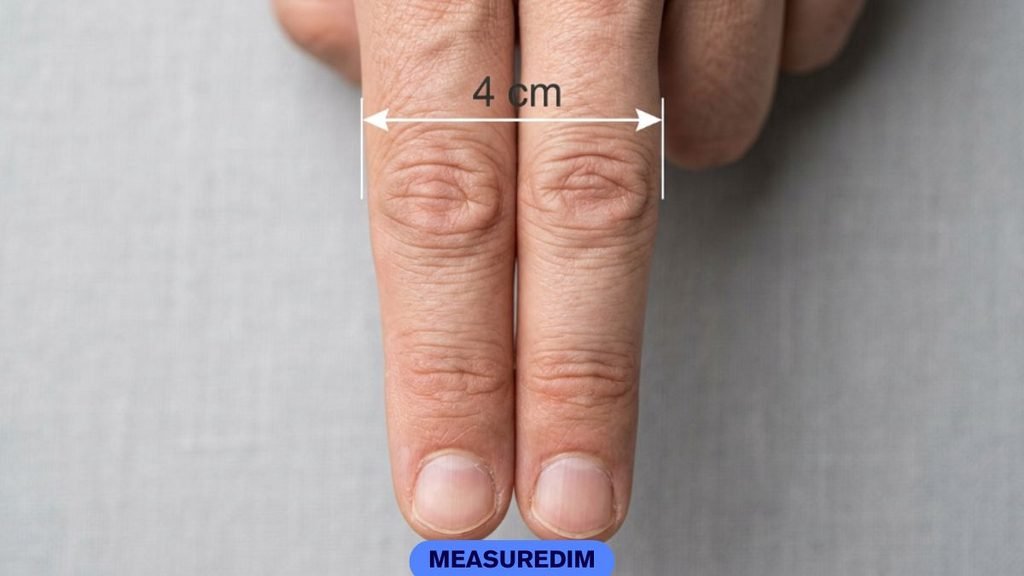
Press your index and middle fingers flat and together, and the width across the pair is roughly 4 cm for most adults. Hands differ, so measure yours once against a ruler and you’ll own a personal gauge that’s always with you.
This body-based trick beats every object on the list for sheer convenience — you can’t leave your hand at home. Because it’s tuned to your fingers, it’s more reliable for you than any borrowed coin. Use it to space picture hooks, judge the mouth of a small plant pot, or set two screws the right distance apart.
Every Reference at a Glance
Here’s the whole set laid side by side so you can pick whichever object you’re most likely to have nearby.
| Object | Real measurement | How it compares to 4 cm |
| Table tennis ball (diameter) | 40 mm | Exactly 4 cm |
| Poker chip (diameter) | ≈ 39 mm | ~1 mm under |
| Two pennies side by side | 38.1 mm | ~2 mm under |
| Golf ball (diameter) | 42.67 mm | ~3 mm over |
| AAA battery (length) | 44.5 mm | ~4–5 mm over |
| Wooden match (length) | ≈ 40–45 mm | About right |
| LEGO minifigure (height) | ≈ 40 mm | About right |
| French macaron (diameter) | ≈ 40–45 mm | About right to slightly over |
| Two adult fingers (width) | ≈ 40 mm | About right (varies by hand) |
Judging 4 cm With Just Your Hands
No ruler, no coins, nothing in the drawer? You still have three reliable ways to gauge 4 cm.
The first is the two-finger method above: index and middle fingers pressed together read about 4 cm for most adults. The second is your thumb: the width across an adult thumbnail is close to 2 cm, so two thumbnail-widths stacked gets you near 4 cm. The third is any coin you happen to have — remember that most everyday coins sit between 2 and 2.5 cm across, so a single coin is not enough; you need roughly a coin-and-three-quarters, which is why “two pennies” is the cleaner shortcut. Calibrate one of these against a real ruler once, and you’ll carry a trustworthy 4 cm estimate everywhere.
Read Also: How Big Is 8 cm? A Clear Look With Everyday Objects
Where 4 cm Actually Comes Up
This size appears more often than you’d think once you start noticing it. Cabinet and drawer hardware is frequently spec’d around 40 mm for knob diameters and screw lengths. Jewelry makers work in this range constantly — a 4 cm pendant drop or hoop is a common, wearable size. In crafting and sewing, 4 cm is a standard seam allowance doubled, or the diameter of a large button. Phone and camera lenses, watch faces, jar lids, and bottle caps all cluster near this figure. And if you’re packing or shipping, 4 cm is a typical clearance to leave around a fragile item — enough padding to matter, small enough not to waste a box.
4 cm Between Its Neighbors: 3 cm vs 5 cm
Sizes make more sense in company, so here’s 4 cm flanked by the centimeter on each side.
3 cm (≈ 1.18 in) is noticeably smaller. A good picture is a U.S. half-dollar coin, which is about 30.6 mm across, or a large grape. Drop from 4 cm to 3 cm and a ping pong ball shrinks to roughly half-dollar width.
4 cm (≈ 1.57 in) is our subject: the ping pong ball, the poker chip, two fingers.
5 cm (≈ 1.97 in) is almost exactly two inches. The easy reference is a AA battery, which stands about 50.5 mm tall, or a jumbo paperclip. Going from 4 cm up to 5 cm is the jump from a ping pong ball to a AA battery laid end-up — a clear, visible step.
Where People Get 4 cm Wrong
A few honest mistakes trip searchers up again and again. Sidestep these and your estimates stay sharp.
Mixing up 4 cm and 4 inches. These are not close. Four inches equals 10.16 cm — more than two and a half times bigger. If a listing says “4 cm” and the object looks palm-filling in the photo, someone likely swapped the unit.
Dropping a decimal between cm and mm. 4 cm is 40 mm, while 4 mm is only 0.4 cm. That’s a tenfold error, and it sneaks into DIY measurements constantly.
Rounding 4 cm up to “about 2 inches.” It’s tempting, but 4 cm is 1.57 inches — closer to one and a half than to two. Calling it 2 inches overshoots by nearly 27%.
Assuming a single coin covers it. A U.S. quarter is only about 24.26 mm across, roughly 2.4 cm — well under 4 cm. One coin always undershoots; you need close to two.
Treating a golf ball as “exactly 4 cm.” It’s 42.67 mm, so about 4.3 cm. Great for a rough upper bound, wrong for a precise one — reach for the ping pong ball when you need it exact.
Quick-Fire Q&A
What does 4 cm look like in size?
It looks like a small round object about the width of a ping pong ball. In numbers, that is 40 mm or roughly 1.57 inches.
How big is 4 cm compared to a fruit?
It’s close to the width of a large grape or a small strawberry. A cherry tomato of about 4 cm across is a near-perfect match.
What is 4 cm comparable to?
It matches a table tennis ball exactly (40 mm) and a poker chip closely (39 mm). A golf ball is just a touch bigger at about 4.3 cm.
How long is 4 cm visually?
Picture a line a little over one and a half inches long. That’s about the length of a wooden matchstick or a AAA battery.
How long is 4 cm on a finger?
It spans roughly your index and middle fingers held together. It also equals about two thumbnail-widths side by side.
Locking 4 cm Into Memory
Now you know exactly how big is 4 cm. It equals 40 mm, or about 1.57 inches. That makes it a small size. A table tennis ball shows it best, because a ball measures 4 cm across. A poker chip and a golf ball come very close too. You can also hold two fingers together to match it. These simple objects turn a plain number into a clear picture in your mind.
Keep one easy image in your head, and you will remember this size for good. Just think of a ping pong ball each time. That single picture carries the exact number with it. You can also press two fingers together when you have no ruler nearby. With these tricks, you will spot 4 cm anywhere with ease.
Related Guides:
1: How Big Is 3 Inches? Real Objects, Sizes & Conversions
2: How Long Is 18 Inches? 10 Objects to Picture It Fast
3: How Big Is 5 cm? Everyday Objects to Help You Picture It
4: How Long Is 10 Feet? 10 Everyday Objects to Picture It
5: How Long Is 1 Meter? 7 Everyday Objects That Show It

2 Comments