
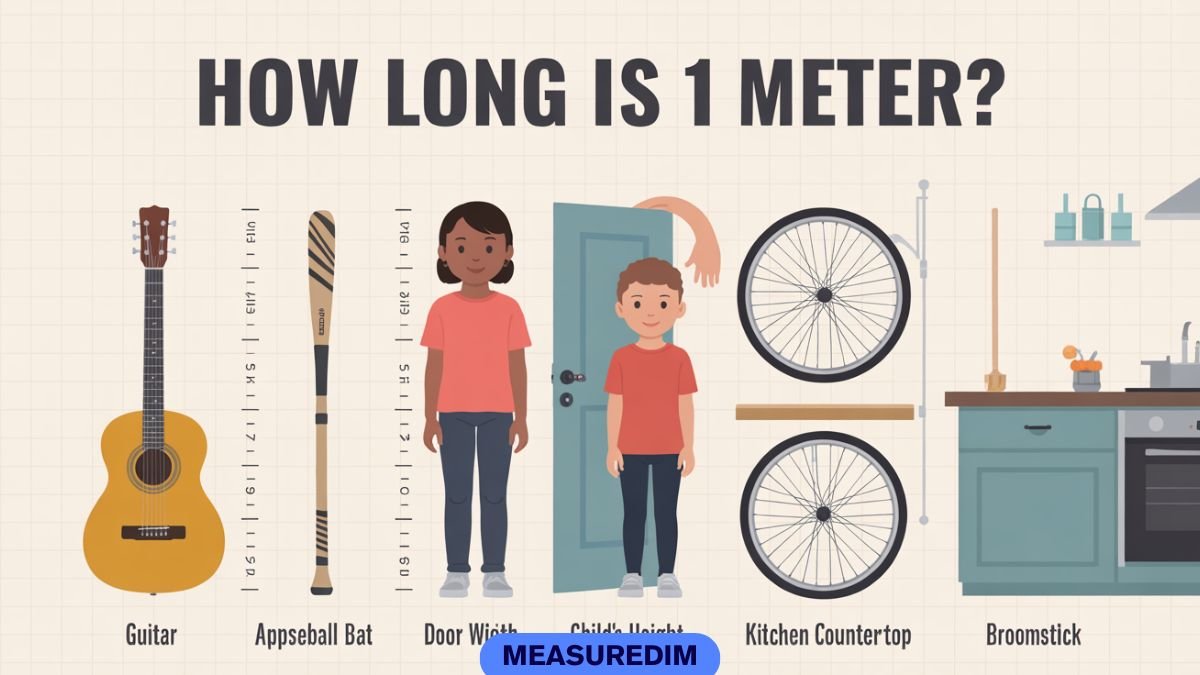
How Long Is 1 Meter? 7 Everyday Objects That Show It
A meter is a unit of length. It equals 100 centimeters, or about 39.4 inches. In simple terms, one meter is a little longer than three feet, and it is the main way most of the world measures length.
Picture one big step across a room. That single stride is close to a meter. Or stand a four-year-old child against the wall — their height is about a meter too. Once you see it, you can spot a meter anywhere.
A meter comes from the metric system, used almost everywhere on Earth. It equals 1,000 millimeters and 10 decimeters. Full-size guitars, single beds, and school meter sticks all land near this handy, everyday length.
The Short Answer
One meter is 100 centimeters, which works out to about 39.4 inches — a hair under 3 feet 3½ inches, and a little longer than a yard. If you want a single object to anchor it: a standard classroom meter stick is exactly one meter, and a full-size acoustic guitar is only a couple of centimeters over. Picture either one and you’ve got it.
1 Meter Converted Into Every Unit You’ll Actually Use
Before the visuals, here are the conversions worth keeping handy. Every figure below describes the same length, so nothing here will ever fight with anything else on the page.
| Unit | 1 meter equals |
| Centimeters | 100 cm |
| Millimeters | 1,000 mm |
| Decimeters | 10 dm |
| Inches | 39.37 in |
| Feet | 3.28 ft (3 ft 3.4 in) |
| Yards | 1.09 yd |
The two numbers most people trip over are the inch and foot values. A meter is 39.37 inches, not a round 40, and it’s 3.28 feet, not a tidy 3. That leftover 0.28 of a foot — about 3.4 inches — is exactly where cheap conversions go wrong.
What a Meter Actually Feels Like
Think of a meter as roughly one big step. When you stride across a room with purpose, that single pace lands close to a meter for most adults. It’s also about the distance from the floor to your belly button if you’re of average height, and roughly the reach from the tip of your nose to the fingertips of one outstretched arm.
That last one isn’t a coincidence. The old English yard was historically gauged nose-to-fingertip, and a yard (0.914 m) sits just shy of a meter. Add the width of your other hand to that reach and you’ve closed the gap. Hold that image and a meter stops being an abstraction and becomes something living in your own body.
Everyday Things That Are About a Meter Long
Here’s the useful part: seven real objects you already know, each landing within a few centimeters of a meter. Notice how they all cluster in the 38-to-41-inch band — that’s the meter’s neighborhood, and once you’ve seen the pattern you’ll spot it everywhere.
A Classroom Meter Stick
A wooden or aluminum meter stick is the one object on this list that is exactly, definitionally one meter: 100 cm, 1,000 mm, 39.37 inches, no rounding involved. It’s the reference the others get measured against, which is why it’s the honest place to start.
If you’ve stood one on end in a school hallway, you already own a precise mental image of a meter — most meter sticks reach somewhere around an adult’s lower chest or upper stomach. When you need to check whether anything else is a meter, this is the yardstick’s bigger, metric cousin, and it’s the cue I fall back on before reaching for tape.
A Full-Size Acoustic Guitar
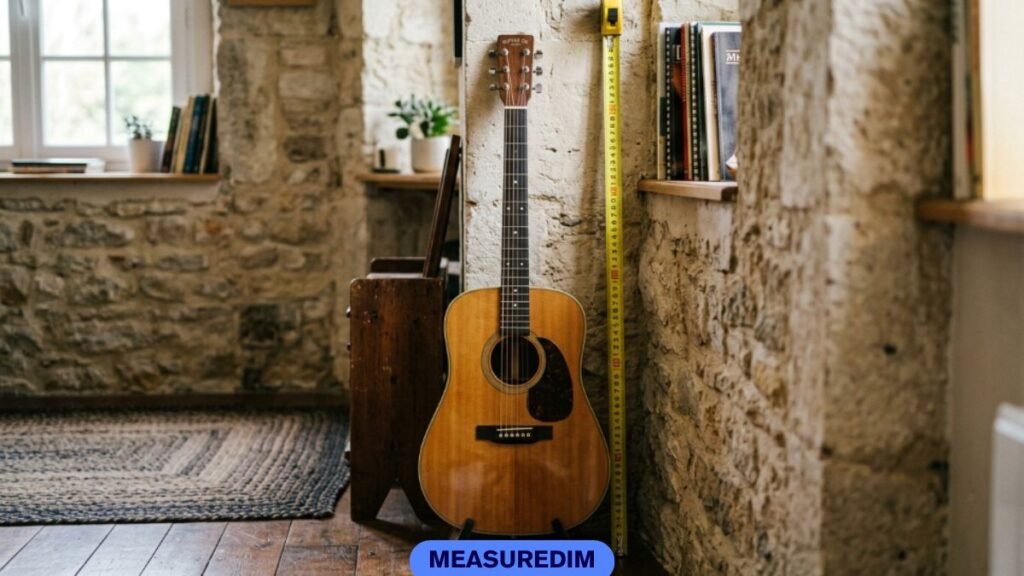
A standard dreadnought acoustic guitar runs about 104 cm (41 inches) from the top of the headstock to the base of the body — so it’s a touch over a meter, by roughly four centimeters. This is an approximate figure; body shapes and scale lengths vary between brands, but the overall length holds remarkably steady across full-size models.
Guitars make a great reference because so many households have one leaning in a corner. Lay it flat, imagine trimming an inch and a half off the headstock, and you’re looking at a meter. It’s the fastest visual I know for anyone estimating shelf length or the height of a floor lamp.
Read Also: How Tall Is 40 Inches? Everyday Comparisons & Conversions
A Fender-Style Electric Guitar
Swap the acoustic for a Fender-style electric guitar — a Stratocaster or Telecaster — and you get even closer to the mark: about 99 cm (39 inches) overall, which is roughly a centimeter under a meter. Treat that as approximate too, but of everything on this list, the electric guitar is one of the tightest everyday matches.
The reason it works so well is the solid, predictable body: unlike a floppy tape measure, a guitar holds its shape, so you can eyeball it against a doorway or a strip of carpet with confidence. When someone tells me a package is “about a meter,” I picture a Strat lying in the box.
The Height of an Average Four-Year-Old
A typical three-and-a-half to four-year-old child stands right around 100 cm (about 39–40 inches) tall. Growth varies from kid to kid, so read this as an average rather than a fixed number — but it’s a genuinely useful one, because heights at that age hover tightly around the meter mark.
This is the reference I reach for around families. Stand your preschooler against a wall and their crown lands near a meter; measure a table or a countertop against that memory and you’ve got a living, breathing ruler that also happens to keep growing. It’s a favorite for teaching kids what “a meter” means, because they are the meter.
The Width of a Single Bed Mattress
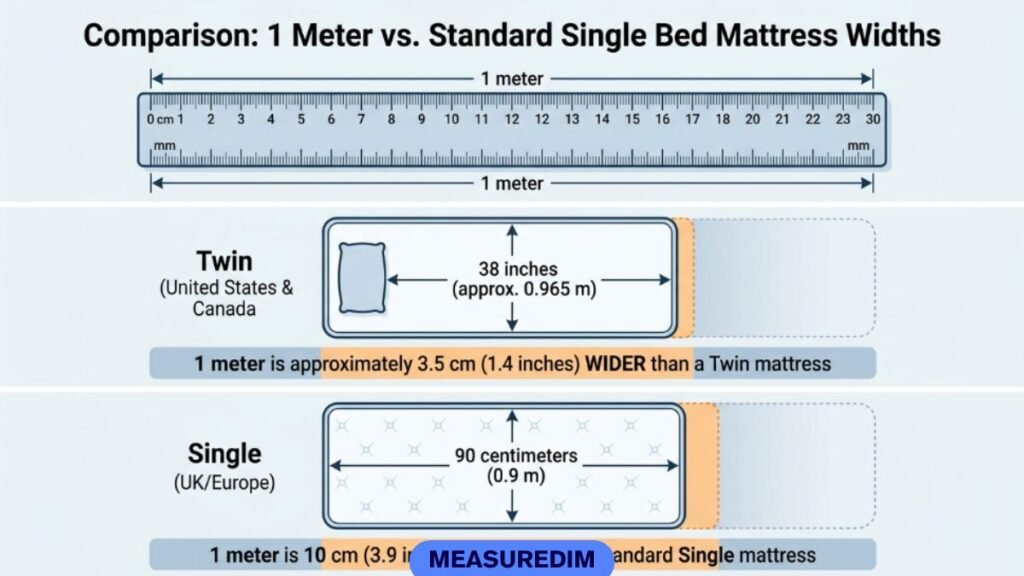
A US twin (single) mattress measures about 97 cm (38 inches) across — a few centimeters under a meter. Worth a small caveat by region: a UK single is narrower at exactly 90 cm (35.4 inches), so if you’re shopping outside North America, adjust your mental picture down a notch.
Mattress width is handy precisely because beds are everywhere and their dimensions are standardized. Picture the short edge of a twin bed, then imagine nudging it out by roughly a hand’s width, and you’ve built a meter. I lean on this one constantly when guessing whether furniture will fit through a bedroom doorway.
A 40-Inch Hula Hoop
A common adult hula hoop is sold at around 38–42 inches in diameter, and the popular 40-inch size measures about 102 cm across — just over a meter. The range here is real (hoops come in many sizes), so treat the 40-inch model as the representative one rather than a universal rule.
What makes the hoop uniquely useful is that it shows a meter as a circle, not a straight line. Stand one upright and its full width across the middle is your meter, roughly waist-high on many adults. If you’ve ever spun one, you already have a felt sense of a meter wrapped around your body.
A Closed Golf Umbrella
A large golf umbrella, folded shut, runs about 99 cm (39 inches) tip to handle — within a centimeter of a meter, and close enough to call a match. Compact travel umbrellas are far shorter, so this specifically means the full-size golf variety you’d share on a fairway.
Because it’s rigid and straight when closed, an umbrella behaves like an improvised meter stick you can carry in a car. Hold one against a suitcase or a length of shelving and you’ve got an instant, reasonably accurate gauge — no metric markings required.
A Few More That Land in the Same Zone
If none of those are within reach, these also sit within striking distance of a meter: a cricket bat at its maximum legal length (96.5 cm / 38 in), a mid-length longboard skateboard (around 102 cm / 40 in), and a baseball bat at its longest permitted size (106.7 cm / 42 in — just over). Any of them will get you inside a couple of centimeters.
The Meter at a Glance
Here’s the whole set side by side, so you can pick whichever object is nearest when you need it.
| Object | Real size | Compared to 1 meter |
| Classroom meter stick | 100 cm / 39.37 in | Exactly 1 meter |
| Dreadnought acoustic guitar | ~104 cm / 41 in | ~4 cm over |
| Fender-style electric guitar | ~99 cm / 39 in | ~1 cm under |
| Average 4-year-old (height) | ~100 cm / 39–40 in | About spot on |
| Twin/single mattress (width) | ~97 cm / 38 in | ~3 cm under |
| 40-inch hula hoop (diameter) | ~102 cm / 40 in | ~2 cm over |
| Closed golf umbrella | ~99 cm / 39 in | ~1 cm under |
How to Judge a Meter Without a Tape Measure
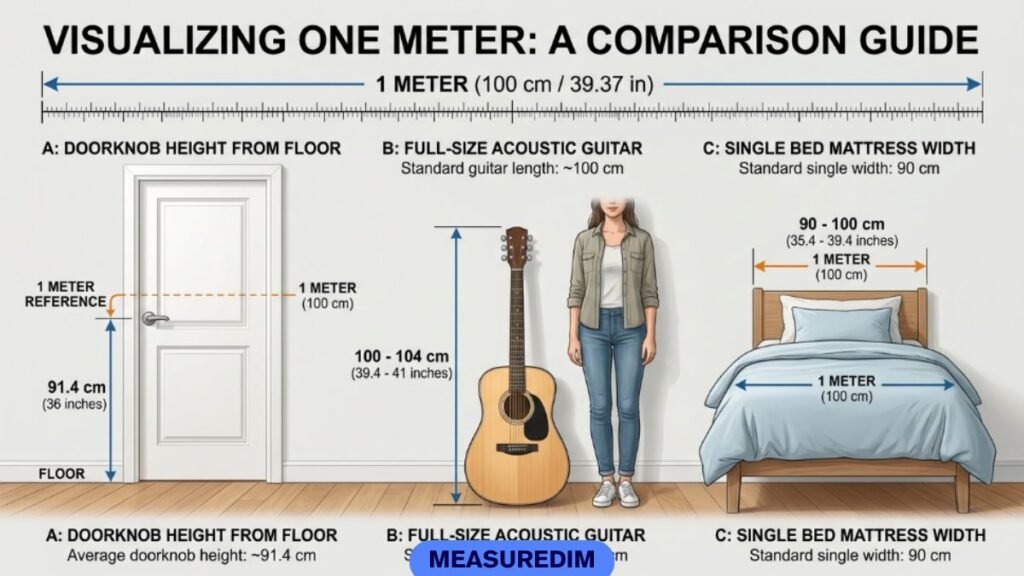
No ruler in sight? Your body is a decent backup instrument, as long as you know its measurements.
The most reliable trick is the outstretched-arm reach: from your nose to the fingertips of one fully extended arm is close to 0.9 m for an average adult, so reaching across and adding a small margin lands you near a meter. Taller people may hit a meter dead-on with this alone. Test yourself once against a real meter stick and you’ll know your personal offset for life.
A second option is the big step. Take one deliberate, slightly exaggerated stride and it’ll measure roughly a meter — ordinary relaxed steps run shorter, closer to 0.75 m, so consciously stretch it out. Pace off a floor this way and you can estimate room dimensions surprisingly well.
Third, use navel height. For an adult of average build, the floor-to-belly-button distance sits very near a meter. Back up against a wall, mark where your navel lands, and you’ve got a wall-mounted reference you can compare furniture and boxes against.
Read Also: How Big Is 7 cm? A Visual Guide With Real-World Comparisons
Where Getting a Meter Right Actually Matters
This isn’t trivia — a meter is one of the most practical lengths in daily life.
In furniture and interiors, a meter is roughly the height of a tall kitchen worktop plus a little (standard counters sit at 91.4 cm / 36 in), the width of a comfortable single bed, and about the length of a modest bookshelf. Misjudge it by “just a few centimeters” and a cabinet stops fitting a wall.
In shopping and shipping, couriers price and restrict parcels by their longest side, and a meter is a common threshold. Fabric, curtains, and cables are frequently sold by the meter, so confusing it with a yard leaves your curtains a hand’s width too short. In sport and fitness, a meter defines pool lanes, throwing circles, and countless field markings. And in teaching, it’s the anchor length kids build the entire metric system around.
The Sizes Right Next Door
Knowing a meter’s neighbors helps you place it fast.
Just below a meter sits the yard at 0.914 m — 91.44 cm, or exactly 36 inches. That’s the classic mix-up: a yard is about 8.6 cm (3.4 in) shorter than a meter, so they are absolutely not interchangeable. A standard kitchen counter, at 91.4 cm, lands almost exactly on the yard mark.
Just above a meter, a good landmark is a bar-height counter at 106.7 cm (42 inches) — the raised kind you pull tall stools up to. So as you climb from 0.91 m to 1.07 m, you travel from a normal countertop, past a meter, to a bar counter. That short ladder — counter, meter, bar — is an easy trio to memorize.
Where People Go Wrong With Meters
A few myths cause most of the confusion. Here’s the record set straight.
“A meter and a yard are the same thing.” They’re close cousins, not twins. A meter is about 3.4 inches longer than a yard. Over a single length that’s minor; over ten meters of fabric it’s more than a foot of difference.
“A meter is exactly 3 feet.” It’s 3.28 feet — 3 feet plus another 3.4 inches. Rounding it down to 3 feet quietly loses nearly a tenth of the length every time.
“100 cm rounds to 40 inches.” A meter is 39.37 inches, so a true 40 inches is actually about 1.6 cm longer than a meter. Fine for a rough guess, misleading for anything you’re cutting or ordering.
“Two feet plus a foot gets me there.” That imperial shortcut lands you on a yard again, not a meter — and leaves you short.
Questions People Actually Ask
How long is 1 meter visually?
About one big step across a room, or the height of a tall four-year-old child. A full-size guitar is nearly the same length.
How long is 1 meter in feet?
One meter equals about 3.28 feet. That is 3 feet plus roughly 3.4 inches.
Is 1 meter 3 feet?
Not exactly. A meter is a little longer, close to 3 feet 3.4 inches, so 3 feet falls short.
How long is 1 meter in length?
One meter is 100 centimeters, or 1,000 millimeters. In inches, that comes to about 39.4.
What does 1 m look like?
It looks like a school meter stick or a single-bed’s width. Picture a closed golf umbrella standing on end.
Now You’ll Spot a Meter Without Thinking
So now you know exactly how long is 1 meter. It is 100 centimeters. It is also about 39.4 inches, or a little more than three feet. A meter is a bit longer than a yard. You can picture it as one big step across a room. You can also think of a full-size guitar or a tall four-year-old child. These simple pictures help you remember the size. The next time you hear the word meter, you will see the length in your mind at once.
Keep one object in your memory as your guide. A guitar works well. A hula hoop works too. Use it to check any length near a meter. Now you can measure the world with confidence.
Related Guides:
1: How Long Is 20 Feet? 11 Everyday Objects Compared
2: How Big Is 3 cm? Real-Life Examples and Conversions
3: How Long Is 12 Inches? 9 Everyday Things to Picture It
4: How Big Is 10mm? Everyday Objects, Conversions & Size Comparisons
5: How Big Is 16 Inches? 8 Everyday Objects to Picture It

One Comment