
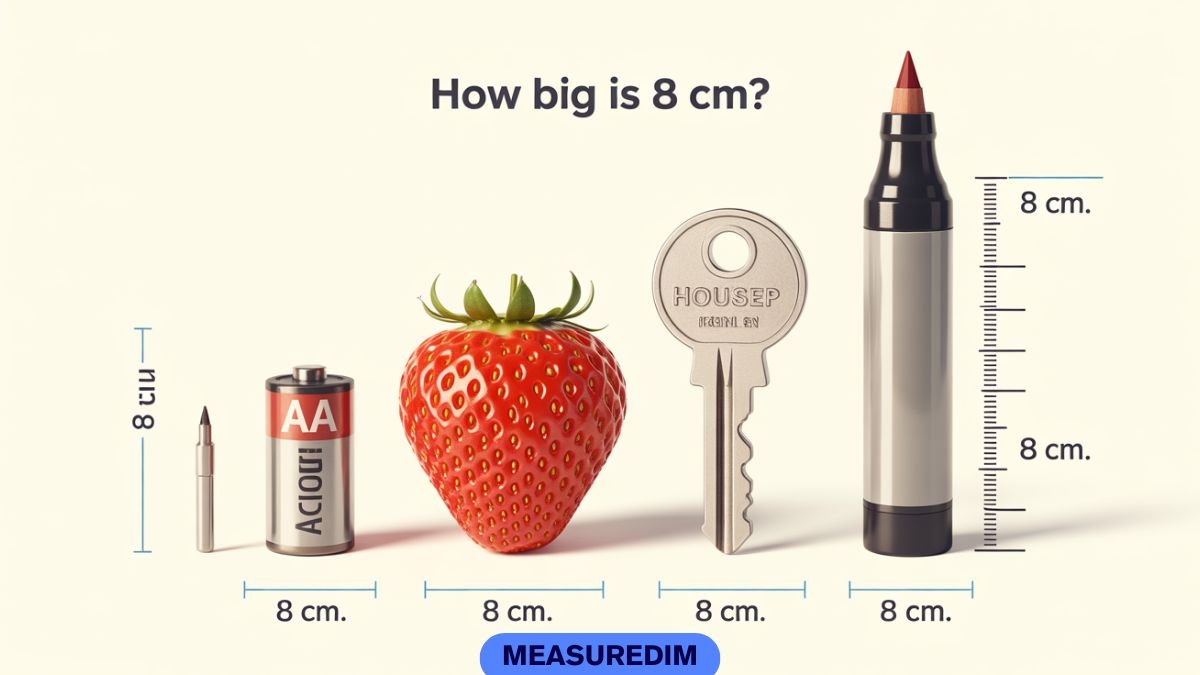
How Big Is 8 cm? A Clear Look With Everyday Objects
Eight centimetres is a small length. It equals 80 millimetres, or about 3.15 inches. That is just a little more than three inches long.
Hold up your thumb and look at it. That is roughly how big 8 cm is. Small enough to hide in your hand, but easy to see.
You meet this size often without noticing. A lighter, a credit card edge, and a mini disc are all near 8 cm. Once you know it, you will spot it everywhere.
Straight to It: What 8 Centimetres Really Is
Eight centimetres is 80 millimetres, or about 3.15 inches — a hair over three inches, not exactly three. Hold your thumb up and it’s roughly the length from the tip to the base joint on an average adult hand. The single closest everyday match is an 8 cm mini disc (the small CD/DVD size), which is 80 mm across on the nose.
Keep that mental image — just past three inches — and you’ll rarely be off by much.
8 cm Translated Into Every Unit You Might Need
Different tasks call for different units. A sewing pattern wants millimetres, a US shipping label wants inches, and a spec sheet might list meters. Here’s 8 cm in all of them at once.
| Unit | 8 cm equals |
| Millimetres | 80 mm |
| Centimetres | 8 cm |
| Inches | 3.15 in (3.1496 exactly) |
| Feet | 0.26 ft |
| Yards | 0.088 yd |
| Meters | 0.08 m |
The conversion that trips people up most is inches. Eight centimetres is not a clean 3 inches — it’s about 4 mm longer than that. If precision matters (drilling a hole, cutting fabric, sizing a frame), treat it as 3.15 in rather than rounding down to 3.
What 8 cm Feels Like Before You Measure Anything
Picture the short stack of playing cards face-up on a table and look at the long side — you’re within a few millimetres of 8 cm. Or picture a disposable lighter standing upright. That upright height is the intuition to lock in: tall enough to grip, short enough to vanish in a closed fist.
In screen terms, 8 cm is roughly the diagonal of a smartwatch face plus a bit, and just under the width of most large phones held sideways. It’s a genuinely handy pocket-sized length — big enough to see clearly, small enough that people underestimate it.
Everyday Objects That Land Right Around 8 cm
Below are eight references you almost certainly own or have handled. I’ve listed the real measurement for each and flagged whether it’s spot-on or just close, so you’re never trusting a fuzzy “about the same.”
The 8 cm Mini Disc
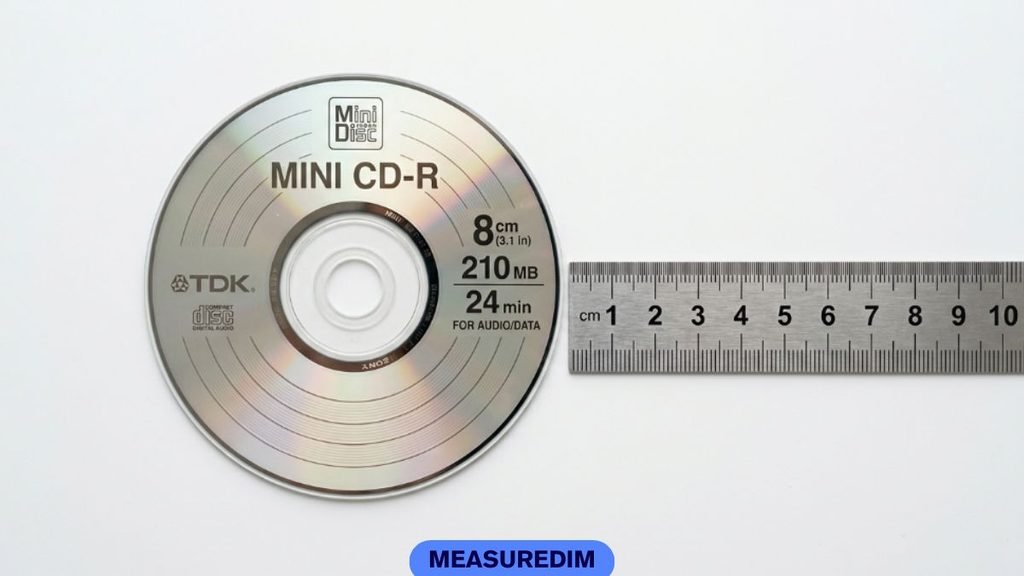
The small “3-inch” CDs and mini DVDs used in older camcorders and single releases measure exactly 80 mm across — a true, dead-on 8 cm. That’s what makes them the gold-standard reference here: no rounding, no “roughly.” If you’ve ever slotted one into a tray drive’s inner ring, you’ve held 8 cm in your fingers.
Because the size is standardised, a mini disc is the one object on this list you can trust to the millimetre. Lay one flat and its diameter is your ruler. It’s the reference I reach for first when I want to check a small parcel’s thickness or eyeball whether a pendant chain drop is in the right range.
A Full-Size Bic Lighter
A standard full-size disposable lighter stands about 81 mm tall — call it 8.1 cm, a single millimetre over target. (The mini version is shorter, around 6.7 cm, so make sure you’re picturing the regular one.) Stood on its base, it’s one of the most reliable 8 cm stand-ins going.
Almost everyone has handled one, which is what makes it useful: you already know how tall it feels in a closed hand. Next time you need to judge 8 cm and there’s a lighter in a drawer, stand it up and you’ve got your measure within a whisker.
Read Also: How Big Is 3 Inches? Real Objects, Sizes & Conversions
A Regulation Hockey Puck
An official ice-hockey puck is 76.2 mm across (3 inches) and an inch thick. That diameter sits just under 8 cm — about 4 mm short — so a puck reads as “nearly 8 cm” rather than exact.
The value of a puck is its rigid, uniform edge: no squish, no taper. Set one on a table and the flat black disc gives you a clean visual for “a shade under 8 cm.” It’s a good sanity-check for round objects like jar lids, coasters, and small plant-pot rims.
A Long Golf Tee
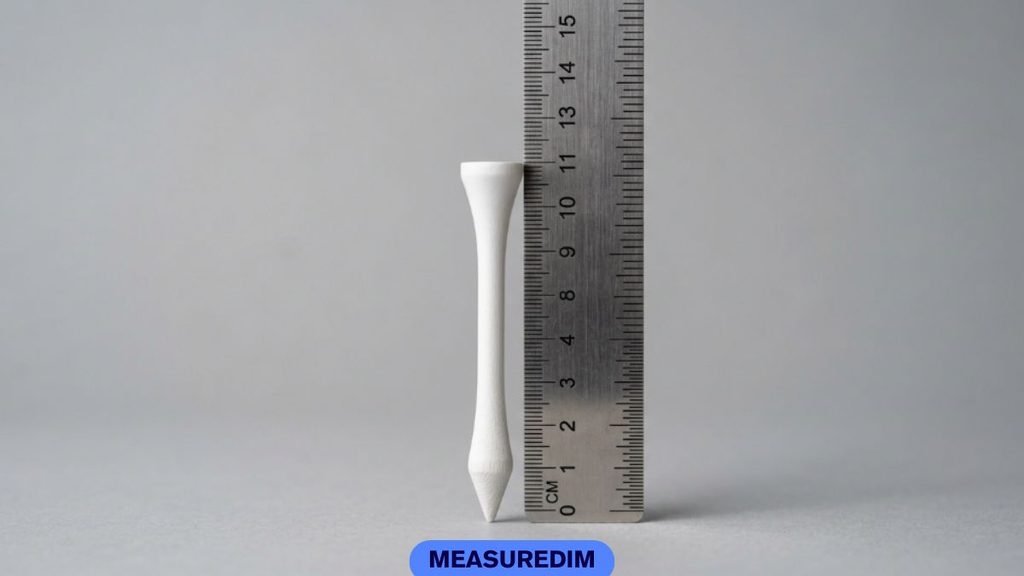
The oversized 3¼-inch golf tee measures about 82.5 mm — roughly 8.25 cm, a touch over the mark. (The common short tee is only 54 mm, so this only works for the long driver tees.) Held point-down, it’s a slim, straight 8 cm-ish ruler you can slip in a pocket.
Golfers already carry these by the handful, which makes the tee a convenient field reference on a course or in a garage. When I want to check the height of a small succulent or the depth of a shallow drawer, a long tee is close enough to trust for a quick gauge.
The Long Edge of a Credit Card
Every bank card follows the same ISO standard: 85.6 mm on the long side. That’s 8.56 cm — about 5 mm past 8 cm — so the card’s length overshoots slightly, but it’s the reference you always have on you.
Because the size never varies between banks or countries, a card in your wallet is a permanent, pocketable ruler. Lay the long edge against anything and subtract a few millimetres in your head to land on 8 cm. It’s my go-to when I’m shopping and want to judge whether a small item — a phone case cut-out, a watch strap, a gift box — is in the right size band.
A Baseball, Edge to Edge
A regulation baseball runs about 73–75 mm across (its circumference is 22.9–23.5 cm). That diameter sits roughly 6 mm under 8 cm, so a ball reads as “close, but a bit smaller.” Treat it as an approximate cue, not a precise one.
Still, a baseball is brilliant for one thing: judging a spherical 8 cm. Flat rulers lie to you about round objects, and holding a ball beside a bulb, an ornament, or a scoop of something gives your eye a fair reference for “a little under 8 cm across.”
Four Pennies in a Neat Row
Line up four US pennies edge to edge and you span 76.2 mm — the same as a hockey puck, just under 8 cm. Each penny is 19.05 mm wide, so the maths is clean: four of them is your “nearly 8 cm” coin ruler.
Coins are everywhere and their diameters are fixed by the mint, which makes them a dependable improvised scale. Short a penny? Three US quarters in a row come to about 72.8 mm — a bit further under, but still in the neighbourhood. Handy when you’re at a desk with loose change and no measuring tool.
Your Own Thumb
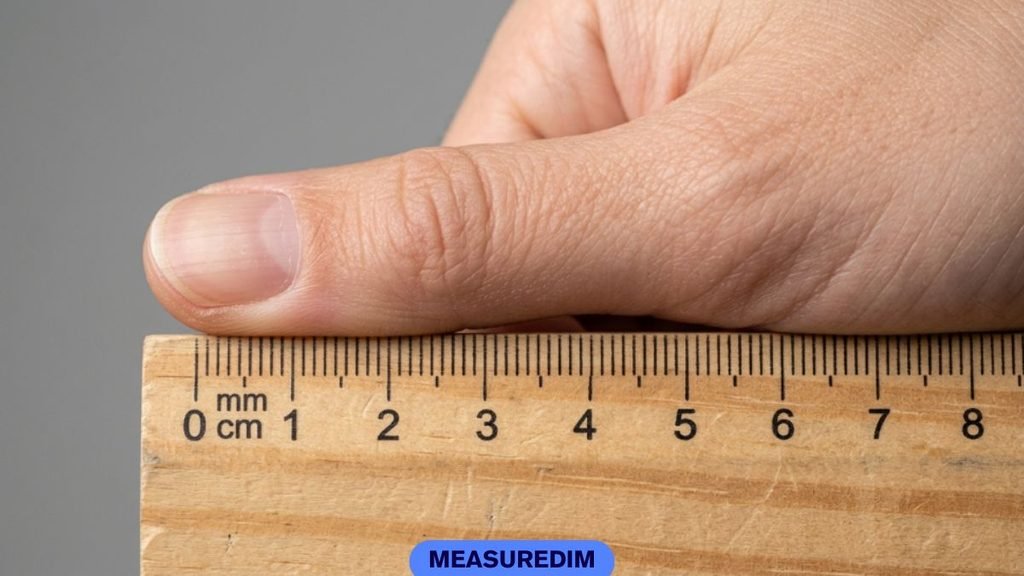
On an average adult hand, the thumb from its tip down to the base joint runs roughly 7.5–8 cm. Thumbs vary with hand size, so this is the loosest reference on the list — but it’s the one you literally always have.
Once you’ve compared your thumb to a card or a mini disc a single time, you’ll know your own personal offset (“mine’s a touch under”) and can correct for it on the fly. That calibrated thumb is the fastest 8 cm estimate there is when you’re caught without anything else.
The Whole Set, Ranked by How Close It Is
| Object | Real measurement | Difference from 8 cm |
| 8 cm mini disc (diameter) | 80 mm | Exact |
| Full-size Bic lighter (height) | ~81 mm | +1 mm |
| Long golf tee, 3¼ in (length) | ~82.5 mm | +2.5 mm |
| Credit card (long edge) | 85.6 mm | +5.6 mm |
| Hockey puck (diameter) | 76.2 mm | −3.8 mm |
| Four pennies (in a row) | 76.2 mm | −3.8 mm |
| Baseball (diameter) | ~74 mm | −6 mm |
| Three quarters (in a row) | 72.8 mm | −7.2 mm |
The pattern is easy to remember: the disc, lighter, tee, and card sit at or just above 8 cm, while the puck, coins, and baseball sit just below it. Bracket a mystery object between those two groups and you’ve placed it within a couple of millimetres.
Guess 8 cm Without Reaching for a Ruler
No tape measure in sight? Use your body — it’s surprisingly consistent once you calibrate it.
- Thumb tip to base joint — around 7.5–8 cm on most adults. Your single fastest estimate.
- Palm width across the knuckles (thumb tucked away) — roughly 8–9 cm for many adults, so 8 cm is a touch narrower than your closed knuckle-line.
- Index finger length — commonly 7–8 cm from tip to the big base crease, another quick stand-in.
The trick is calibration. Measure one of these against a credit card or a mini disc once, note how you personally compare, and from then on your hand becomes a ruler you never leave at home.
Read Also: How Long Is 18 Inches? 10 Objects to Picture It Fast
Where People Get 8 cm Wrong
A few predictable mix-ups throw people off:
- Reading it as 8 inches. Eight inches is 20.3 cm — more than double. A misread unit turns a pocket-sized length into something the size of a forearm span.
- Rounding 8 cm to a flat 3 inches. It’s 3.15 in. That extra ~4 mm sounds trivial until it’s a drilled hole or a cut edge that no longer fits.
- Thinking 80 mm is bigger than 8 cm. They’re identical. The larger-looking number just means smaller units, not a bigger length.
- Slipping a decimal on the ruler and landing on 8 mm — a tenth of the size. Always confirm whether the marks you’re counting are millimetres or centimetres.
Sizes on Either Side: 7 cm, 8 cm, 9 cm
Seeing the neighbours sharpens your sense of the target.
7 cm (2.76 in) is roughly a tennis ball across (about 6.7 cm) rounding up, or the diameter of a standard soda can plus a few millimetres. It reads as noticeably rounder and smaller in the hand than 8 cm.
8 cm (3.15 in) is your mini disc, your upright lighter, your near-full credit-card length.
9 cm (3.54 in) is about the long edge of a US business card or a poker-size playing card (both near 8.9 cm) rounded up. Held next to the 8 cm group, that extra centimetre is just visible — the difference between a card that’s “almost 8” and one that’s clearly past it.
Where 8 cm Actually Turns Up
This isn’t a random length — it shows up constantly once you notice it. Nursery plant pots are commonly sold in an 8 cm size, ideal for seedlings and small succulents. Jewellery leans on it too: an 8 cm pendant drop or a small hoop diameter falls right in this band. Phone makers live near it — many large handsets are about 7.5–7.8 cm wide, so 8 cm is “just past a big phone’s width.”
It matters for small-parcel shipping, where an 8 cm dimension can decide which postage bracket a box falls into, and for crafts and DIY, where 8 cm covers a lot of tile spacers, dowel lengths, and frame borders. Once the size lives in your head, you’ll clock it on packaging, product listings, and spec sheets without a second thought.
Quick-Fire Questions About 8 cm
What does 8 cm look like in inches?
8 cm looks like about 3.15 inches — just a little more than three inches long, or a hair past the width of two US quarters side by side.
How big is 8 cm compared to fruit?
8 cm is close to the width of a medium apple or a large lime, and roughly the length of a small banana without its curve.
What does 8 cm look like?
8 cm looks like an upright disposable lighter or an 8 cm mini disc — a small, pocket-sized length just over three inches.
What is 8 cm compared to?
8 cm compares to the long edge of a credit card (a touch under it) and to your thumb from tip to base joint.
What object is comparable to 8 cm?
A regulation hockey puck (7.6 cm) and a full-size lighter (8.1 cm) are both close, with the 8 cm mini disc matching it exactly.
Locking 8 cm Into Memory
Now you know how big is 8 cm. It is 80 millimetres, or about 3.15 inches. That length is just a bit more than three inches. You can picture it in many easy ways. A mini disc measures exactly 8 cm across. A lighter standing up reaches close to this height too. The long edge of a credit card comes very near it as well. These simple objects help you hold the size in your mind.
Your own body also gives you a quick guide. Your thumb, from the tip to the base, measures near 8 cm. Check it once against a card, and you will remember it well. From that moment, you can judge 8 cm anywhere with ease and confidence.
Related Guides:
1: How Big Is 5 cm? Everyday Objects to Help You Picture It
2: How Long Is 10 Feet? 10 Everyday Objects to Picture It
3: How Long Is 1 Meter? 7 Everyday Objects That Show It
4: How Tall Is 40 Inches? Everyday Comparisons & Conversions
5: How Big Is 7 cm? A Visual Guide With Real-World Comparisons

2 Comments