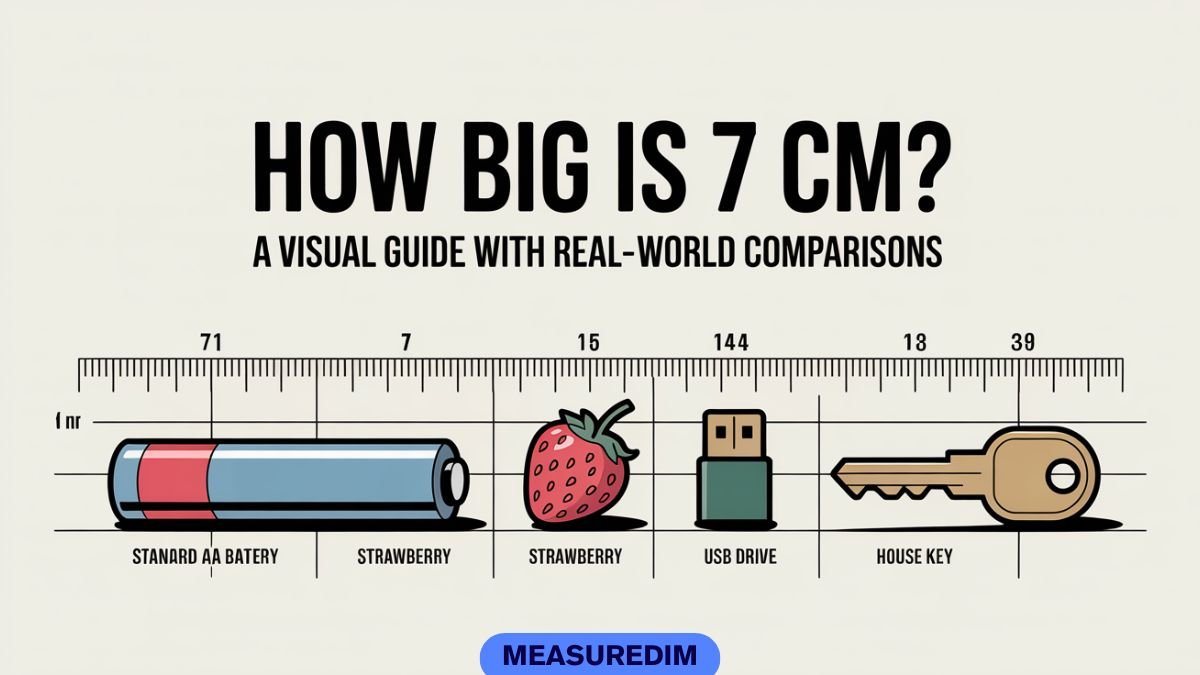
How Big Is 7 cm? A Visual Guide With Real-World Comparisons
Seven centimeters is a short length. It equals 70 millimeters exactly. In inches, it is about 2.76. That is just over two and three-quarter inches. It is small enough to hold in one hand. Think of it as a palm-sized measurement.
Picture the phone in your pocket right now. Turn it sideways and look at the short edge. That width is close to 7 cm. A tennis ball is nearly the same across. So is a baseball, just a touch bigger. You already know this size well.
Many everyday things sit near 7 cm. A soda can is 6.6 cm wide. Three US quarters in a row reach 7.3 cm. Your index finger is about 7 cm long. It shows up in product sizes too. Once you see it, you spot it everywhere.
The Short Answer: How Big Is 7 cm?
Seven centimeters is about 2.76 inches — call it just over 2¾ inches. It’s also exactly 70 millimeters. Picture the short edge of a typical smartphone, or a tennis ball with a sliver shaved off: that’s the length. It’s a palm-friendly, fits-in-a-closed-fist kind of size — small enough to hide in your hand, big enough to notice.
7 cm Converted: mm, Inches, Feet and More
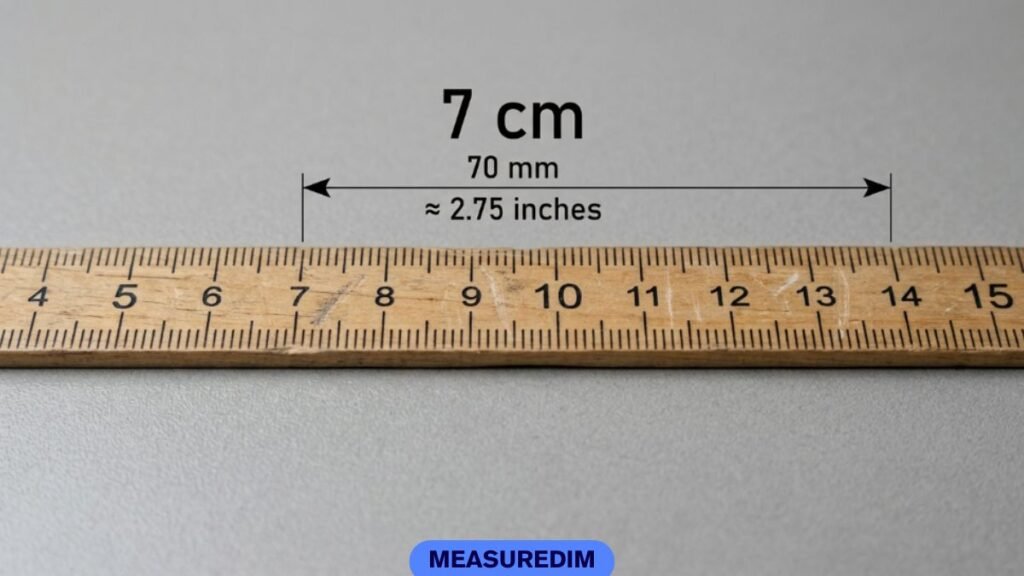
Here’s 7 cm expressed in every unit you’re likely to run into, so you never have to reach for a calculator mid-task.
| Unit | 7 cm equals |
| Millimeters (mm) | 70 mm |
| Centimeters (cm) | 7 cm |
| Inches (in) | 2.76 in (≈ 2¾ in) |
| Feet (ft) | 0.23 ft |
| Yards (yd) | 0.077 yd |
| Meters (m) | 0.07 m |
The two conversions worth memorizing: 7 cm = 70 mm (exact — a centimeter is always ten millimeters) and 7 cm ≈ 2.76 in (rounded from 2.7559). Everything else on the chart flows from those.
Picture It: What a 7-Centimeter Length Looks Like
Numbers are abstract, so anchor 7 cm to your own body first. Stretch out your index finger and look at it from base knuckle to tip — for most adults that runs right around 7 cm. Now imagine the long edge of a credit card (8.6 cm) and mentally trim off the last centimeter; what’s left is roughly our target.
The key intuition: 7 cm is round-object territory. It’s the diameter of the sports balls you can palm — baseball, cricket ball, tennis ball — rather than the big ones you two-hand. Once you file it under “ball you can grip in one hand,” the size stops feeling vague.
10 Everyday Things That Are About 7 cm
Each object below is measured and mapped honestly — I’ll tell you when a comparison is spot-on and when it’s a few millimeters off. Together they cover the size from just under to just over, so at least one will click for you.
A Smartphone’s Width
A standard modern phone measures almost exactly 7 cm across its short edge. An iPhone 15 is 71.6 mm wide — that’s 7.16 cm, a hair over target — and most compact-to-regular handsets sit within a couple of millimeters of it. Only the oversized “Max” and “Ultra” models stretch out to roughly 7.7–7.8 cm.
This is the single most convenient 7 cm ruler you own, because your phone is almost always within reach. Turn it sideways and notice how much of your palm the width spans — memorize that feeling. When a listing says a case, a trinket box, or a plant pot is 7 cm wide, hold your phone edge-on and you’ll instantly know whether it’ll swallow a pocket or perch on a windowsill.
A Tennis Ball
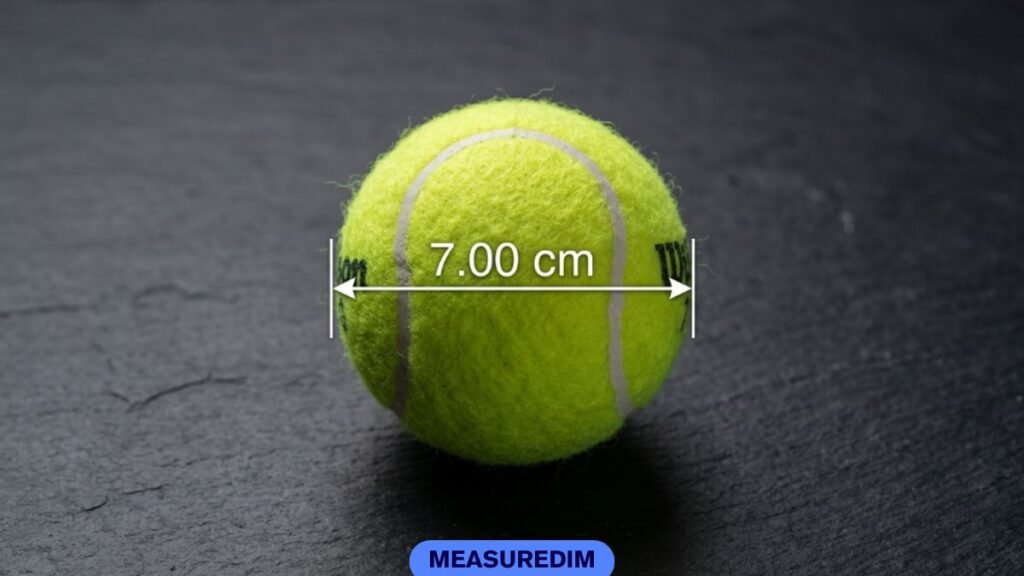
A regulation tennis ball measures 6.54 to 6.86 cm in diameter, so it lands a whisker under a full 7 cm. “Just shy of 7” is the safe way to describe it, and the fuzzy yellow sphere is one of the most size-consistent objects in any household or gym bag.
It’s reliable precisely because it’s manufactured to tight tournament tolerances — every can holds nearly identical balls. Cup one in your hand and note how it fills your palm without spilling over the edges; that’s the 7 cm sensation, minus a few millimeters. If you’re picturing something like a round drawer knob or a small ornament sold at “7 cm,” a tennis ball tells you it’ll be comfortably one-handed.
Read Also: How Long Is 20 Feet? 11 Everyday Objects Compared
A Baseball
Flip to the slightly-over side and you get the baseball, about 7.3 to 7.5 cm across. Its circumference is fixed at roughly 22.9–23.5 cm, which works out to that diameter — a touch bigger than 7 cm but close enough to be an excellent visual proxy.
Because baseballs are made to a strict spec, the size barely varies from one to the next, which makes it dependable as a reference. Hold one and it sits denser and marginally wider than a tennis ball — a useful “7 cm plus a nudge” benchmark. It’s handy when you want to sanity-check the diameter of something round like a candle, a small jar lid, or a stress ball before buying.
A Cricket Ball
For readers outside North America, the cricket ball is the cleaner match at roughly 7.1–7.3 cm in diameter. Its regulation circumference of about 22.4–22.9 cm puts it right on the upper shoulder of 7 cm — essentially “7 cm, rounded up.”
A cricket ball is harder and heavier than it looks, but for pure size it’s a first-class stand-in, since the diameter is standardized for professional play. Weigh one in your hand and it reads as a compact, solid sphere that never quite becomes a “big” ball. Reach for this comparison when you’re gauging the width of things like a doorknob, a small grapefruit, or a round soap.
A Hockey Puck
A standard ice hockey puck is 7.62 cm across (three inches) and about 2.5 cm thick. The diameter runs a little over our target — think “7 cm and change” — but it’s a great flat, disc-shaped reference when a ball won’t do.
Pucks are molded to a fixed size for the sport, so the measurement is trustworthy. Lay one flat and you’re looking at a face slightly wider than a tennis ball’s silhouette. It’s the reference to reach for when the thing you’re picturing is disc-like rather than round — a jar lid, a coaster edge, a large watch face, or a round tin.
A Soda Can Across the Middle
A standard 355 mL (12 fl oz) soda can is 6.6 cm in diameter, so its width is a touch under 7 cm. Nearly every mainstream drinks can uses this same body size, which makes it a globally recognizable yardstick.
You’ve wrapped your hand around thousands of these, so the grip is already muscle memory — that’s what makes it useful. Notice that your fingers almost meet your thumb around it; a true 7 cm object would leave a fractionally bigger gap. It’s a quick gut-check for the diameter of tubes, mugs, or cylindrical packaging labeled around 7 cm.
Three Quarters Lined Up
Line up three US quarters edge to edge and you get about 7.3 cm — each coin is 24.26 mm across, and three of them total 72.8 mm. It overshoots 7 cm by a few millimeters, but coins are precision-minted, so the figure is rock-solid.
This is the reference for when you have no phone or ball handy but you do have loose change. Slide three quarters together on a table and you’ve built a makeshift 7 cm gauge in seconds. It’s especially handy for small, flat measurements — the width of a slot, a strap, or a gap you’re checking before something ships.
Your Index Finger
For most adults, the index finger runs roughly 7 cm from base knuckle to fingertip (approximate — hand size varies from person to person). It’s the body ruler you literally carry everywhere.
Calibrate it once against a real ruler and you’ll trust it for life: hold your finger flat and you’ve got a portable, always-available 7 cm stick. Because fingers differ, treat it as a good estimate rather than a precise gauge — but for “will this roughly fit” decisions while shopping or packing, it’s more than close enough.
A Sticky Note (the 3-Inch Kind)
The classic square sticky note measures 76 mm — that’s 7.6 cm — per side, a shade over 7 cm. These 3-by-3-inch pads sit on nearly every desk, so the reference is easy to summon.
Peel one off and picture trimming a slim strip from one edge; the remaining width is your 7 cm. It’s an ideal desk-side reference when you’re eyeballing the footprint of a small gadget, a badge, or a photo print. Anything described as “about 7 cm wide” will land just inside the note’s edges.
A Medium Lemon, End to End
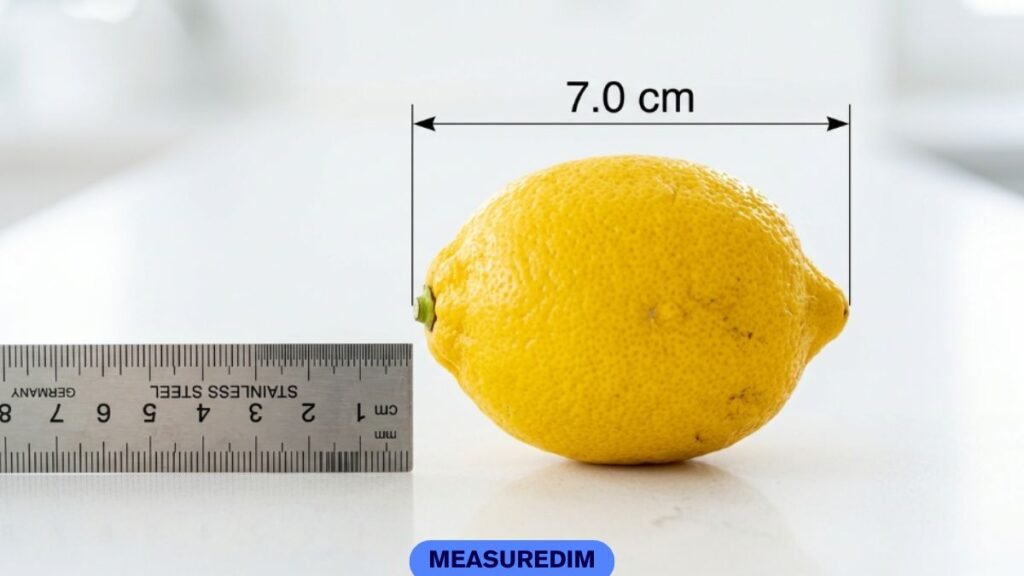
A medium lemon runs roughly 6–7 cm along its length (approximate — citrus size swings with variety and growing conditions, so treat this as a ballpark). A typical supermarket lemon, measured tip to tip, hovers right around our target.
Fruit is never as consistent as a manufactured part, which is exactly why I’ve labeled this one loosely — but as a kitchen-counter sanity check it works well. Hold a lemon lengthwise and you’re within a centimeter of 7 cm without any tool at all. Useful when you’re standing in the kitchen wondering how big “7 cm” really is and the nearest ruler is a drawer away.
7 cm at a Glance: The Reference Objects Side by Side
Scan this to find the closest match for whatever you’re picturing.
| Object | Real size (diameter/length) | vs 7 cm |
| Smartphone width (standard) | ≈ 7.1 cm | ~Exact |
| Tennis ball | 6.5–6.9 cm | Just under |
| Soda can (across) | 6.6 cm | Just under |
| Index finger | ≈ 7 cm | ~Exact (varies) |
| Cricket ball | 7.1–7.3 cm | Just over |
| Three US quarters | 7.3 cm | Just over |
| Baseball | 7.3–7.5 cm | Just over |
| Hockey puck / 3-inch sticky note | 7.6 cm | A bit over |
| Medium lemon (length) | 6–7 cm | Around |
No Ruler? Gauge 7 cm With Your Hand
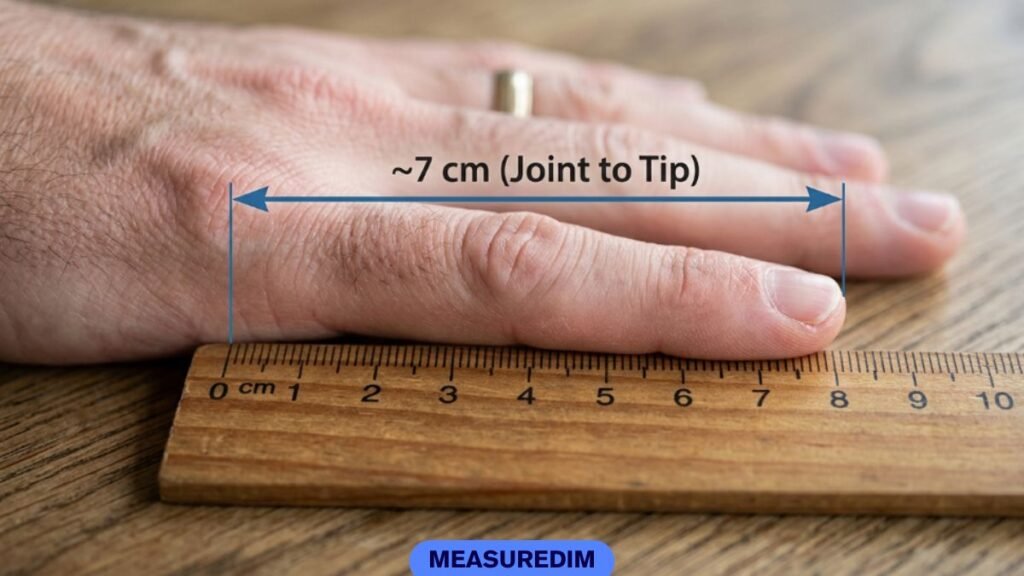
When there’s nothing to measure with, your body fills in. Try these, roughly in order of accuracy:
- Index finger, base to tip: about 7 cm for many adults — your most direct estimate.
- Thumb-tip to first knuckle × 3: that top thumb joint is close to 2.5 cm (one inch), so stacking the length three times lands near 7.5 cm — a smidge over.
- Four fingers, held together, measured across: for a lot of adults the width of the four fingers (no thumb) is in the 7–8 cm zone.
Each of these varies with hand size, so calibrate once against a real ruler and adjust. Do that, and you’ll carry a decent 7 cm gauge on you forever — no tape measure required.
[IMAGE: an adult index finger held beside a ruler, showing the ~7 cm length]
Where 7 cm Turns Up in Real Life
This length shows up more than you’d expect. Plenty of small products live here: phone widths, chunky watch faces, mini plant pots, jewelry boxes, travel-size toiletries, and the short side of many compact gadgets. If you shop online, 7 cm is right in the “will this fit my pocket / shelf / bag” decision zone, which is exactly why picturing it matters. [INTERNAL LINK: everyday objects that are around 3 inches]
It’s also a figure people meet in a medical setting — a cyst, a stone, a fibroid, or a dilation measurement described as “7 cm” — and understandably want to visualize. If that’s what brought you here: 7 cm is roughly a baseball’s width, or a hair under a tennis ball. Seeing the size can be grounding, but any question about what a measurement means for you belongs with your doctor, not a size chart.
Read Also: How Big Is 3 cm? Real-Life Examples and Conversions
6 cm, 7 cm, 8 cm: Telling Close Sizes Apart
A single centimeter is easy to misjudge, so here’s a short ladder of nearby lengths with an honest object pinned to each. Use it to place 7 cm between its neighbors at a glance.
| Length | Everyday match |
| 5 cm | AA battery, end to end (5.05 cm) |
| 6 cm | Standard light-bulb, at its widest (≈ 6 cm) |
| 7 cm | Smartphone width / tennis ball |
| 7.6 cm | Hockey puck / 3-inch sticky note |
| 8.6 cm | Credit card, long edge |
| 10.2 cm | 4×6 photo print, short edge |
Notice how tightly these stack. A tennis ball (just under 7) and a hockey puck (just over) are barely a centimeter apart, yet side by side the difference is obvious — which is why picking the right reference object matters more than the raw number.
Slip-Ups People Make When Judging 7 cm
A few recurring errors trip people up:
- Confusing 7 cm with 7 inches. Seven inches is 17.78 cm — more than double. If a figure looks surprisingly large, check which unit you’re reading.
- Rounding 2.76 inches down to 2½. It’s actually just over 2¾ inches. Small gap, but it adds up on precise cuts or fits.
- Assuming every phone is 7 cm wide. Standard models are close, but oversized flagships run 7.7–7.8 cm — measure yours before trusting it as a ruler.
- Treating soft or natural objects as exact. A lemon or your own finger is a ballpark, not a caliper. For anything that has to fit precisely, verify with a real measure.
Quick-Fire Questions About 7 cm
What does 7 cm look like?
It looks palm-sized — about the width of a smartphone’s short edge or a tennis ball. Small enough to grip in one hand.
What does 7 cm look like in inches?
It equals about 2.76 inches, or just over 2¾ inches. Picture the long edge of a credit card with one centimeter trimmed off.
What can you compare 7 cm to?
Compare it to a baseball’s width (7.3–7.5 cm), a cricket ball, three US quarters in a row (7.3 cm), or a soda can across (6.6 cm).
What is something that is 7 cm?
A standard smartphone is about 7.1 cm wide, and an adult index finger runs close to 7 cm from base knuckle to tip.
How big is 7 cm image?
An image shows a 7 cm line beside a ruler, marked 70 mm and 2.76 inches, next to a phone or tennis ball for scale.
Now You’ll Know 7 cm on Sight
Now you know how big is 7 cm. It is 70 millimeters. It is about 2.76 inches, or just over two and three-quarter inches. That is a small, palm-sized length. You can picture it with easy objects. The short edge of a phone is close to 7 cm. A tennis ball is nearly that wide. A baseball is a tiny bit bigger. Three US quarters in a row reach about 7.3 cm. Your index finger is close to 7 cm too. These pictures make the size clear.
Pick one object that you like best. Keep it in your mind as your ruler. Next time, you will know 7 cm right away. You will not need a tape measure. A quick glance will give you the answer. This simple trick works at home, at school, and while you shop. Now you can measure with confidence and trust your own eyes every single time.
Related Guides:
1: How Long Is 12 Inches? 9 Everyday Things to Picture It
2: How Big Is 10mm? Everyday Objects, Conversions & Size Comparisons
3: How Big Is 16 Inches? 8 Everyday Objects to Picture It
4: How Big Is 40 cm? Real Objects to Picture It Instantly
5: How Big Is 7mm? A Plain-English Guide to a Very Small SizeAa