
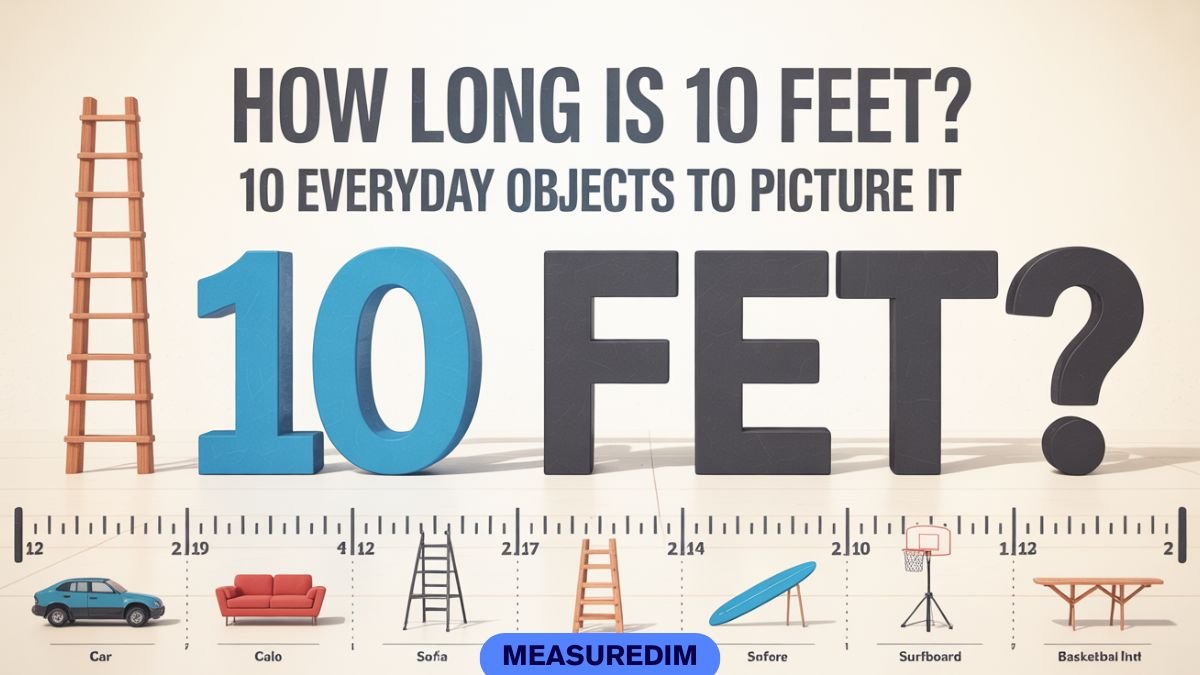
How Long Is 10 Feet? 10 Everyday Objects to Picture It
Ten feet is a length. It equals 120 inches or about 3.05 meters. That is the same height as a basketball rim above the floor.
Ever tried to picture 10 feet in your head? The number is easy, but the size is hard to see. A quick object comparison makes it click right away.
You meet 10 feet more than you think. A tall ceiling, a small kayak, and a 10-foot board all match it. Once you know a few objects this size, you can gauge it fast.
The Short Answer, Up Top
Ten feet is 120 inches, 3.048 meters, or 304.8 centimeters. In yards it’s exactly 3⅓ yards. The cleanest mental anchor: it’s the height of a regulation basketball rim above the floor — a measurement millions of people have stared up at without realizing they already know what 10 feet looks like.
10 Feet in Every Unit You’ll Need
Here’s the full conversion set so you never have to second-guess a figure mid-project.
| Unit | Value for 10 feet |
| Inches | 120 in |
| Feet | 10 ft |
| Yards | 3.33 yd (3 yd 1 ft) |
| Millimeters | 3,048 mm |
| Centimeters | 304.8 cm |
| Meters | 3.048 m |
Every object figure in this article is checked back against these numbers, so nothing here will contradict itself.
What 10 Feet Actually Feels Like
Picture the ceiling of a slightly grander-than-average room — the kind that feels airy the moment you walk in. That’s roughly 10 feet from floor to plaster. Standard homes usually run 8 or 9 feet, so 10 feet reads as tall.
Another quick gut check: lay two people of average height head-to-toe and you’ll slightly overshoot 10 feet, since two ~5-foot-6 adults come to about 11 feet. So 10 feet is a hair under two average bodies end to end. Hold that image and the objects below will click into place fast.
10 Real Things That Are (Just About) 10 Feet Long
Each example below gets two paragraphs: what it is and how its size maps to 10 feet, then why it’s a dependable reference and when it’s genuinely useful. I’ve flagged which ones are exact and which are approximate.
A Regulation Basketball Rim
The rim of a basketball hoop sits exactly 10 feet off the floor — the same in the NBA, FIBA, college, and high school play. That height hasn’t changed since the game’s early days, which makes it one of the most stable 10-foot references on the planet. Stand under one and look up: that vertical gap is your benchmark.
This is the reference I reach for first because so many people have a felt sense of it already. If you’ve ever tried to dunk, hung a hoop in a driveway, or watched a player’s fingertips graze the rim, your brain has logged the distance. When you need to imagine 10 feet of height — a tree you’re pricing, a ceiling you’re framing — replay that upward glance and you’re there. [IMAGE: basketball hoop with a labelled 10 ft arrow from floor to rim]
Ten One-Foot Rulers End to End
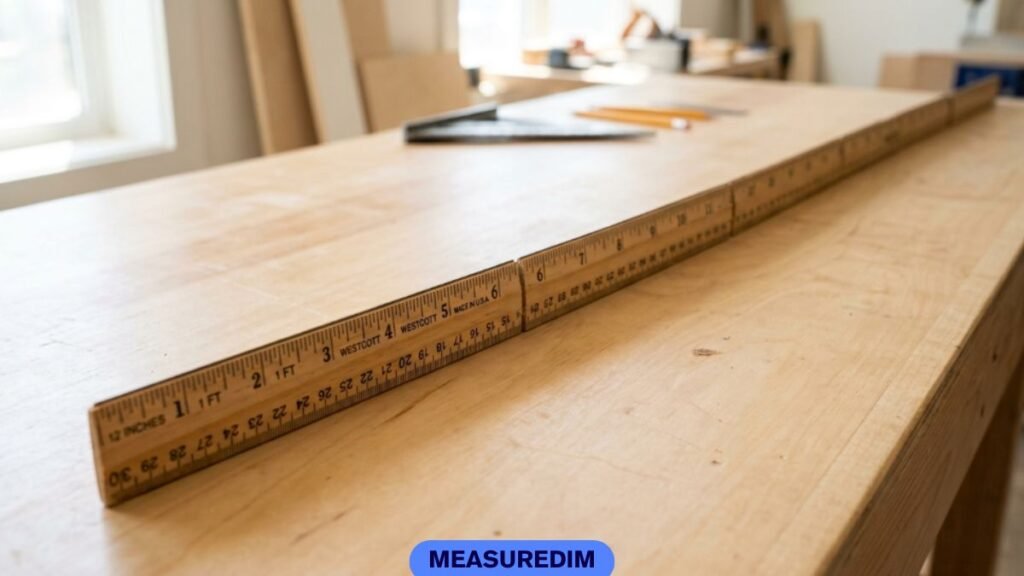
Line up ten standard 12-inch rulers nose to tail and you get exactly 120 inches — 10 feet, no rounding required. It’s the least glamorous entry here and the most literally correct one. Each ruler is a foot, ten of them are ten feet, done.
I include it because it’s the perfect teaching tool. If you’re explaining the measurement to a kid or sanity-checking your own mental math, physical foot-rulers turn an abstract number into something countable. Teachers use this exact trick to make “feet” concrete before a class ever touches a tape measure.
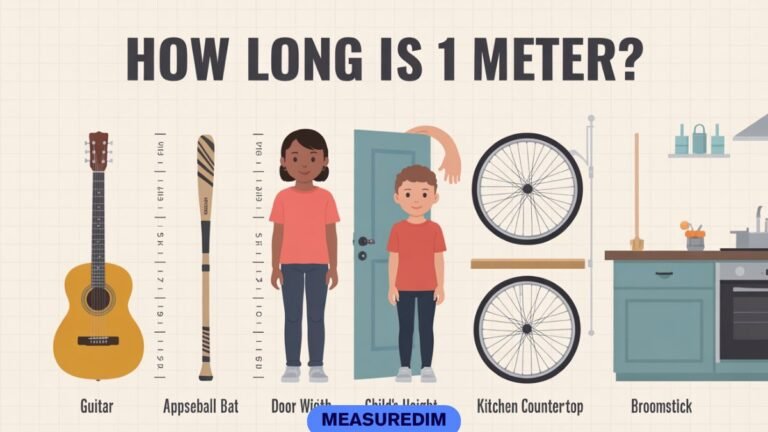
Read Also: How Long Is 1 Meter? 7 Everyday Objects That Show It
A 10-Foot Length of 2×4 Lumber
Framing lumber is sold in fixed lengths — 8, 10, 12, and 16 feet — so a 10-foot 2×4 is a real, exact, buy-it-off-the-rack object. The board measures a true 120 inches end to end, even though its cross-section is famously not a full 2 by 4 inches (that’s a separate quirk of lumber naming).
For anyone doing DIY, this is the reference that lives in your hands. Sling a 10-foot 2×4 over your shoulder and you get an unforgettable sense of the length — it’s long enough to be awkward through a doorway but short enough to carry solo. Next time you’re estimating a fence run or a shelf span, remember how that board felt.
A 10-Foot Recreational Kayak
The single most common length for a recreational sit-in or sit-on-top kayak is right around 10 feet. It’s the sweet spot: stable, easy to store, and light enough for one person to car-top. Popular models cluster at 10’0″ to 10’6″, so if you’ve paddled a beginner-friendly boat, you’ve probably sat in almost exactly 10 feet of hull.
This one earns its place because the number matters when you buy. Roof racks, garage walls, and apartment closets all have to accommodate that 10-foot span, and shoppers constantly misjudge it. Stand a 10-foot kayak on its tail against a two-story wall and it reaches past the first-floor windows — a useful reality check before you commit.
A 10-Foot Round Trampoline (Diameter)
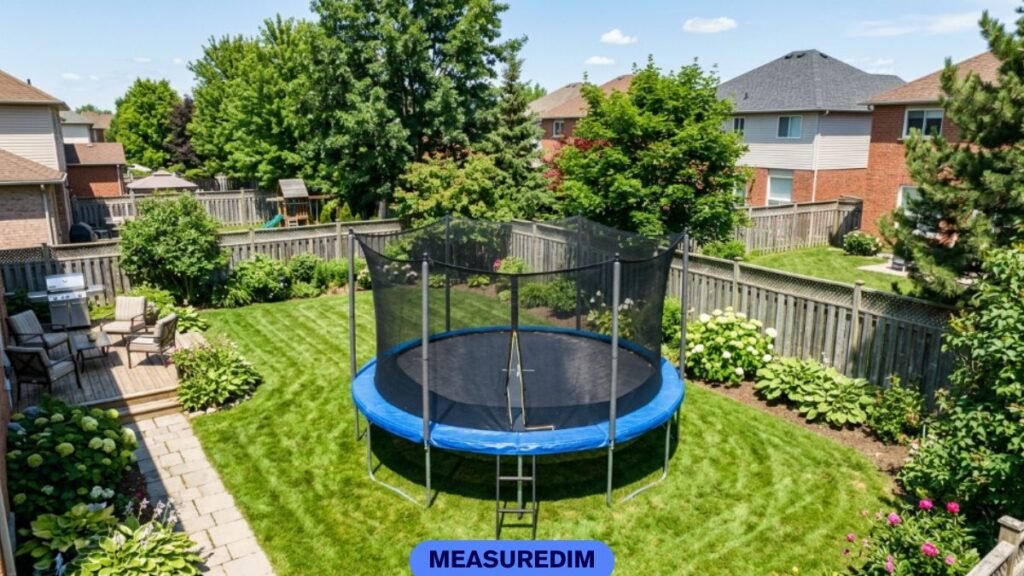
Backyard trampolines come in stepped diameters — 8, 10, 12, 14, and 15 feet — and the 10-foot round is the go-to for smaller yards and younger jumpers. Here the 10 feet is measured across the frame as diameter, corner to corner through the center, not around the edge.
I like this reference because it’s a width you can walk around, which balances out all the heights and lengths on this list. If you’re eyeballing whether something 10 feet wide will fit — a patio zone, a parking pad, a garden bed — picture the footprint of a 10-foot trampoline and you’ve got it. Just don’t confuse diameter with circumference; the distance around a 10-foot trampoline is over 31 feet.
A 10-Foot Ceiling
A 10-foot ceiling is the classic “high ceiling” of older homes, lofts, and upscale new builds. Since the everyday standard is 8 or 9 feet, that extra foot or two is exactly what makes a room feel expansive. Real-estate listings call it out on purpose.
This matters most when you’re shopping for furniture or fixtures that live near the top of a room — tall bookcases, pendant lights, floor-to-ceiling curtains. A 10-foot ceiling changes what fits and what looks right. If you can picture a basketball rim’s height as your ceiling line, you’re picturing a genuine 10-foot room.
A Good-Sized Adult American Alligator
A mature American alligator is a believable stand-in for 10 feet of length. Large adult males commonly run 11 to 13 feet, and females stay smaller, so a 10-foot gator is a solid, fully grown animal rather than a record-breaker. Nose to tail tip, that’s your ten feet stretched out horizontally.
It’s a memorable reference precisely because it’s a little unsettling — and vivid images stick. When a length feels too big to picture with furniture, a full-grown alligator gives your brain a single continuous object to scale against. Nature documentaries have done the hard work of burning that size into your memory already.
A Classic Longboard Surfboard
A traditional longboard surfboard — the mellow, nose-riding “log” — typically measures 9 to 11 feet, and a 10-foot board sits squarely in the middle of that range. Shorter performance boards are nowhere near this, but the classic cruiser is a genuine 10-footer.
If you’ve ever carried one down a beach path, you know the length in your body: too long to tuck under one arm comfortably, long enough that you swing it flat to get through gaps. That lived sense of a 10-foot board is a great everyday yardstick, especially for anyone judging whether a long, narrow object will clear a hallway or a stairwell.
The Long Edge of an 8×10 Area Rug
An 8×10 area rug — one of the most popular sizes for living rooms — has a long edge of exactly 10 feet (120 inches). It’s flat, familiar, and probably already on someone’s floor near you. Pace along the ten-foot side and you’ve walked the length in question.
This is the reference for indoor spatial planning. When you’re deciding whether a sofa wall, a dining zone, or a hallway runner works, an 8×10 rug gives you a real rectangle to reason with. Because rugs are cut to precise dimensions, the 10-foot side is dependable — no manufacturing guesswork like you get with a living animal.
A 10-Foot Artificial Christmas Tree
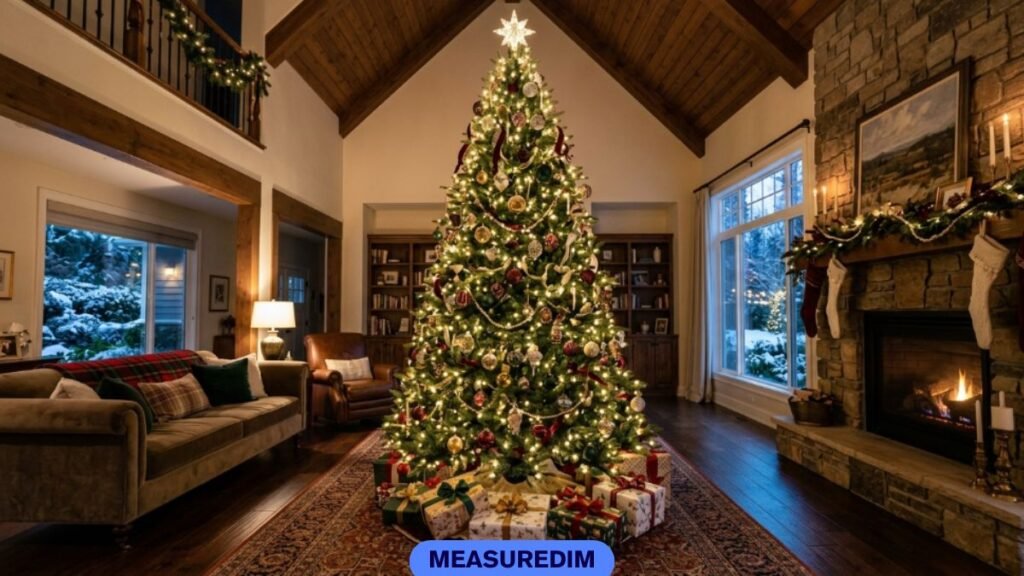
For homes with those tall ceilings mentioned above, a 10-foot artificial Christmas tree is a genuine premium size (they scale up from the common 6- and 7-footers). Boxed and labeled at 10 feet, the assembled tree stands a full ten feet from stand to tip.
I include it as a seasonal, whole-object height that most people can summon instantly. A 10-foot tree needs a room with real headroom — try to fit one under an 8-foot ceiling and it simply won’t stand up. That mismatch is a handy reminder of just how tall 10 feet is compared to an ordinary room.
The 10-Foot Lineup at a Glance
| Object | Approx. length | Exact or approx? | Quick note |
| Basketball rim height | 10 ft | Exact | Floor to rim, all leagues |
| Ten 12-inch rulers | 10 ft | Exact | 10 × 12 in = 120 in |
| 10-ft 2×4 lumber | 10 ft | Exact | Sold at this length |
| Recreational kayak | ~10 ft | Approx (10’0″–10’6″) | Common beginner size |
| Round trampoline | 10 ft | Exact (diameter) | Frame across center |
| High ceiling | 10 ft | Approx | Vs. 8–9 ft standard |
| Adult American alligator | ~10 ft | Approx | Good-sized mature animal |
| Longboard surfboard | ~10 ft | Approx (9–11 ft) | Classic noserider |
| 8×10 area rug (long side) | 10 ft | Exact | Long edge = 120 in |
| Artificial Christmas tree | 10 ft | Exact | Premium tall size |
How to Estimate 10 Feet Without a Tape Measure
No tool handy? Your own body is a decent ruler once you calibrate it.
Walking steps. A relaxed adult step covers roughly 2.5 to 3 feet. Take about four normal steps and you’ve walked close to 10 feet. Pace it heel-to-toe more deliberately and you can tighten the estimate.
Arm spans. A typical adult’s fingertip-to-fingertip span is close to their height — often 5.5 to 6 feet. A span and three-quarters lands you near 10 feet. It’s rough, but useful for a wall you can reach across in stages.
Stacked references. Remember the basketball rim: one rim-height of vertical space is your 10 feet. For the ground, picture the long side of that 8×10 rug, or lay a known 6-foot object down and add a bit more than half again.
Label these as what they are — estimates. They’ll get you within a foot or so, which is plenty for rough planning but not for cutting materials.
Where 10 Feet Comes Up in Real Life
This measurement shows up more than you’d think:
- Home and real estate: ceiling heights, room widths, and furniture clearances.
- Watercraft: kayaks, paddleboards, and surfboards you have to store and transport.
- DIY and building: lumber lengths, fence sections, shelf spans, and cable/cord runs (10-foot HDMI, USB, and extension cords are stock sizes).
- Shipping: the 10-foot ISO container is a real, if less common, cousin of the standard 20- and 40-footers.
- Backyard gear: trampoline diameters, above-ground pool sizes, and setback distances.
Knowing what 10 feet looks like turns each of these decisions from a guess into a glance.
Read Also: How Tall Is 40 Inches? Everyday Comparisons & Conversions
Slip-Ups People Make With 10 Feet
Confusing feet with square feet. “A 10-foot room” describes one length. Ten square feet is an area barely bigger than a bath mat. Storage units, freezers, and rooms are where this mix-up costs people real money.
Reading the wrong symbol. The prime marks matter: 10′ means 10 feet, while 10″ means 10 inches. On product listings and blueprints, one slipped symbol turns a board into a bookmark.
Assuming ceilings are 10 feet. Because 10 is a round number, people default to it — but most homes are 8 or 9 feet. Measure before you order that tall tree or bookcase.
Mistaking a table tennis table for 10 feet. A regulation table is 9 feet long (2.74 m), not 10. It’s close enough to fool the eye, which is exactly why the error is common.
9 Feet vs. 10 Feet vs. 12 Feet
Sizes this close are easy to blur, so here’s the neighborhood.
Just under — 9 feet (2.74 m). This is the length of a regulation table tennis table and the width of many single-car garage doors. It’s also the concert-grand piano length. Nine feet reads as “large room” rather than “tall room.”
Your target — 10 feet (3.05 m). The basketball-rim height, the 10-foot lumber and kayak zone, the airy ceiling.
Just over — 12 feet (3.66 m). The next standard lumber length up and a genuinely lofty ceiling. Twelve feet is where “high” starts to feel “grand,” and where two average adults lying head-to-toe finally undershoot the span with room to spare.
Quick-Fire Q&A
How long is 10 ft visually?
Ten feet is the height of a basketball rim above the floor, or an airy 10-foot ceiling. Picture that upward gap and you’ve got it.
How far is 10 feet in steps to walk?
About four normal adult steps, since each relaxed step covers roughly 2.5 to 3 feet. Treat it as a close estimate, not an exact measure.
How long is a 10 ft example?
A 10-foot 2×4 board, a recreational kayak, or the long side of an 8×10 area rug all measure right around 10 feet.
How long is 10 feet compared to a human?
Ten feet is a bit shorter than two average adults lying head-to-toe, since two 5-foot-6 people reach about 11 feet.
What does 10 feet look like?
It looks like a tall ceiling, a full-grown alligator nose to tail, or a classic longboard surfboard standing on end.
Lock It In With One Image
Now you know how long is 10 feet. It is 120 inches. It is also about 3.05 meters. The easiest way to remember it is the basketball rim. The rim sits exactly 10 feet above the floor. You can also picture a 10-foot piece of wood, a small kayak, or the long side of a big rug. These objects all match the same length. Each one gives your mind a clear picture to hold.
Keep two or three of these objects in your memory. They will help you gauge 10 feet with just a glance. You will not always carry a tape measure. A good mental picture does the job well. Practice with real objects around you, and this length will soon feel simple and clear.
Related Guides:
1: How Big Is 7 cm? A Visual Guide With Real-World Comparisons
2: How Long Is 20 Feet? 11 Everyday Objects Compared
3: How Big Is 3 cm? Real-Life Examples and Conversions
4: How Long Is 12 Inches? 9 Everyday Things to Picture It
5: How Big Is 10mm? Everyday Objects, Conversions & Size Comparisons

2 Comments