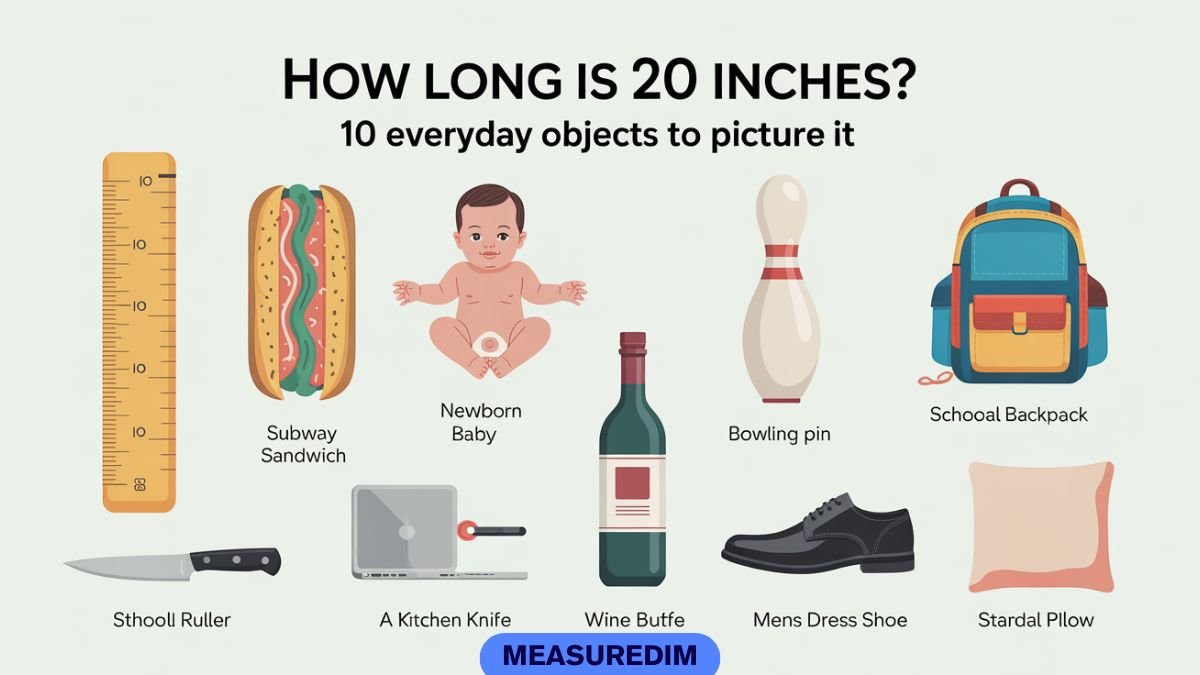
How Long Is 20 Inches? 10 Everyday Objects to Picture It
Twenty inches is a length. It equals 50.8 centimeters. In feet, that is one foot and eight inches. It is four inches short of two feet. On a ruler, it is 20 one-inch marks in a row.
Have you ever tried to picture a size without a ruler? Numbers alone are hard to feel. But you touch 20 inches every day. The short side of your bed pillow is exactly this long. Once you see it, you cannot unsee it.
Many common things measure close to 20 inches. A kids’ bike wheel is 20 inches across. A newborn baby is about this long at birth. In metric units, it is 508 millimeters, or 0.508 meters. Learn a few of these and you can estimate the length by eye.
The Quick Answer
20 inches equals 50.8 centimeters — that’s 508 mm, or 1 foot 8 inches (0.508 meters). It sits four inches short of two feet, and it’s the exact width of a standard bed pillow. Picture a foot-and-a-half ruler with another palm-width added on, and you’re there.
20 Inches Converted: cm, mm, Feet, and Meters
Because one inch is defined as exactly 2.54 cm, every figure below is precise, not rounded guesswork.
| Unit | 20 inches equals |
| Centimeters | 50.8 cm |
| Millimeters | 508 mm |
| Feet | 1.667 ft (1 ft 8 in) |
| Yards | 0.556 yd |
| Meters | 0.508 m |
Two quick anchors worth memorizing: 20 inches is half a meter plus about 8 mm, and it’s exactly 10 inches doubled (10 in = 25.4 cm). Both make mental conversion between the imperial and metric systems quicker.
So What Does 20 Inches Actually Look Like?
Think of the long side of a laptop, then add a little. Or think of your elbow to your fingertips with a couple of inches to spare. It’s a length you can wrap both hands around comfortably — wider than a sheet of paper, shorter than your own arm, and roughly the reach from one shoulder to the opposite collarbone on many adults.
Twenty inches lives in a useful sweet spot. It’s big enough to be furniture-relevant (shelf depths, nightstand widths) but small enough to hold in front of you. That’s why so many common items land right around this size.
10 Everyday Objects That Measure Close to 20 Inches
Some of these are dead-on exact; others are honest approximations. I’ve flagged which is which, because a comparison you can’t trust is worse than no comparison at all.
The Width of a Standard Bed Pillow
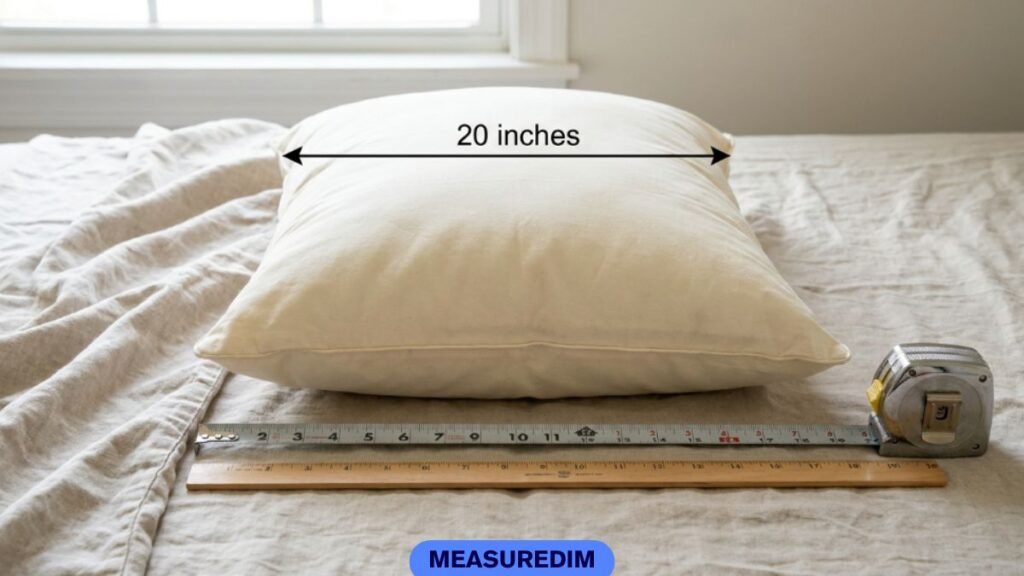
A standard US bed pillow measures 20 × 26 inches, which makes its short side an exact 20-inch reference. Queen (20 × 30) and king (20 × 36) pillows change only in length — the width stays 20 inches across all three. Grab the pillow behind your head right now and you’re holding the answer.
This is my single favorite reference for the size because almost everyone has one within arm’s reach, and it doesn’t drift with brand or price. Lay a pillow flat, run your eye along the narrow edge, and you’ve got a reliable mental yardstick for anything near half a meter. It’s especially handy when you’re shopping online for something like a cushion cover or a shelf and the listing only gives centimeters.
The Wheel on a Kids’ 20-Inch Bike
A “20-inch bike” is named for its wheel diameter — an exact 20 inches (50.8 cm) measured across the tire. This is the standard wheel size for kids roughly 6 to 9 years old, sitting between the smaller 16-inch and the larger 24-inch children’s bikes.
Because the spec is defined by that measurement, it’s one of the most dependable real-world references you can picture. If you’ve ever wheeled a child’s bike out of a garage, you’ve handled a 20-inch length without knowing it. Next time you pass a bike rack, glance at a small wheel and lock the size in.
Read Also: How Big Is an Inch? A Length You Can Picture Without a Ruler
A Newborn Baby, Head to Heel
The average full-term newborn measures about 19.5 to 20 inches long (roughly 49–51 cm), so a healthy newborn is a living, breathing 20-inch ruler — give or take. Most babies land just under the mark at birth and cross it within a week or two.
I list this as an approximate reference because birth length genuinely varies from baby to baby. Still, it’s a comparison that sticks emotionally, which is exactly why it’s memorable. Parents describing a newborn’s length are, almost always, describing something within a whisker of 20 inches.
A 20-Inch Carry-On Suitcase
A 20-inch spinner carry-on takes its name from the case body’s height — about 20 inches, before you count the wheels and retracted handle. That puts the packable shell right at our target length, with the full external height creeping toward 22 inches once hardware is added.
This one earns its place because luggage is where the “20-inch” label trips people up most. When a retailer says 20-inch carry-on, they mean the height of the case, not its width or depth. Keep that in mind and you’ll never be surprised by a bag that looks bigger in person than the number suggested.
A Large 20-Inch Wall Clock
An oversized 20-inch wall clock measures 20 inches across its face (the diameter), which is on the larger end of decorative clocks and a common statement size for a living room or kitchen wall. Hold your arms up as if framing a big round clock and that gap is roughly 20 inches.
Diameter-based references like this are useful because they train your eye on width rather than a straight edge. When you’re judging how a round object — a mirror, a serving tray, a drum — fits a space, a 20-inch clock is a clean mental stand-in.
Your Forearm, Elbow to Fingertips
For most adults, the distance from the elbow crease to the tip of the middle finger runs about 18 to 19 inches — a hair short of 20. Historically this span was the basis of the ancient “cubit,” which hovered around 18 inches. Add roughly two fingers past your fingertips and you’ve extended it to a full 20.
I flag this as approximate because arm length varies with height, but that’s also what makes it powerful: it’s always attached to you. When you need a rough gauge and have nothing else, your forearm plus a short reach is a portable 20-inch estimate you can deploy anywhere.
A 20-Inch Necklace Strand
A 20-inch necklace measures 20 inches around the full loop of chain, a length jewelers class as “matinee.” On an average adult it settles just below the collarbone, a touch lower than the classic 18-inch “princess” length. Uncoil one and you’ve got a precise 20-inch line.
This reference shines when you’re shopping for jewelry and can’t visualize how a listed length will sit. A 16-inch choker hugs the throat; an 18-inch strand rests at the collarbone; a 20-inch chain drops a little onto the chest. Knowing that two-inch cadence saves a lot of returns.
A 20-Inch Car Rim
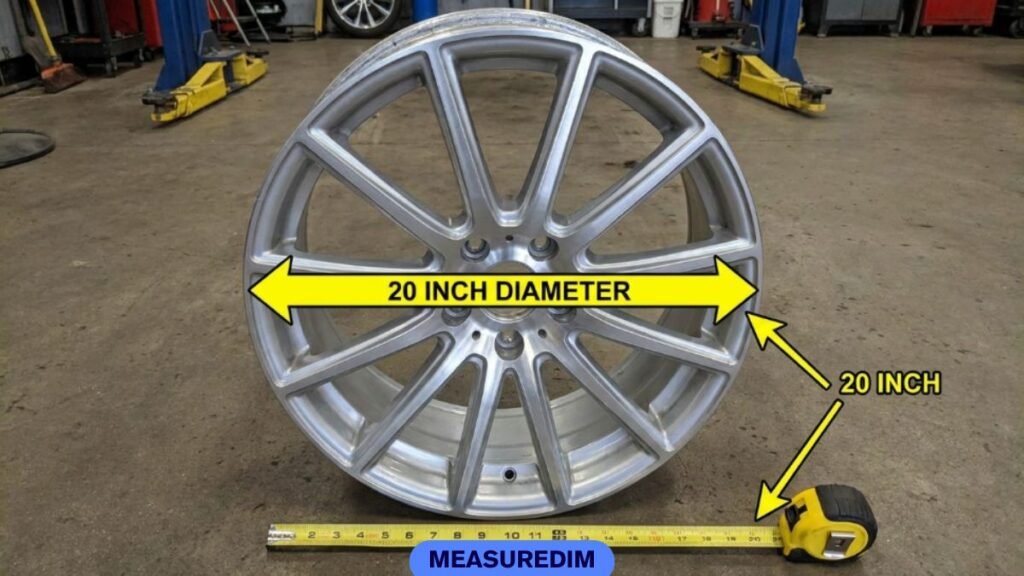
A 20-inch wheel rim measures exactly 20 inches across the metal rim’s diameter — not the tire, just the rim the tire mounts onto. These are common on larger SUVs and trucks and are frequently marketed as a size upgrade.
The reason I include the caveat is that people routinely confuse rim diameter with overall tire diameter, which on a passenger vehicle is closer to 28 or 29 inches. When someone quotes “20-inch wheels,” they mean that inner rim measurement. It’s a precise, if specialized, way to hold 20 inches in your head.
A House Cat’s Body, Nose to Tail Base
An average adult domestic cat has a head-and-body length of roughly 18 inches — measured from the nose to the base of the tail, before the tail itself begins. Larger cats stretch that toward 20, so a big tomcat’s body is a near-perfect match.
This lands in the approximate column because breed and build move the number around. But it’s a relatable one: if you’ve ever measured a cat for a carrier, you’ve sized up something in the 18-to-20-inch range. Add the tail and the total jumps to nearly 28 inches, which is a separate reference entirely — don’t conflate the two.
A French Tapered Rolling Pin
A classic French tapered rolling pin — the handle-free, pointed-end style — is commonly made around 20 inches long, giving you a slim, straight, kitchen-drawer reference. The pin’s simple stick shape makes it easy to lay against whatever you’re measuring.
It’s approximate because lengths range from about 18 to 24 inches depending on the maker, but the 20-inch version is a mainstay. If you bake, this is a handy one to keep in mind: next time you roll out dough, you’re gliding a rough 20-inch measuring stick across the counter.
The 20-Inch Lineup at a Glance
| Object | Real measurement | Match to 20 in | Type |
| Standard bed pillow (width) | 20 in | Dead-on | Exact |
| 20-inch kids’ bike wheel | 20 in diameter | Dead-on | Exact by name |
| Newborn baby (length) | ~19.5–20 in | Just under to spot-on | Approximate |
| 20-inch carry-on case (height) | ~20 in | Matches the shell | Named size |
| 20-inch wall clock | 20 in diameter | Dead-on | Named size |
| Forearm (elbow → fingertip) | ~18–19 in | 1–2 in short | Approximate |
| 20-inch necklace | 20 in loop | Dead-on | Named size |
| 20-inch car rim | 20 in diameter | Dead-on | Named size |
| House cat body (nose → tail base) | ~18 in | Slightly under | Approximate |
| French tapered rolling pin | ~20 in | Spot-on | Approximate |
Estimating 20 Inches Without a Tape Measure
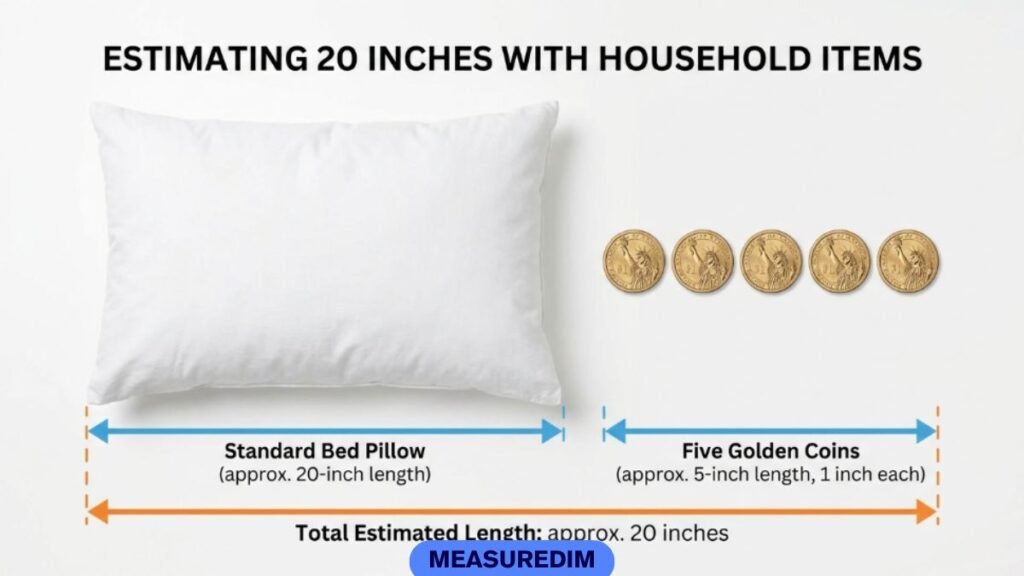
No ruler nearby? Any of these will get you within an inch.
The two-ruler trick. Two 12-inch rulers laid end to end make 24 inches. Subtract one adult hand width across the knuckles — about 4 inches — and you land at 20. Even without physical rulers, “two rulers minus a hand” is easy to picture.
The paper method. A sheet of US Letter paper is 11 inches on its long side. Lay two sheets end to end and you get 22 inches, so 20 inches is a touch under two sheets — pull them back by about an inch each and you’re there. (A4 is slightly longer at 11.7 inches, so two A4 sheets overshoot to 23.4 inches; adjust down more.)
The body method. Run from your elbow to your fingertips (about 18–19 inches for most adults), then add a two-finger reach past the tip. That extension brings you to a full 20 inches, and it’s always with you.
The pillow method. Simplest of all — grab a standard bed pillow and use its short edge. That side is exactly 20 inches, no math required.
Read Also: How Much Is 10 Inches? A Real-World Size Guide
Where People Trip Up on 20 Inches
Confusing diagonal with width. A “20-inch monitor” measures 20 inches diagonally, corner to corner — its actual width on a 16:9 panel is only about 17.4 inches. If you need the horizontal span, the screen-size label will overstate it.
Mistaking 20 cm for 20 inches. They sound similar but aren’t close: 20 cm is just 7.9 inches, less than half of 20 inches. Always check whether a listing is metric or imperial before you commit.
Assuming it’s basically two feet. Twenty inches is 1 foot 8 inches — a full 4 inches short of 2 feet. That gap matters when you’re fitting furniture or cutting material to length.
Reading “20-inch” specs literally in the wrong dimension. As covered above, a 20-inch bike is its wheel, a 20-inch rim is the metal (not the tire), and a 20-inch suitcase is its height. The number is real; the dimension it refers to changes by product.
When 20 Inches Genuinely Matters
This length turns up constantly once you start looking. Bedding is the obvious one — every US bed pillow is 20 inches wide, so pillowcases and shams are built around it. Kids’ cycling uses the 20-inch wheel as the standard step between beginner and pre-teen bikes.
It’s also a common furniture depth: many nightstands, floating shelves, and shallow bookcases run right around 20 inches front to back, which is why it’s worth being able to gauge on sight. In luggage, the 20-inch carry-on is a go-to for short trips. And in displays, 20 inches marks a small-to-midsize monitor or TV diagonal. Knowing the size helps whether you’re packing, decorating, or shopping.
18 Inches vs 20 Inches vs 24 Inches
Twenty inches makes the most sense flanked by its neighbors, so here’s the ladder:
| Length | Metric | Everyday anchor |
| 18 inches | 45.72 cm | A “princess” necklace; a standard cubit |
| 20 inches | 50.8 cm | A bed pillow’s width; a kids’ bike wheel |
| 24 inches | 60.96 cm | Exactly 2 feet; a common desk-shelf depth |
The jump from 18 to 20 inches is small — barely more than the width of two fingers — which is why the two are easy to mix up. The step from 20 to 24 inches is bigger, a full 4 inches, and it’s the difference between a shallow shelf and a deep one. When precision counts, don’t treat these three as interchangeable.
Quick-Fire Questions
How big is 20 inches visually?
It looks like the short side of a bed pillow, or a foot-and-a-half plus a palm width. Picture a small kids’ bike wheel standing upright.
What is comparable to 20 inches?
A standard bed pillow’s width, a 20-inch kids’ bike wheel, a newborn baby’s length, and a large 20-inch wall clock are all close matches.
How tall is 20 inches in feet?
Twenty inches is 1 foot 8 inches, which is 1.667 feet. That falls four inches short of a full two feet.
What item is 20 inches long?
The short edge of a standard US bed pillow is exactly 20 inches long. A French tapered rolling pin is about the same.
How big is 20 inches compared to a human?
It roughly matches an adult’s forearm plus a short reach, or the span from one shoulder across to the opposite collarbone.
Reach for a Pillow, Not a Ruler
So now you know how long is 20 inches. It is 50.8 centimeters, or one foot and eight inches. That is four inches less than two feet. The best way to remember it is simple. The short side of a bed pillow is exactly 20 inches. A kids’ bike wheel measures the same. A newborn baby is about this long too. These objects turn a plain number into a real size.
Keep these pictures in your mind. Next time you need this length, you will spot it fast. You will not need a ruler or a tape measure. Your own forearm gives you a close guess. Learn how long is 20 inches once, and you will use it for life.
Written by a dimensions writer who has measured more pillows, rolling pins, and bike wheels than is strictly reasonable — every figure here is checked against real-world objects and exact conversion math.
Related Guides:
1: How Big Is 5 Inches? 9 Everyday Objects to Picture It
2: How Long Is 2 Inches? Real Objects That Show You Exactly
3: How Long Is 6 Inches? Real Objects to Picture It Fast
4: How Big Is 4 Inches? A Complete Size Guide With Real Objects
5: How Long Is 8 Inches? Everyday Objects to Picture It