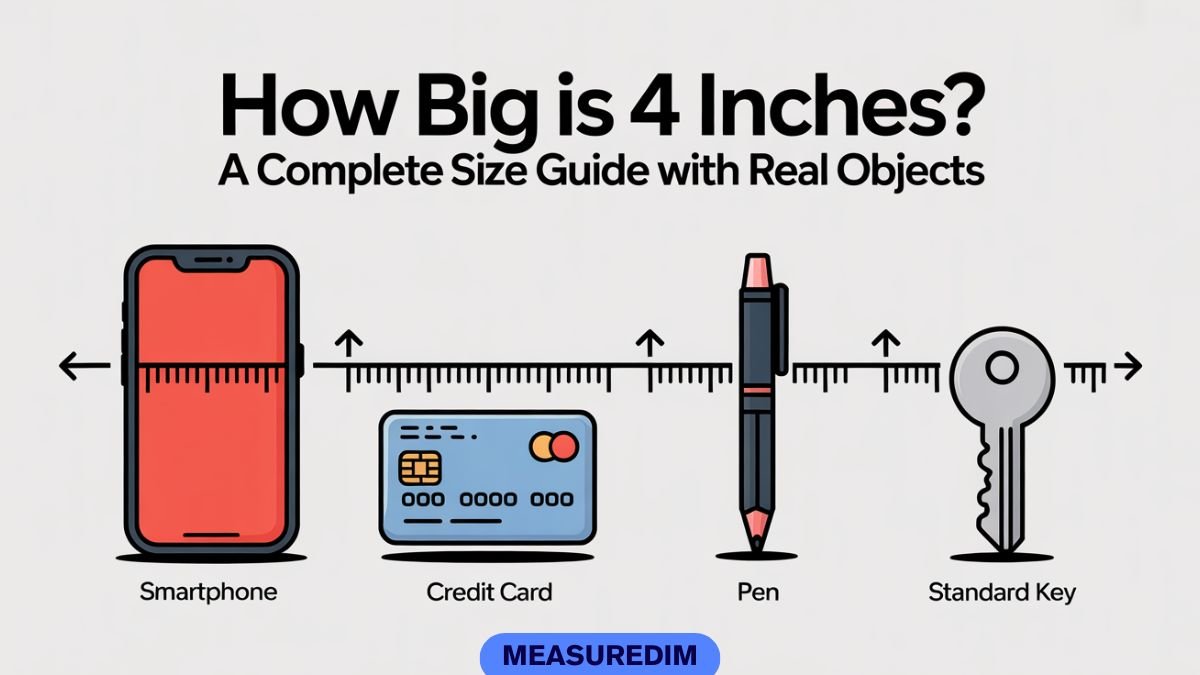
How Big Is 4 Inches? A Complete Size Guide With Real Objects
Four inches is a short length. It equals 10.16 centimeters or 101.6 millimeters. That’s exactly one-third of a foot on any ruler.
Ever tried to picture 4 inches without grabbing a ruler? Most people can’t do it fast. But the answer is probably sitting in your pocket right now.
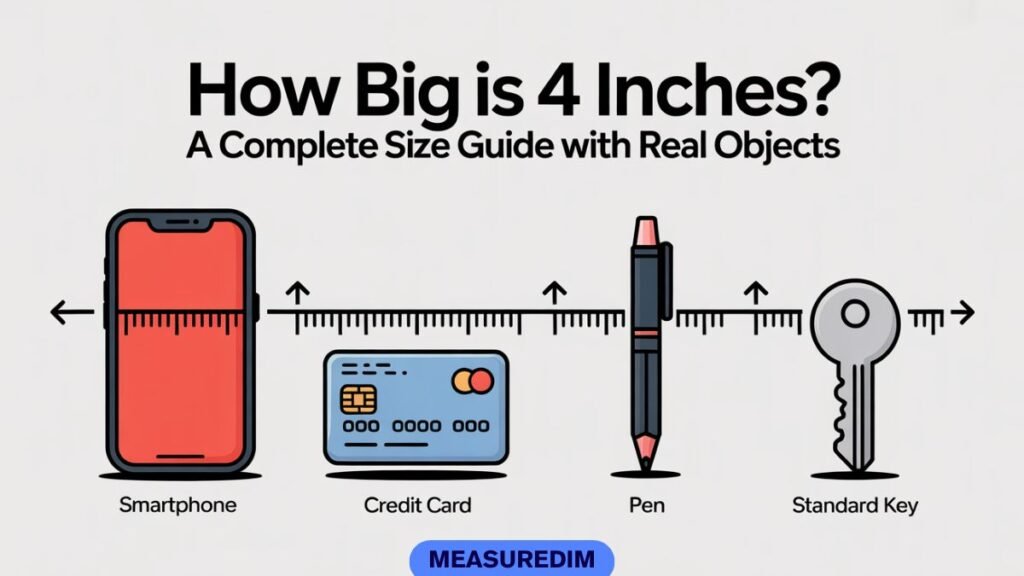
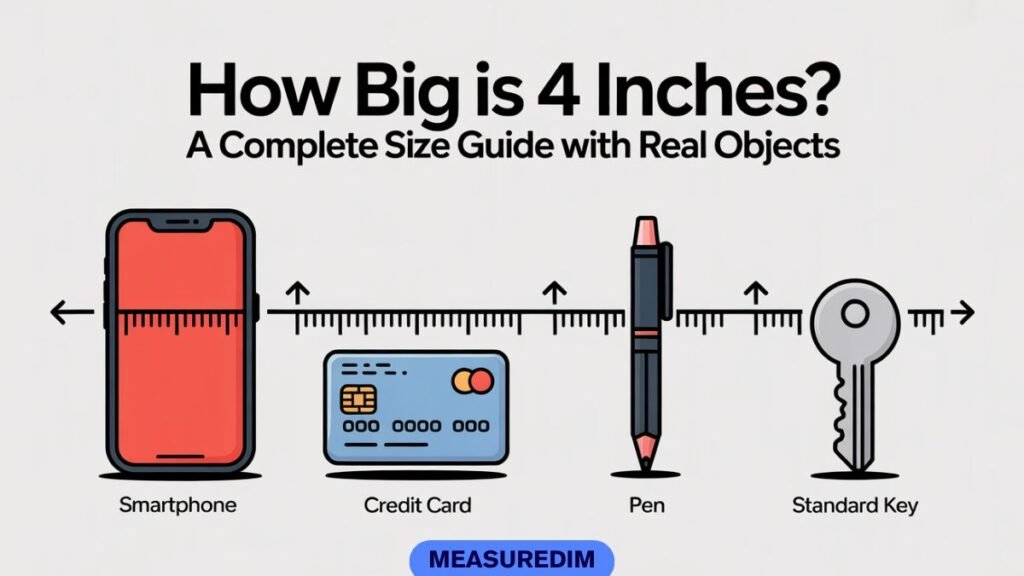
A credit card held corner to corner is almost exactly 4 inches. So is the short side of a 4×6 photo. Once you learn a few objects, you’ll spot this size anywhere.
The Short Answer, Right Away
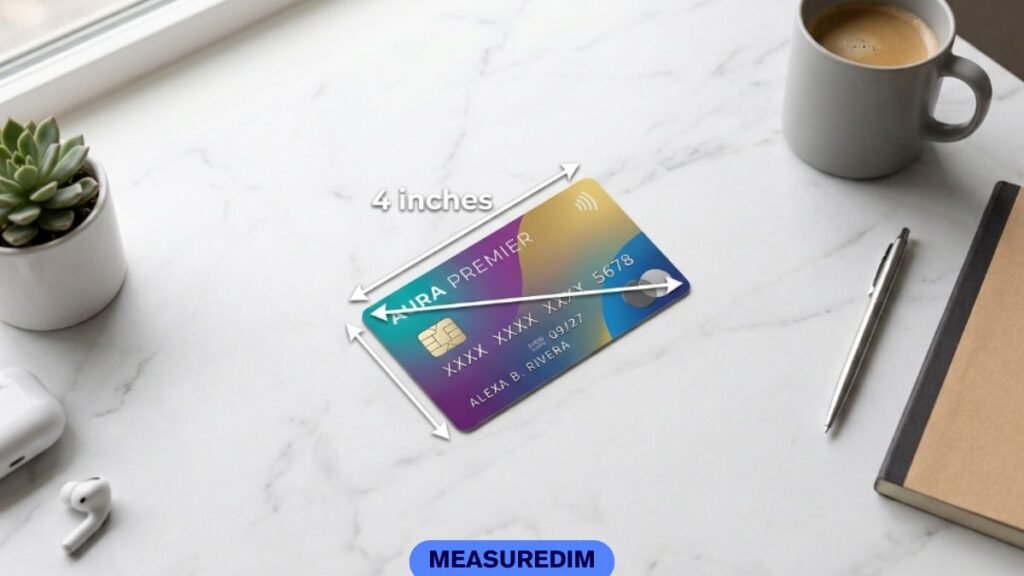
Four inches is 10.16 centimeters, or 101.6 millimeters. It’s exactly one-third of a foot and just over a hand’s width for most adults. Hold up a credit card diagonally, corner to corner, and you’re looking at almost precisely 4 inches.
If you only remember one image, make it that card. Nearly everyone has one within arm’s reach, and its corner-to-corner span is a reliable, pocket-sized ruler.
4 Inches in Every Unit You Might Need
Online listings love to switch systems on you — a US site quotes inches, the manufacturer’s spec sheet quotes millimeters, and a European retailer quotes centimeters. Here’s the same length across the board so nothing gets lost in translation.
| Unit | 4 inches equals |
| Centimeters | 10.16 cm |
| Millimeters | 101.6 mm |
| Feet | 0.333 ft (⅓ foot) |
| Yards | 0.111 yd |
| Meters | 0.1016 m |
For quick context, here’s how 4 inches sits among its neighbours on the ruler:
| Inches | Centimeters | Millimeters |
| 3 in | 7.62 cm | 76.2 mm |
| 3.5 in | 8.89 cm | 88.9 mm |
| 4 in | 10.16 cm | 101.6 mm |
| 4.5 in | 11.43 cm | 114.3 mm |
| 5 in | 12.7 cm | 127 mm |
Notice that 4 inches is not a clean 10 cm — it’s 10.16 cm. That 1.6 mm gap sounds trivial, and for cutting a sandwich it is, but for a phone case or a pipe fitting it’s the difference between “fits” and “doesn’t.”
What 4 Inches Actually Feels Like
Think of the long edge of a standard playing card and then add a little. A card runs 3.5 inches; nudge that up by half an inch and you’ve arrived. It’s a span you can comfortably cover with your palm, roughly the width of your hand across the knuckles.
It’s short enough to feel compact — smaller than a dollar bill, shorter than a soda can — but long enough that you’d never mistake it for a fingertip measurement. Four inches is the sweet spot where “small object” becomes “small tool.”
Nine Everyday Things That Are About 4 Inches
Each object below sits at or very near 4 inches. I’ve flagged which are dead-on and which are close-enough estimates, because honest labelling is what separates a useful reference from a guess.
A Credit or Debit Card, Corner to Corner
A payment card measures 85.6 mm by 53.98 mm — that’s its universal ISO size, the same in every wallet on the planet. Run the tape from one corner to the diagonally opposite corner and you get about 101 mm, or 3.98 inches — a rounding error away from a perfect 4.
This is the single most portable 4-inch reference you own. The card’s printed edges are crisp and its size never varies by brand, so it beats a fuzzy “about this big” gesture every time. Next time you’re sizing up whether a small gadget will fit a slot or a pocket, tilt a card against it and read the diagonal.
The Short Side of a 4×6 Photo or Index Card
A 4×6 print — the default size at every drugstore photo kiosk — is exactly 4 inches on its short edge and 6 on its long one. Index cards share the same 4×6 footprint, so a stack of them doubles as a ruler.
Because this one is exact rather than approximate, it’s my go-to for teaching the measurement to someone. Lay a photo flat, point to the short side, and say “that’s 4 inches.” No caveats, no rounding. It’s also handy when you’re planning frames, envelopes, or a scrapbook layout and need to gut-check spacing.
The Short Edge of a #10 Business Envelope
The #10 envelope — the one your bills and statements arrive in — measures 4⅛ inches tall by 9½ inches wide. That short dimension, 4.125 inches, sits a whisker above our target.
It earns a spot on this list because it’s genuinely everywhere: a drawer at home almost certainly holds a few. When you need a flat, straight edge that’s a touch over 4 inches and you don’t want to hunt for a card, the height of a standard envelope does the job.
Read Also: How Long Is 8 Inches? Everyday Objects to Picture It
The Screen of an iPhone 5 or First-Gen SE
Apple’s iPhone 5, 5s, and the original 2016 SE all shipped with a display that measures 4.0 inches on the diagonal — corner to corner across the glass. That figure is a published spec, not an estimate, which makes these phones a precise stand-in if you happen to have one in a drawer.
The catch worth remembering: “4 inches” here means the diagonal, not the height or width of the phone. The body of an iPhone 5 is actually about 4.87 inches tall. Screen sizes are always measured corner to corner, a quirk that confuses plenty of first-time buyers — more on that below.
Two AA Batteries End to End
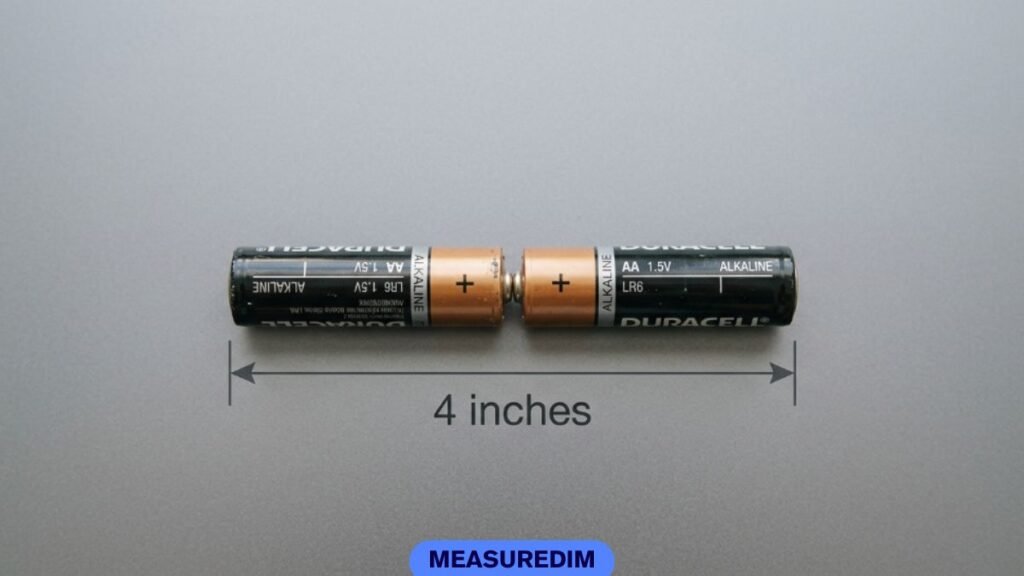
A single AA cell is 50.5 mm long, or just under 2 inches. Line two up nose to tail and you land at roughly 101 mm — essentially 4 inches, near enough that you’d need calipers to argue.
Batteries are a great emergency ruler because they’re rigid, uniform, and lurking in every remote and flashlight. Stand two on a table against the thing you’re measuring and you’ve got an instant, repeatable 4-inch gauge that won’t stretch or bend the way a tape sometimes does.
A 4-Inch Golf Tee
Golf tees come in a handful of standard lengths, and the longest common size — designed for oversized driver heads — is exactly 4 inches. Shorter tees run 2⅛, 2¾, or 3¼ inches, so check before you assume, but the tall driver tee is a purpose-built 4-inch stick.
If you or someone in the house golfs, this is a slim, straight, precisely-sized reference. It’s especially useful for gauging small vertical clearances — the kind of “will this shelf lip clear that latch?” question where a rigid 4-inch marker beats eyeballing.
A 4-Inch Door Hinge
Residential door hinges are sold mainly in two sizes, 3.5 inch and 4 inch, and the larger one is standard on heavier exterior and solid-core doors. A 4-inch hinge measures exactly 4 inches tall when closed flat.
This is a builder’s and DIYer’s reference. If you’ve ever installed or replaced a door, you’ve handled the exact length. It’s a satisfyingly solid, square-cornered object to hold against something when you want certainty rather than a “roughly.”
A Softball
An official softball has a circumference of 12 inches, which works out to a diameter of about 3.8 inches — a shade under 4. It’s the biggest of the common sports balls you’ll bump into and the closest to our number.
Round objects are trickier to read than flat edges, so treat this as an intuition-builder rather than a precision tool: “4 inches is about the width of a softball, minus a hair.” It’s a good mental image when you’re trying to picture a diameter — a pot, a jar lid, a hole — rather than a flat length.
The Width of a Toilet Paper Roll
Measure across the flat face of a standard toilet paper roll — the width of the cardboard tube and the paper wrapped around it — and most rolls come in at roughly 4 inches. Brands vary by a few millimeters as they trim sheet width, so call this an approximate reference.
Nobody keeps a golf tee handy, but everyone has this. When you want a fast, no-thinking sense of 4 inches in a pinch, glance at the width of the roll on the holder. It’s the most democratically available object on the entire list.
The Whole List at a Glance
| Object | Measurement | Exact or approximate? |
| Credit/debit card (diagonal) | 3.98 in | Approximate (≈4) |
| 4×6 photo/index card (short side) | 4.0 in | Exact |
| #10 envelope (short edge) | 4.125 in | Approximate (just over) |
| iPhone 5 / SE screen (diagonal) | 4.0 in | Exact spec |
| Two AA batteries end to end | ~4.0 in | Approximate |
| 4-inch golf tee | 4.0 in | Exact |
| 4-inch door hinge | 4.0 in | Exact |
| Softball (diameter) | 3.8 in | Approximate (just under) |
| Toilet paper roll (width) | ~4 in | Approximate |
Judging 4 Inches With Just Your Hands
Lost your ruler and every card in your wallet? Your body is a decent backup, as long as you know your own proportions.
Line up your thumb four times. For most adults, the thumb measures about 1 inch across the nail, so four thumb-widths side by side land close to 4 inches. It’s rough, but it gets you in the neighbourhood.
Better still, use your palm. Measured across the knuckles — index to pinky, thumb tucked away — the average adult hand spans roughly 3.5 to 4 inches. Press your palm flat against the object and you’ve got an instant estimate. Everyone’s hand differs, so calibrate once against a ruler and you’ll trust your own palm for years.
For a straight edge, the long side of a business card gives you 3.5 inches; add the width of your fingertip and you’ve bridged the gap to 4. Stacking small known references like this is how you gauge a length when nothing purpose-made is around.
Read Also: How Big Is 7 Inches? 10 Everyday Objects to Picture It
Mistakes People Make With 4 Inches
Confusing inches with centimeters. This is the big one, and online shopping is where it bites. Four centimeters is only about 1.57 inches — less than half of 4 inches. Misread the unit on a listing and a “4 cm” trinket shows up laughably smaller than the “4 inch” object you pictured.
Treating 4 inches as exactly 10 cm. It’s 10.16 cm. For most jobs the difference vanishes, but round it down to 10 and you’ve quietly shaved off 1.6 mm — enough to matter for a snug phone case, a bracket, or a machined part.
Reading a screen size as height or width. A “4-inch phone” refers to the diagonal of the display, not how tall or wide the device is. The same logic applies to TVs and monitors. People expecting a 4-inch-tall gadget are often surprised the phone is nearly 5 inches from chin to top.
Assuming a card’s long edge is 4 inches. It isn’t — that edge is 3.37 inches. Only the diagonal of a payment card reaches ≈4 inches. Use the wrong edge and you’ll shortchange yourself by over half an inch.
Where This Size Shows Up in Real Life
Four inches is a workhorse dimension across a surprising number of fields. Photo prints default to 4×6. Plumbing leans on it hard — 4-inch PVC is the standard diameter for the main drain and sewer line in a typical house. Nursery pots for seedlings and small plants are commonly the 4-inch size, and gardeners space many transplants on similar centres.
It turns up in hardware as the larger standard door hinge, in fashion as the “4-inch heel” (about as tall as most people wear comfortably), and in cutlery as the blade length of a compact paring or utility knife. Once you’ve got the length locked in, you’ll start noticing it everywhere from ductwork flanges to speaker cones.
How 4 Inches Compares to Its Neighbours
Just below — 3.5 inches (8.89 cm): the long side of a standard business card, the length of many bars of soap, and the other common door-hinge size. If 4 inches is a palm’s width, 3.5 is a palm minus a fingertip.
Just above — 5 inches (12.7 cm): the long edge of a 3×5 index card, roughly the diagonal of a modern compact phone screen, and a hair taller than a standard soda can (which runs about 4.8 inches). Stepping from 4 to 5 inches is the jump from “fits in a shirt pocket” to “starting to feel bulky.”
That one-inch spread on either side is worth internalising, because a lot of real-world sizing decisions come down to picking between these three: 3.5, 4, and 5 inches.
Quick-Fire Q&A
How big is 4 inches visually?
It looks like a credit card held corner to corner, or the short side of a 4×6 photo. That’s about the width of an adult palm.
How many fingers is 4 inches?
About four fingers held side by side, since each adult finger is roughly 1 inch wide. Three fingers plus a thumb also works.
What is an example of something that is 4 inches?
A 4×6 photo’s short side, a 4-inch golf tee, or a standard door hinge. Each one measures a true 4 inches.
How long is 4 inches without a ruler?
Line up two AA batteries end to end, or hold a credit card on the diagonal. Both land near 4 inches.
How to measure 4 inches with your fingers?
Place four fingers flat and side by side across the object. Calibrate once against a ruler, and your hand becomes a quick gauge.
Locking This Size Into Memory
Now you know how big is 4 inches. It is 10.16 centimeters or 101.6 millimeters. It is one-third of a foot. You can picture it with simple things you own. A credit card held corner to corner shows this length. The short side of a 4×6 photo matches it too. Two AA batteries end to end land close as well. These objects give you a quick and easy guide.
Keep one of these pictures in your mind. Your palm across the knuckles also spans about 4 inches. With these tricks, you can measure without a ruler. You will size up a photo, a plant pot, or a phone screen fast. This small skill helps you every day.
Written by a dimensions-blog editor who has measured far too many household objects with calipers so you don’t have to.