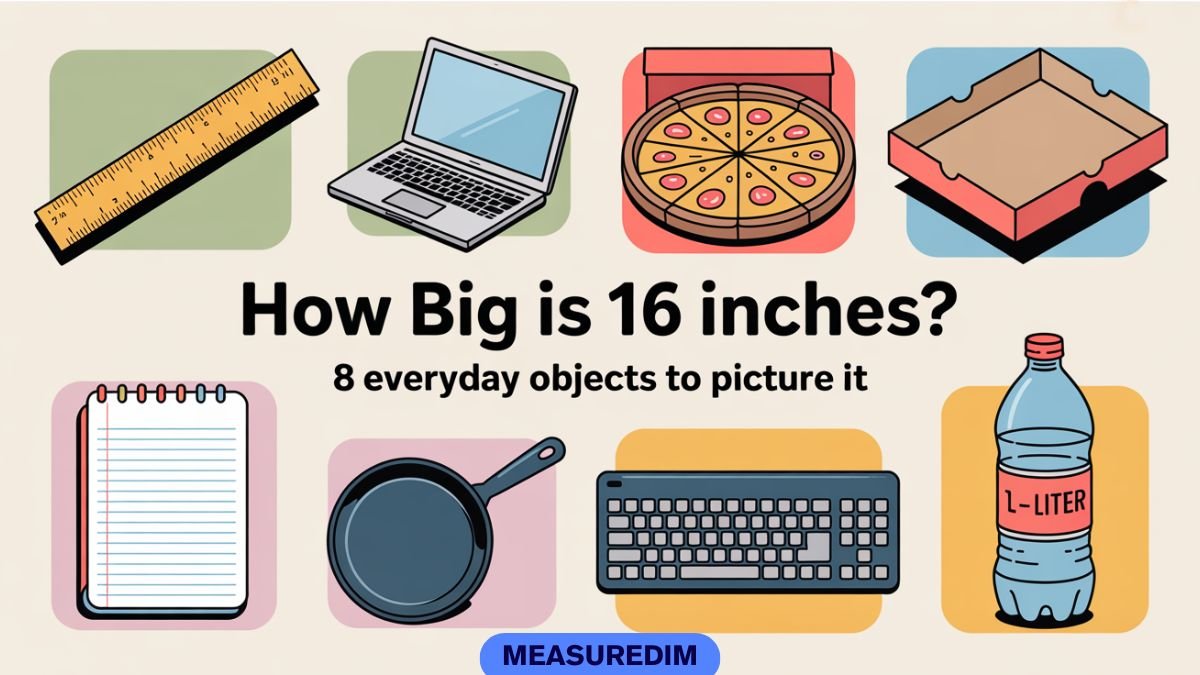
How Big Is 16 Inches? 8 Everyday Objects to Picture It
Sixteen inches is a length equal to 40.64 centimeters. It is the same as one foot and four inches. That makes it a bit longer than a standard 12-inch ruler.
Ever tried to picture 16 inches and drawn a blank? You are not alone, because this size hides between the ruler and the yardstick. The trick is to match it to things you already know.
A 16-inch pizza is exactly this wide, and so is a common throw pillow. A kid’s bike wheel and a laptop screen sit near it too. Once you link the number to real objects, the size sticks.
16 Inches at a Glance
Sixteen inches equals 40.64 centimeters. That’s the whole answer in one figure, and it’s exact — an inch is defined as precisely 2.54 cm, so there’s no rounding fudge here. Stated another way, 16 inches is 1 foot 4 inches, or a little over a third of a meter. Picture a 16-inch pizza, a hollow concrete block, or the diagonal of a 16-inch laptop screen and you’re looking at it.
The reason the size feels slippery is that it’s just past the two most familiar rulers we carry in our heads — the 12-inch ruler and the 18-inch “half a yardstick.” Sixteen lands in the gap between them, which is exactly why a few concrete reference objects help so much.
16 Inches Converted Into Every Unit You’ll Actually Use
Here’s the same length expressed across the metric and imperial systems. Every row below describes the identical distance — nothing here contradicts anything else, which matters more than it sounds like it should (competitor pages routinely print two different centimeter values for the same measurement).
| Unit | Value | Notes |
| Inches | 16 in | The starting point |
| Centimeters | 40.64 cm | Exact (16 × 2.54) |
| Millimeters | 406.4 mm | Handy for precise work |
| Feet | 1.333 ft | Same as 1 ft 4 in |
| Yards | 0.444 yd | Just under half a yard |
| Meters | 0.4064 m | Roughly four-tenths of a meter |
If you only remember one line, make it 40.64 cm. It’s the conversion you’ll reach for most, whether you’re reading a European product spec or explaining the size to someone who grew up on the metric system.
Getting a Feel for the Length
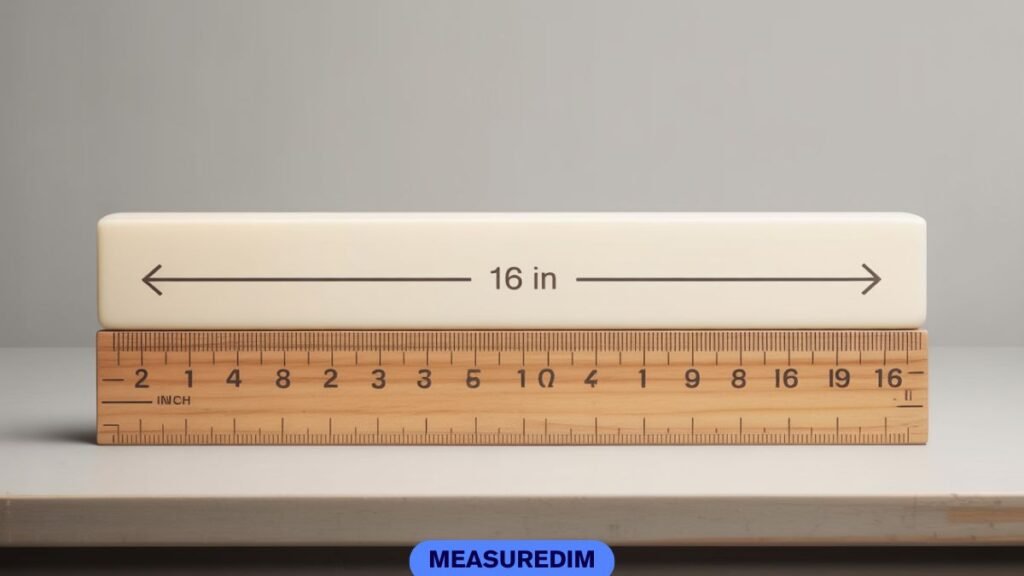
Close your eyes and imagine a standard 12-inch ruler. Now add a third of it again — one more hand-width past the end. That’s 16 inches. It’s a touch longer than the long side of a sheet of legal paper (14 in), and about the height of two stacked house bricks with a little room to spare. It’s not a small measurement, but it’s not unwieldy either; it’s roughly the span you’d hold your hands apart to describe a large pizza box or a small pet carrier.
Another quick anchor: your forearm. For most adults, the distance from the point of the elbow to the tip of the middle finger runs 17 to 18 inches. Sixteen inches is that reach, minus your fingertips. Once you connect the length to your own arm, you stop needing the ruler at all.
Eight Everyday Objects That Measure About 16 Inches
Each object below is a real, checkable reference. Where the fit is exact, I say so. Where it’s a close approximation, I say that too — a rough match you can trust beats a precise number that’s quietly wrong.
A Standard Concrete Block (CMU)
The gray hollow concrete masonry unit stacked in every builder’s yard is the classic “16-inch” object — with an asterisk. Its nominal size is 8 × 8 × 16 inches, but the block you actually lift measures 15⅝ inches long (15.625 in). That missing ⅜ inch isn’t a mistake; it’s deliberately left for the mortar joint, so that block-plus-mortar lands back on a tidy 16-inch grid.
This makes a CMU one of the most dependable references going, because concrete blocks are manufactured to a tight, regulated standard and barely vary from one to the next. Lay one on the ground and you’re looking at 16 inches, near enough that the eye can’t tell. It’s the reference I reach for when someone needs to visualize the length outdoors, where a pizza or a pillow would look absurd.
A 16-Inch Pizza
Here the number is dead-on: a 16-inch pizza measures 16 inches straight across the crust, edge to edge. Most pizzerias file this under “extra-large,” a step up from the common 14-inch large. It covers about 201 square inches of surface — worth knowing, because the jump from 14 to 16 inches adds roughly 30% more pizza, not the modest bump the two-inch difference suggests.
A pizza works so well as a reference because it’s a flat circle you can lay a tape across without any guesswork, and almost everyone has one within arm’s reach on a Friday night. Next time a box lands on the table, measure the diameter once. That mental snapshot — hands spread the width of an XL pie — becomes your portable 16-inch gauge.
Read Also: How Big Is 40 cm? Real Objects to Picture It Instantly
The Gap Between Wall Studs
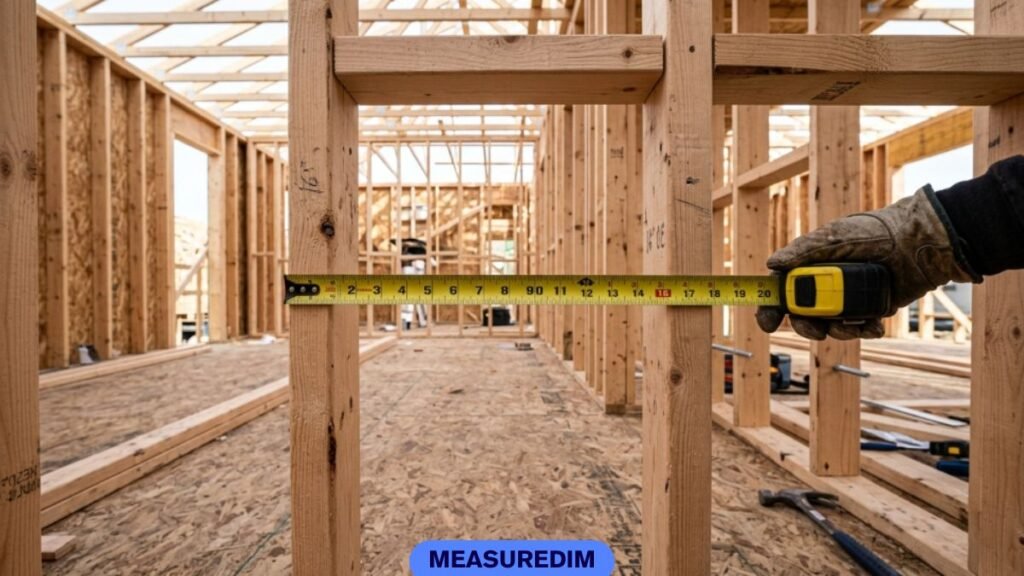
Walk into any North American house and the vertical timbers inside the walls are spaced 16 inches on center — meaning 16 inches from the middle of one stud to the middle of the next. It’s the framing standard that quietly governs where you can hang a heavy shelf and how sheets of drywall break evenly across a wall.
This one’s a reference you can’t see but can absolutely rely on, which is its charm. Run a stud finder along a wall, mark two adjacent studs, and the distance between your marks is a built-in 16-inch ruler embedded in your home. Handy when you’re hanging a mirror and want to picture the span before you drill.
A Square Throw-Pillow Insert
The decorative cushions on most sofas hide a standard secret: a huge share of throw-pillow inserts measure 16 × 16 inches. It’s one of the most-sold sizes in home décor, sitting just below the 18-inch and 20-inch options, and the cover is cut to match. Squeeze one and each side is your 16 inches, exactly as labeled.
Because these pillows are soft and square, they’re the easiest indoor reference to grab and hold against whatever you’re measuring. Shopping for a slipcover or arranging cushions on a bed, you’re already handling a 16-inch object — it just doesn’t announce itself.
The Screen on a 16-Inch Laptop
A 16-inch laptop, like the current 16-inch MacBook Pro, is named for its screen diagonal — the corner-to-corner distance across the display, which is about 16.2 inches. Read that carefully, because it’s the single biggest trap in this whole topic: the number refers to the diagonal, not the width. The laptop itself is only around 14 inches wide.
Still, if you draw a line from one bottom corner of that screen to the opposite top corner, you’ve traced a genuine 16 inches. It’s a useful reference for anyone who works at a desk daily, and a perfect teaching moment for why screen sizes always describe the diagonal rather than any single edge.
A Kid’s 16-Inch Bike Wheel
Children’s bikes are sized by wheel diameter, and the 16-inch wheel — tire included — suits most kids roughly ages four to six. The full circle of rubber measures 16 inches top to bottom, a size that sits between the tiny 12-inch balance-bike wheels and the 20-inch wheels of an older child’s ride.
Wheels make satisfying references because a diameter is unambiguous — no edges to argue over. Stand a 16-inch bike wheel upright next to a yardstick and it reaches just past the 15-inch mark, coming up shy of half a yard. Parents shopping for a first pedal bike are already navigating exactly this measurement.
A 16-Inch Necklace
In jewelry, chain length is measured as the full loop, and a 16-inch necklace falls right at the top of the “choker” range, settling at the base of the throat just above the collarbone on most adults. It’s the shortest of the common everyday lengths, one notch below the 18-inch “princess” length that most pendants ship on.
Because the number describes the circumference of the closed chain rather than a straight line, a necklace is a nice reminder that “16 inches” isn’t always a ruler-straight distance. Lay the open chain flat and it stretches 16 inches end to end — the same length, just curled around the neck when worn.
A Rolling Pin (Approximate)
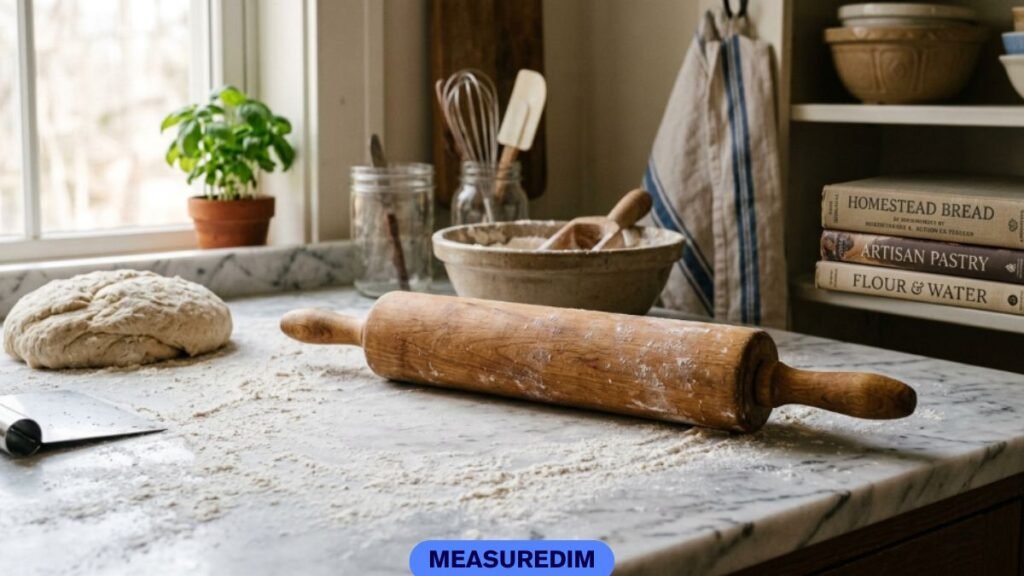
Here’s an honest “close, not exact.” A classic wooden rolling pin — either the tapered French style or a dowel — typically runs 16 to 20 inches overall, with plenty landing right around the 16-inch end of that band. Unlike the pizza or the pillow, there’s no single fixed spec; models genuinely vary by maker and style, so treat this as a ballpark rather than a ruler.
That said, a rolling pin earns its place because it’s a long, rigid, straight object most kitchens already own — far easier to hold up against something than a floppy tape measure. Grab yours, measure it once, and you’ll know whether your particular pin is a reliable 16-inch stand-in or runs a few inches long.
Quick Reference: How These Objects Stack Up
| Object | Real Measurement | Match to 16 in |
| Concrete block (CMU) | 15⅝ in long | Very close (nominal 16) |
| 16-inch pizza | 16 in diameter | Exact |
| Wall stud spacing | 16 in on center | Exact |
| Throw-pillow insert | 16 in per side | Exact |
| 16-inch laptop screen | 16.2 in diagonal | Near-exact (diagonal only) |
| Kids’ 16-inch bike wheel | 16 in diameter | Exact |
| 16-inch necklace | 16 in chain loop | Exact (as a loop) |
| Rolling pin | 16–20 in overall | Approximate |
No Tape Measure? Estimate 16 Inches With Your Body
You carry a rough ruler with you everywhere. Here’s how to read it.
Start with your hand span — the stretch from thumb tip to pinky tip with your fingers spread wide. For most adults that’s 8 to 9 inches, so two spans laid end to end lands you right around 16 to 18 inches. Walk your spread hand across a surface twice and you’ve measured the length, give or take.
Prefer a single reach? Use your forearm. Elbow to wrist is about 10 to 11 inches on a typical adult; elbow to fingertip stretches to 17 or 18. Sixteen inches is that full forearm reach, stopping short of the last knuckle. And if you happen to have paper handy, a sheet of US letter paper is 11 inches on its long edge — 16 inches is that page plus a bit under half again.
None of these is laboratory-precise, and that’s fine. Your body-based estimate will get you within an inch or so, which is all most everyday situations need.
Read Also: How Big Is 7mm? A Plain-English Guide to a Very Small SizeAa
Where People Get 16 Inches Wrong
Confusing the diagonal with the width. As covered above, a 16-inch laptop or monitor is 16 inches corner to corner, never edge to edge. Expecting a 16-inch-wide device sets you up for a surprise when the box arrives narrower than you pictured.
Underestimating the pizza jump. Two inches sounds trivial, so people assume a 16-inch pie is barely bigger than a 14-inch one. Area doesn’t work that way — the 16-incher packs about 30% more food, because surface grows with the square of the diameter.
Treating the concrete block as a flat 16. The block is nominally 16 inches but physically 15⅝. For casual visualizing it doesn’t matter; for a bricklayer setting a course, that ⅜-inch mortar allowance is the whole point.
Mixing up 16 inches and 16 centimeters. They’re wildly different — 16 cm is only about 6.3 inches, less than half the length. If you’re reading an international spec sheet, always confirm which unit you’re looking at before you picture it.
16 Inches Versus Its Nearest Neighbors
Sizes make more sense in company, so here’s what sits on either side.
Just below, at 15 inches, is a regulation bowling pin — they stand exactly 15 inches tall. Set one beside a 16-inch object and the pin comes up a single inch short, a difference small enough that a pin makes a passable stand-in when nothing better’s around.
Just above, at 18 inches, you hit half a yardstick — and, conveniently, the standard 18-inch “princess” necklace and many large 18-inch floor tiles. That two-inch step from 16 to 18 is easy to feel once you’ve anchored both: 16 sits at the base of the throat, 18 drops to the collarbone.
Where the 16-Inch Mark Quietly Shows Up
This length turns up in more corners of daily life than you’d guess. In construction, it’s the backbone spacing for wall framing and the module that drywall and sheathing are cut to fit. In food, it’s the extra-large pizza and the reach of a serving board. Around the home, it governs throw-pillow sizing and plenty of shelf and drawer dimensions.
In tech, it names a whole class of laptop screens. In cycling, it’s the wheel size that gets a kid off training wheels. And in jewelry, it’s the choker length that sits highest on the neck. Learn to see 16 inches and you’ll start noticing it everywhere — which is the real payoff of pinning the size down once.
Questions People Actually Type
How big is 16 inches compared to an object?
It is about the width of a large pizza, a square throw pillow, or a child’s 16-inch bike wheel.
What does 16 inches look like on a ruler?
It fills one full 12-inch ruler plus another 4 inches, so you need a ruler and a third more.
How big is an inch in fingers?
One inch is roughly the width of your thumb at the knuckle, or the top segment of your index finger.
How big does 16 inches look?
It looks a little longer than a standard ruler and about the length of your forearm from elbow to wrist plus your hand.
Is 16 inches big?
It is medium — not small like a phone, not large like a yardstick, but a handy everyday size at 40.64 cm.
Locking 16 Inches Into Memory
So now you know how big is 16 inches. It is 40.64 centimeters, or one foot and four inches. That is a little longer than a school ruler. You can picture it in many easy ways. A large pizza measures 16 inches across. A soft throw pillow often shows the same size on each side. A small child’s bike wheel matches it too. These simple objects turn a plain number into a clear picture.
Keep three facts in your mind, and you will always remember this length. First, 16 inches equals 40.64 centimeters. Second, it equals one foot and four inches. Third, it matches the width of a big pizza box. Hold these facts close, and you will spot 16 inches with ease.
Related Guides:
1: How Tall Is a Monster Can? Every Size, Measured
2: How Big Is 6 cm? Compare It to Real Everyday Objects
3: How Big Is 11 Inches? 9 Everyday Objects That Show You the Size
4: How Tall Is 60 Inches? A 5-Foot Size Guide With Real Examples
5: How Long Is 30 Feet? 10 Everyday Objects to Picture It